
T: +86-0731-85185770
E: enquiry@qilumetal.com
E: enquiry@qilumetal.com
No. 18 Xiangfu Middle Road,Yuhua District, Changsha City
Views: 0 Author: Site Editor Publish Time: 2026-03-05 Origin: Site


AISI 4140 is frequently cited as the "workhorse" of the industrial alloy world. Engineers and machinists prize this chromium-molybdenum alloy for its exceptional balance of high strength, toughness, and wear resistance. However, this versatility creates a manufacturing paradox. The material's utility depends almost entirely on its heat treatment condition. A component made from 4140 steel can be ductile enough to withstand heavy impact or hard enough to snap under stress, depending solely on its thermal history.
Specifying the wrong condition carries significant financial and safety risks. If you order stock that is too hard, machining costs can spiral as cutting tools wear out prematurely. Conversely, installing a soft, under-hardened shaft in a high-stress environment can lead to catastrophic mechanical failure. This guide moves beyond basic material datasheets. We will explore how 4140 properties dictate machinability, application suitability, and procurement strategies to help you make smarter engineering decisions.
The "Goldilocks" Zone: The most common industrial state is Quenched and Tempered (Q&T) at 28–32 HRC, balancing strength with reasonable machinability.
Machinability Threshold: Processing costs spike significantly once hardness exceeds 30–35 HRC, often necessitating grinding or hard turning.
Condition Matters: Buying "Pre-hardened" (PH) saves heat treatment time but limits complex machining; buying "Annealed" allows easy shaping but requires post-process hardening.
Hardness vs. Toughness: Higher Rockwell values correlate with wear resistance but inversely impact impact toughness; 4140 steel is rarely used above 55 HRC due to brittleness risks.
Understanding the spectrum of hardness is critical for selecting the right stock for your project. 4140 is an "oil-hardening" steel, meaning its microstructure changes drastically based on how it is heated and cooled. This variability requires a clear reference point to avoid confusion between suppliers and shop floor personnel.
The following 4140 steel hardness chart breaks down the material's properties across its lifecycle states. While hardness is often the primary specification, it serves as a proxy for other mechanical traits like tensile strength and ductility.
| Condition | Hardness (HRC) | Hardness (HB) | Characteristics & Best Use |
|---|---|---|---|
| Annealed (Softest) | 15–22 HRC | 197–235 HB | Softest state. Best for complex CNC machining, heavy material removal, and cold forming. Requires subsequent heat treatment. |
| Normalized | 22–28 HRC | 235–280 HB | Refined grain structure with relieved internal stresses. Offers better dimensional stability than as-rolled stock. |
| Pre-Hardened (QT) | 28–32 HRC | 269–302 HB | Commercial Standard. Ready to use. No risk of warping from further heat treatment. Good balance of strength and machineability. |
| As-Quenched | 54–59 HRC | 550+ HB | Extremely brittle and unstable. This is a transitional state immediately after quenching and before tempering. Rarely used in service. |
| Nitrided (Surface) | 60–65 HRC | - | Case hardening process. Creates a ceramic-like wear layer while maintaining a tough core (approx. 30 HRC). Ideal for wear strips. |
You will often see hardness data listed in different units depending on the material's state. Suppliers typically quote Brinell hardness (HB) for annealed or normalized stock because the indentation is larger, averaging out local inconsistencies in the softer matrix. Conversely, Rockwell C (HRC) is the standard for treated, harder stock. Understanding the relationship between these scales ensures you do not reject valid material simply due to a unit mismatch.
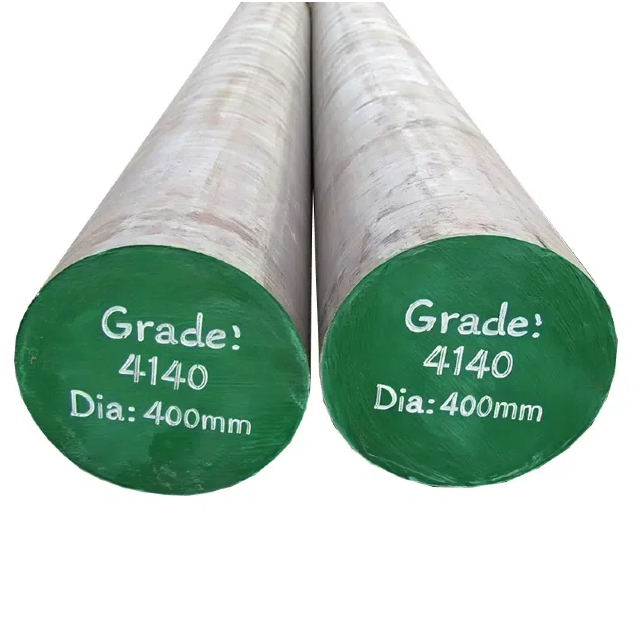
Selecting the correct 4140 hardness is rarely about achieving the maximum number possible. Instead, it involves finding the optimal compromise between wear resistance and impact toughness. Each hardness range serves specific engineering functions.
Typical Use Cases: Large base plates, fixtures, and extensive structural components requiring heavy welding.
Why: In this range, the priority is placed on ductility and dimensional stability. Components that require massive material removal during machining benefit from the softer annealed state. Furthermore, softer structures are less prone to cracking during welding operations, although pre-heating is still recommended. This range is rarely used for wear surfaces but is excellent for static structural support.
Typical Use Cases: Axles, crankshafts, high-strength bolts, connecting rods, and stripper plates.
Why: This is the industry standard "Sweet Spot." Material in this condition provides high fatigue strength, allowing parts to withstand cyclic loading without failure. Crucially, it retains enough toughness to absorb shock loads without snapping. For 90% of general machinery applications, this pre-hardened range offers the best reliability. It resists deformation under load but will yield slightly before breaking, providing a safety margin.
Typical Use Cases: Slide cams, moderate-duty molds, ejector pins, and wear strips.
Why: At this level, the engineering priority shifts almost exclusively to abrasion resistance. The harder surface prevents scoring and galling in sliding contact scenarios. However, engineers must exercise extreme caution. As Rockwell values climb, impact toughness drops precipitously. If a part at 50 HRC is subjected to a hammer-blow shock, 4140 may fail catastrophically. For high-impact applications requiring this hardness, consider upgrading to shock-resistant alloys like S7 or tougher nickel-based alloys like 4340.
Deciding between annealed and pre-hardened (PH) stock is a fundamental business decision that affects lead times, risk, and machining costs. It is essentially a "Buy vs. Build" logic applied to metallurgy.
This is the most popular option for job shops and general fabrication. You receive the material already heat-treated to its final operational hardness.
Pros: There is zero risk of heat treatment distortion because no further thermal cycling is required. This drastically reduces the "scrap rate" for precision parts. It offers a faster time-to-market and eliminates logistics costs associated with sending parts to a third-party heat treater.
Cons: Machining is slower. Cutting speeds must be reduced, and tool life will decrease compared to cutting annealed stock. Welding also requires strict protocols to avoid hydrogen cracking.
This route involves buying soft steel, machining it, and then hardening it.
Pros: This state offers maximum material removal rates. Complex geometries and deep pockets are easier to cut without vibration or tool breakage. It allows for custom hardness targeting; for example, if you specifically need 42 HRC for a gear, you can temper it to that exact specification.
Cons: The primary risk is warping. When steel is quenched, internal stresses can twist or bow the part. You must leave "grind stock" on the part to clean up these distortions after treatment. Lead times are longer due to the extra processing steps.
When should you choose one over the other? Follow this simple rule: If the part requires tight tolerances (e.g., ±0.0005") and has uneven cross-sections, start with Pre-hardened stock to avoid the nightmare of warping. However, if the design requires massive material removal—hogging out 50% or more of the original block—start with Annealed stock to save on machining time and tooling costs.
The hardness of the workpiece dictates the fabrication approach. There is a distinct "tipping point" where standard machining methods become inefficient or risky.
Below 30 HRC, standard carbide tooling and even high-quality High-Speed Steel (HSS) taps function reliably. Chips break manageable, and tool life is predictable. However, once hardness exceeds 30–35 HRC, the physics of cutting change. Tapping becomes a high-risk operation; broken taps in hardened holes are difficult and expensive to remove. Above 35 HRC, shops often switch to "Hard Turning" using ceramic or CBN inserts, or they move the part to a surface grinder. Recognizing this threshold helps in accurate job quoting.
Welding 4140 is significantly more complex than welding mild steel due to its high carbon and alloy content. The primary danger is Hydrogen Embrittlement in the Heat Affected Zone (HAZ). When you weld hardened 4140, the rapid cooling of the weld pool creates brittle martensite next to the weld bead.
To prevent cracking, a strict protocol is necessary. The material must be pre-heated (typically to 200°C–300°C) to slow down the cooling rate. Immediately after welding, post-weld heat treatment (stress relieving) is required. Ignoring these steps usually results in under-bead cracking that may not be visible until the part is under load.
While harder steel is more difficult to cut, it generally yields superior surface finishes. Soft, annealed steel tends to be "gummy," resulting in torn material and burrs. Pre-hardened or TG&P (Turned, Ground, and Polished) stock cuts cleanly, leaving a shiny, smooth surface directly off the machine. For cosmetic parts or sealing surfaces, the harder state is often preferred despite the slower feed rates.
While 4140 is versatile, it is not the only option. Comparing it against common alternatives clarifies when it is the correct choice versus when an upgrade or downgrade is necessary.
The Trade-off: AISI 1045 is a medium-carbon steel that is cheaper but lacks the molybdenum and chromium found in 4140. These alloying elements give 4140 its "hardenability"—the ability to harden all the way through the cross-section. 1045 typically only hardens on the outer skin (case hardening) or requires drastic water quenching which causes distortion.
Verdict: Use 4140 for critical load-bearing parts like drive shafts where strength is needed throughout the core. Use 1045 for simple pins, non-critical shafts, or parts where cost is the primary driver.
The Trade-off: 4340 is essentially 4140 with added nickel. This addition provides superior toughness and ductility at high hardness levels. Where 4140 might become brittle at 45 HRC, 4340 retains significant impact resistance.
Verdict: If your 4140 components are fracturing or cracking at the required hardness, do not just lower the hardness. Upgrade to 4340 to maintain strength while gaining toughness.
The Trade-off: D2 is a high-carbon, high-chromium tool steel designed for cutting. It is vastly harder, capable of reaching 60+ HRC, and offers extreme wear resistance. However, it is expensive and relatively brittle compared to the tough 4140.
Verdict: Stick to 4140 for structural, axle, and toughness applications. Switch to D2 for cutting dies, punches, and stamping applications where holding a sharp edge is paramount.
AISI 4140 remains an engineering staple not because it is the hardest or strongest metal available, but because it is "tunable." Its hardness is a variable design parameter, not a fixed statistic. By manipulating heat treatment, engineers can optimize the alloy for heavy machining, high-fatigue axles, or wear-resistant slides.
A final verification step is crucial: always verify stock hardness upon receipt. Visually, Hot Rolled (unpredictable skin hardness) and Cold Finished/Annealed (consistent) bars can look similar once machined, but their internal stresses differ wildly. Using a portable hardness tester before cutting can save thousands of dollars in wasted machine time.
For critical safety components, we strongly encourage consulting with a qualified metallurgist or heat treatment specialist before finalizing your specification. The right hardness ensures longevity; the wrong one invites failure.
A: In the "As-Quenched" state, 4140 can reach approximately 54–59 HRC. However, this state is extremely brittle and unfit for service. The practical maximum usable hardness for industrial components is typically around 50–52 HRC. Above this level, the risk of brittle fracture under impact increases significantly. For applications requiring 60+ HRC, surface treatments like Nitriding are recommended over through-hardening.
A: It depends entirely on the condition. In the Annealed state (~20 HRC), it machines easily, similar to standard carbon steels. In the Pre-hardened state (28–32 HRC), it is moderately difficult but yields a good finish; carbide tools are standard here. Above 40 HRC, machining becomes difficult, requiring specialized inserts, rigid setups, and lower cutting speeds.
A: Yes. While 4140 is a through-hardening alloy, it is an excellent candidate for surface treatments like Gas Nitriding, Ion Nitriding, or Flame Hardening. These processes can produce a surface hardness of 60–65 HRC for extreme wear resistance, while maintaining the tough, ductile core (typically 30 HRC) needed to absorb shock loads.
A: Welding without pre-heat causes rapid cooling in the Heat Affected Zone (HAZ). This creates a localized band of untempered, brittle martensite. As the weld cools and contracts, this brittle zone often cracks (hydrogen cracking). Pre-heating to 200°C–300°C slows the cooling rate, preventing the formation of this brittle microstructure.
A: Yes. Tempering is the process of reheating quenched steel to a specific temperature below its critical point. There is a linear relationship: higher tempering temperatures result in lower final hardness but higher ductility and toughness. For example, tempering at 400°F might yield 50 HRC, while tempering at 1000°F might yield 30 HRC.