
T: +86-0731-85185770
E: enquiry@qilumetal.com
E: enquiry@qilumetal.com
No. 18 Xiangfu Middle Road,Yuhua District, Changsha City
Views: 0 Author: Site Editor Publish Time: 2026-03-10 Origin: Site


AISI 4140 steel, often called Chromoly, serves as a true industrial workhorse across the globe. From crankshafts to hydraulic shafts, its versatility is unmatched, yet its "as-supplied" condition rarely matches the final service requirements needed for heavy-duty applications. Improper thermal processing frequently leads to machining nightmares, immediate quench cracking, or catastrophic component failure under load. Engineers and metallurgists know that the difference between a high-performance part and a pile of scrap lies entirely in the thermal cycle.
This guide moves beyond generic dictionary definitions to provide actionable 4140 heat treatment recipes, precise hardness-to-temperature correlations, and clear procurement specifications. We aim to empower engineers, shop floor managers, and buyers to optimize 4140 for specific mechanical outcomes. You will learn how to balance the critical trade-off between extreme hardness for wear resistance and the necessary ductility required to prevent shock failure.
The "Sweet Spot": 4140 excels in applications requiring high fatigue strength and impact resistance (e.g., shafts, gears) typically in the 28–36 HRC range.
Critical Timing: Quenched parts must be tempered immediately upon reaching 150°F (65°C) to prevent brittle fractures.
Media Matters: Oil quenching is the mandatory standard for 4140; water quenching induces high risks of distortion and cracking.
Procurement Strategy: choosing between Pre-Hardened (PH) stock vs. Annealed stock depends heavily on machining volume and final geometry complexity.
Heat treatment is not a binary step where you simply "harden" the metal. Think of it as a sensitive dial used to tune the alloy's specific chemical strengths. 4140 steel contains Chromium, which provides deep hardness penetration, and Molybdenum, which ensures toughness and resistance to creep. Without precise thermal calibration, these expensive alloying elements are wasted.
Success depends on what the part must endure. A gear tooth needs a hard surface to resist wear, while a heavy-duty bolt needs internal ductility to stretch without snapping. We adjust the process to prioritize either surface hardness or core toughness. Failing to define this criteria early often leads to parts that are either too brittle to handle shock or too soft to resist abrasion.
The state of the material dictates how easily you can manufacture it versus how well it performs in the field. We generally categorize 4140 into three distinct states during its lifecycle:
Annealed State: This is the "soft" state, optimized for rapid material removal. If you are machining complex geometries with significant waste material, you want the steel annealed. It offers low strength but a high machinability rating (approximately 65% of 1212 steel).
Normalized State: This process is essential after forging. It refines the grain structure, ensuring the metal is uniform and dimensionally stable before further processing.
Quenched & Tempered (Q&T): This is the final service state. It provides the high strength required for operation. However, machining 4140 in this state is costly and slow. Conversely, hardening it after machining introduces the risk of distortion, potentially ruining tight tolerances.
Why spend the money on advanced thermal cycles? The Return on Investment (ROI) comes from longevity. Correct heat treatment can extend a part's service life by 200% to 300% in fatigue-heavy applications compared to untreated carbon steels. This drastic increase in lifecycle justifies the initial Total Cost of Ownership (TCO) involved in processing.
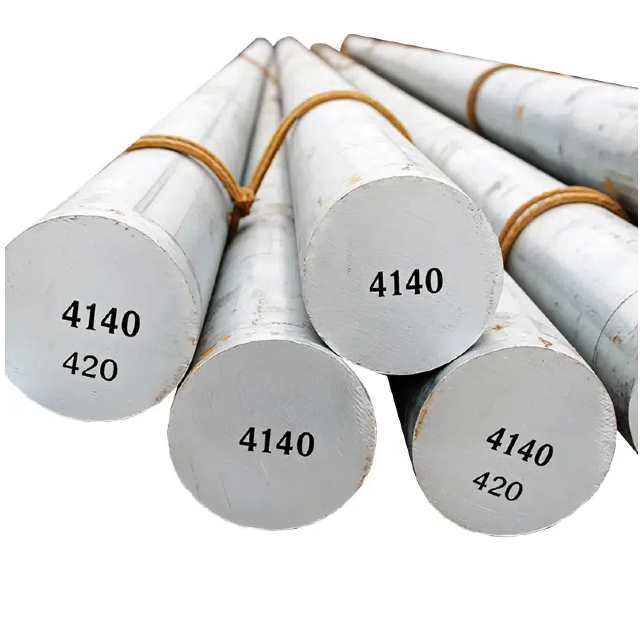
Achieving consistent results requires adhering to a strict process architecture. Below is a breakdown of the four critical thermal cycles used to transform this alloy. Engineers often refer to a 4140 steel heat treatment chart to visualize these steps.
| Process | Temperature Range | Cooling Medium | Primary Purpose |
|---|---|---|---|
| Forging | 2000°F – 2200°F (Start) Finish above 1750°F | Still Air | Shape the material while plastic; refine cast structure. |
| Normalizing | 1600°F – 1700°F (870°C – 925°C) | Still Air | Homogenize microstructure; relieve internal forming stresses. |
| Annealing | 1450°F – 1600°F (790°C – 870°C) | Furnace Cool (Slow) | Soften steel to ~200 HB for easiest machining. |
| Hardening | 1550°F – 1600°F (845°C – 870°C) | Oil | Transform structure to Martensite for maximum hardness. |
| Tempering | 400°F – 1200°F (205°C – 650°C) | Still Air | Restore toughness and set final hardness level. |
The journey often begins with forging. Once the part is shaped, normalizing is critical. We heat the steel to between 1600°F and 1700°F (870°C – 925°C) and allow it to cool in still air. This step acts as a "reset button" for the steel's grain structure, ensuring that subsequent hardening is uniform. Without normalizing, you risk varying hardness levels across the same part.
If extensive CNC work is required, annealing is mandatory. The material is heated to 1450°F – 1600°F (790°C – 870°C) and soaked for approximately one hour per inch of thickness. The critical distinction here is cooling; it must be a slow furnace cool to below 600°F. This slow drop reduces hardness to roughly 200 Brinell (HB), allowing tools to cut cleanly without chatter.
This is the high-risk phase. The steel is heated to the austenitizing range of 1550°F – 1600°F (845°C – 870°C). The quench medium is non-negotiable: Oil (Mineral Oil) is the standard. While polymer quenchants are possible with strict concentration controls, water is generally prohibited for 4140. Water cools too aggressively, causing the material to tear itself apart via quench cracks.
Critical Control Point: Operators must monitor the part temperature closely during the quench. Parts should never cool completely to room temperature while in the "as-quenched" state. You must transfer the component to the tempering furnace when the surface reaches approximately 150°F (65°C). Delaying this transfer allows brittle martensite to stabilize, leading to delayed cracking.
For precision components, stress relieving is performed after rough machining but before the final finish pass. This minimizes movement and warping during the final grind, ensuring the part stays within geometric tolerance.
Tempering defines the final personality of the steel. After quenching, the steel is extremely hard but essentially glass-brittle. Tempering sacrifices some of that hardness to regain ductility. The temperature you choose depends entirely on the application.
Range: 400°F – 500°F (205°C – 260°C).
Result: ~50–55 HRC.
We target this zone for components that face extreme abrasion but minimal impact. Applications include tooling fixtures, wear plates, and heavy-duty scrapers. The trade-off is ductility; these parts are liable to suffer brittle failure if subjected to sudden shock loads or hammer blows.
Range: 700°F – 1000°F (370°C – 540°C).
Result: ~30–45 HRC.
This is the "Sweet Spot" for the majority of 4140 applications. Parts tempered here retain significant strength while gaining enough elasticity to resist fatigue failure. Common examples include crankshafts, high-stress bolts, and connecting rods. If you are unsure where to specify your heat treat, this zone offers the safest balance for dynamic machinery.
Range: 1100°F – 1200°F (595°C – 650°C).
Result: ~28–32 HRC.
When failure is not an option and the part must yield before it snaps, we temper at high temperatures. Hydraulic cylinders, drill collars, and pipe fittings fall into this category. The benefit here is maximum resistance to cracking and superior machinability post-treatment. This is effectively the range used for pre-hardened stock.
Even with the correct recipe, process variables can ruin a batch. Paying attention to these quality assurance factors prevents expensive re-works.
Temperature is useless without time. The standard rule is 1 hour of soak time per inch of cross-section thickness. If you under-soak, the core of the part remains soft, creating a weak point that will fail under torsion. Conversely, over-soaking at high temperatures promotes grain growth, which reduces the steel's impact toughness. It is a precise window that requires calculation based on the thickest section of your part.
When steel is heated above 1400°F, carbon atoms on the surface love to bond with oxygen. This leads to decarburization—a phenomenon where the surface loses carbon and becomes a "soft skin" layer. Without a protective atmosphere (like Argon, Nitrogen, or Vacuum), your hardened shaft might have a soft surface that wears out immediately.
Solution: Use controlled atmosphere furnaces. If open-air furnaces are the only option, leave a machining allowance of 0.015" to 0.030" on all critical surfaces. You can then grind off this decarburized layer after heat treatment to reach the hard metal underneath.
Physics dictates that sharp corners concentrate stress. During the violent cooling of a quench, these stress risers become nucleation points for cracks. If a design features sharp internal corners or drastic changes in cross-section (thick to thin), the reject rate will skyrocket.
Design Fix: Engineers should add radiused corners wherever possible. Symmetrical heating and cooling strategies also help minimize thermal shock. If the design cannot change, a polymer quench with a slower cooling rate might be necessary, though oil remains the preference.
Ordering steel sounds simple, but vague purchase orders (POs) are a leading cause of project delays. Deciding between raw stock and pre-treated material is the first step.
This route is best for complex parts requiring heavy metal removal. It provides the cheapest raw material cost and the easiest machining experience. However, it introduces logistics headaches. You must machine the part, ship it to a heat treater, wait for processing, and then finish grind it. This extends lead times significantly.
Pre-Hardened stock typically arrives at 28–32 HRC. This is ideal for shafts, simple turned parts, and urgent repairs. The massive advantage is that no further heat treatment is needed—you machine it and install it. There is zero risk of warping because the thermal stress is already resolved. The downsides are slower machining speeds (due to the hardness) and a slightly higher initial material cost.
Never write "Heat Treat to Max Hardness" on a print. This is ambiguous and dangerous. A proper specification includes the material, the process, the verification method, and the acceptance criteria.
Correct Syntax Example:
"Material: AISI 4140. Process: Quench and Temper. Target Hardness: 32-36 HRC. Minimum Yield Strength: 100 ksi. Certs Required: Material Test Report (MTR) including Charpy V-Notch values at -20°F."
For safety-critical load-bearing parts, visual inspection is insufficient. Specify Magnetic Particle Inspection (MPI) after quenching. This Non-Destructive Testing (NDT) method highlights invisible surface micro-cracks that could propagate into failures once the part is in service.
The utility of 4140 steel is defined entirely by the precision of its heat treatment. A shaft can either be a reliable component lasting years or a liability that snaps in weeks, depending solely on the tempering temperature and quench timing. By respecting the chemical limitations of the alloy and strictly controlling the thermal cycle, you unlock its full potential.
For high-volume production, we recommend establishing a fixed recipe validated by destructive testing to ensure repeatability. For general maintenance, repair, and low-volume gearing, standard Pre-Hardened (PH) stock offers the best balance of risk reduction and efficiency, eliminating the variables of post-machining heat treatment.
A: It is possible for field repairs, but highly discouraged for critical parts. Torch heating is uneven, leading to soft spots and uncontrolled internal stresses. You cannot accurately control the temperature or the soak time, which often results in brittle failure or immediate cracking upon quenching. Use a furnace whenever possible.
A: 4140 usually refers to the alloy in an annealed or as-rolled state (soft, ~20 HRC). 4140PH (Pre-Hardened) has already been quenched and tempered at the mill to approximately 28–32 HRC. PH is ready to use immediately after machining, whereas standard 4140 requires heat treatment after machining.
A: The most common causes are using water instead of oil, or failing to temper the part immediately. 4140 cannot handle the thermal shock of water. Additionally, if the part cools completely to room temperature before entering the temper furnace, internal stresses will tear the material apart.
A: No. 4140 is an oil-hardening steel. It does not have enough alloy content to harden significantly by cooling in still air. If you air cool it from austenitic temperatures, it will likely normalize rather than harden. For air-hardening properties, you would need tool steels like A2 or D2.
A: Theoretically, 4140 can reach 55–58 HRC directly after the quench (as-quenched hardness). However, using it at this hardness is risky due to extreme brittleness. A practical maximum usable hardness for wear parts is usually around 50–52 HRC after a low-temperature temper.