
T: +86-0731-85185770
E: enquiry@qilumetal.com
E: enquiry@qilumetal.com
No. 18 Xiangfu Middle Road,Yuhua District, Changsha City
Views: 0 Author: Site Editor Publish Time: 2026-03-03 Origin: Site


In the world of industrial metallurgy, few materials achieve the legendary status of AISI/SAE 4140. Often referred to as "Chromoly," this versatile alloy represents the definitive workhorse for engineers balancing strict cost constraints against high performance requirements. It bridges the gap between basic carbon steels, which frequently lack deep hardenability, and exotic nickel-based alloys that can destroy project budgets. You likely face a constant challenge: selecting a material that survives high stress and fatigue without over-engineering the component. Making the wrong choice can lead to catastrophic part failure or unnecessary procurement costs.
This guide addresses that specific engineering dilemma. We explore the chemical composition that gives this alloy its strength and break down critical 4140 steel properties including tensile strength and impact resistance. You will also learn about the hidden risks of heat treatment—specifically temper brittleness—and how to navigate procurement trade-offs effectively. By the end, you will know exactly how to specify the delivery condition that matches your manufacturing capabilities.
The "Sweet Spot" Material: 4140 offers significantly higher fatigue strength than plain carbon steel without the premium price tag of nickel-alloys.
Versatility: Available in annealed (soft) for machining or pre-hardened (28–32 HRC) for immediate use.
Heat Treatment Sensitivity: Highly responsive to quenching and tempering, but prone to cracking if welded without preheating.
Common Applications: High-stress shafts, gears, bolts, and mold bases where failure is not an option.
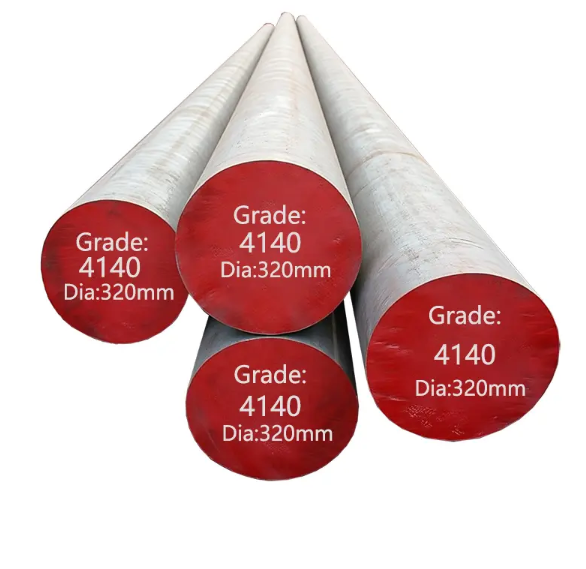
Understanding how the "4-1-40" designation dictates performance.
The name itself is a code that reveals exactly how this steel behaves under stress. The AISI/SAE naming convention uses a four-digit system to describe the chemical makeup. The first digit, 4, places the steel in the Molybdenum series. This element provides deep hardening capabilities and maintains strength even as operating temperatures rise. The second digit, 1, indicates the Chromium content. At roughly 1%, chromium acts as the primary agent for corrosion resistance and allows hardness to penetrate deeper than the surface.
The final two digits, 40, represent the nominal carbon content of 0.40%. This is the metallurgical balance point. It provides enough carbon to achieve high hardness after heat treatment, yet it remains low enough to retain toughness. If carbon were higher, the steel would become too brittle; if lower, it would fail to harden sufficient for high-stress applications.
Chromium (0.80–1.10%): This is the primary driver for hardenability. It allows parts to harden throughout their cross-section rather than just forming a hard outer shell.
Molybdenum (0.15–0.25%): A critical addition that mitigates temper brittleness. It also helps the material maintain its structural integrity at elevated temperatures.
Manganese (0.75–1.00%): This element enhances workability during forging and contributes significantly to tensile strength.
| Region | Standard / Grade | Notes |
|---|---|---|
| USA | AISI 4140 / SAE 4140 | Most common commercial specification. |
| USA (Aerospace) | AMS 6349 | Stricter cleanliness requirements for aerospace. |
| Germany (DIN) | 42CrMo4 (1.7225) | Direct equivalent widely used in Europe. |
| Japan (JIS) | SCM440 | Standard equivalent for Asian machinery. |
Critical data for structural analysis and failure prevention.
Engineers must realize that data on a datasheet is meaningless without defining the heat treatment state. The properties of 4140 shift drastically between its annealed delivery condition and its final quenched and tempered (Q&T) state.
When analyzing 4140 steel properties psi, the delivery condition dictates the starting point. In the annealed state, tensile strength sits at approximately 95,000 PSI (655 MPa). While this allows for easy machining, the material is mechanically "soft" and unsuited for structural loads. However, once the material undergoes quenching and tempering, the potential skyrockets. You can dial in tensile strength from 130,000 PSI up to over 150,000 PSI (900–1000+ MPa), depending entirely on the tempering temperature selected. This adjustability allows one alloy to serve as both a ductile bolt and a rigid driveshaft.
Hardness is the primary indicator of wear resistance and machinability. The range of 4140 steel properties hardness varies significantly across different processing stages:
Annealed: Typically registers around 197 HB (Brinell). In this state, the steel chips easily and tools last longer.
Pre-Hardened (Commercial): Most stock is sold at 28–32 HRC. This is the sweet spot where the material is tough enough for immediate use but still machinable with carbide tooling.
Maximum Potential: Immediately after quenching (before tempering), hardness can spike to 54–59 HRC. However, using the steel in this "as-quenched" state is dangerous due to extreme brittleness.
Perhaps the most valuable characteristic of 4140 is its fatigue limit. Unlike standard 1045 carbon steel, 4140 can endure millions of stress cycles without initiating a crack. This makes it the ideal candidate for cyclic loading applications like crankshafts, axles, and connecting rods.
How to dial in specific properties and avoid catastrophic failures.
Heat treatment transforms 4140 from a raw slug of metal into a precision engineering material. The process sequence typically follows Forging (>850°C), Normalizing, Hardening (Oil Quench), and immediately Tempering. The tempering stage acts as your volume knob for mechanical properties, trading hardness for toughness.
The temperature you choose for tempering defines the final character of the part:
Low Temp (200–250°C): Retains high hardness (~50 HRC). Ideal for wear parts where impact is minimal.
Medium Temp (300–400°C): WARNING ZONE. See below.
High Temp (500–650°C): The industry standard for structural components like shafts and bolts. This yields 28–34 HRC and provides excellent impact resistance.
You must exercise extreme caution when tempering in the 250°C–400°C (approx. 500–750°F) range. Metallurgists call this the "Blue Brittleness" zone. Tempering here causes a sudden drop in impact toughness (Temper Brittleness) without offering a proportional gain in yield strength. Parts treated in this range are prone to unexpected brittle failure under shock loading. Always aim for temperatures above or below this window.
Implementation considerations for the shop floor.
Understanding how 4140 reacts to cutting and joining is just as important as knowing its theoretical strength. The manufacturing approach impacts both the final cost and the reliability of the component.
In the annealed condition, 4140 has a machinability rating of approximately 65% compared to B1112. Chips break reasonably well, and surface finishes are generally good. However, when machining Pre-Hardened stock (28–32 HRC), the dynamic changes. The process becomes slower, requiring rigid setups and coated carbide tooling to hold tight tolerances. While slower, machining pre-hardened stock ensures the part dimensions remain stable.
For many shops, buying pre-hardened 4140 is a strategic Total Cost of Ownership (TCO) decision. While the raw material cost is slightly higher and machining is slower, it eliminates post-machining heat treatment. This removes the risks of distortion and quench cracks that often ruin finished parts. It is the ideal workflow for precision mold bases and fixtures where dimensional stability is paramount.
Welding 4140 presents significant challenges. The high carbon equivalent makes the alloy susceptible to Hydrogen Embrittlement and cracking in the Heat Affected Zone (HAZ). To weld successfully, you must follow a strict protocol:
Never weld in the Quenched & Tempered state if avoidable, as the heat will destroy the mechanical properties in the HAZ.
Preheat is mandatory. The part must be brought to 200°C–300°C before the arc strikes.
Select the right filler. Use low-hydrogen electrodes that match the tensile strength of the base metal.
Post-Weld Stress Relief. This is not optional; it is required to prevent delayed cracking.
Shortlisting logic for buyers and engineers.
Choosing the right steel often comes down to a direct comparison. Here is how 4140 stacks up against common alternatives.
The decision between these two often rests on the type of load the part must support. Choose 4140 if the component faces high impact, torque, or requires thorough hardening in thick sections. 1045 is surface-hardenable but lacks the core strength to support heavy twisting loads. While 4140 is approximately 15-20% more expensive, it offers more than double the fatigue life.
4340 is a Nickel-Chrome-Moly alloy, essentially a "super" version of 4140. You should only upgrade to 4340 if the section thickness exceeds 4 inches or if the part must survive critical impact at sub-zero temperatures. For most general machinery, 4340 is overkill. 4140 remains the cost-effective default, while 4340 carries a significant price premium.
These two are chemical cousins. Choose 4130 for welding applications, such as tube frames or roll cages, because its lower carbon content improves weldability. Choose 4140 when raw strength and wear resistance are the priority, such as in solid shafts and tooling.
AISI 4140 steel represents the intersection of affordability and high performance for structural applications. It serves as the "go-to" alloy for power transmission and tooling, provided the engineer respects the heat treatment limitations—specifically avoiding the blue brittleness temperature range—and the welder follows strict preheat protocols.
When procuring this material, success starts with the purchase order. Always specify the delivery condition (Annealed vs. Pre-Hardened) to match your internal machining capabilities and lead-time requirements. By understanding the unique properties and processing risks of 4140, you ensure your components perform reliably for years to come.
A: There is no difference in chemical composition. AISI (American Iron and Steel Institute) and SAE (Society of Automotive Engineers) use the same numbering system for this alloy. They are technically the same standard.
A: Yes, 4140 is not stainless steel. It contains only about 1% chromium, which is insufficient to prevent oxidation. It requires surface protection like black oxide, zinc plating, or oil to prevent rust.
A: Yes, typically via nitriding or flame hardening to achieve a hard surface. However, it is not ideal for carburizing due to its higher carbon content; grades like 8620 are better suited for that specific process.
A: In the "as-quenched" state, 4140 can reach approximately 54–59 HRC. However, it is rarely used in this brittle condition. Practical working hardness is usually tempered down to 28–32 HRC for toughness or up to 50 HRC for wear resistance.