
T: +86-0731-85185770
E: enquiry@qilumetal.com
E: enquiry@qilumetal.com
No. 18 Xiangfu Middle Road,Yuhua District, Changsha City
Views: 0 Author: Site Editor Publish Time: 2026-03-12 Origin: Site


You see 1045 steel used in many industries. It is strong, tough, and easy to machine. This medium-carbon steel has different names in different places. You can look at the table below to see its other names:
Standard Name | Alias/Equivalent | Region |
|---|---|---|
AISI 1045 | C45 | EU |
AISI 1045 | S45C | Japan |
BS 970 080M40 | EN8 | UK |
AISI 1040 | 1040 Steel | USA |
1045 steel is special because it has tensile strength from 570 to 880 MPa. It also has good impact toughness. People use it for shafts, gears, and other parts that must be strong and easy to make. Many engineers trust it because it is known all over the world.
1045 steel is a medium-carbon steel. It is strong and tough. This makes it good for parts like shafts and gears.
The chemical makeup of 1045 steel has carbon and manganese. These elements make it harder and help it resist wear. This gives it reliable performance.
Heat treatment methods like quenching and tempering can make 1045 steel stronger and tougher. This lets people use it for different jobs.
1045 steel can be machined and welded fairly well. But it needs to be preheated before welding. This stops it from cracking.
This steel does not cost a lot. It is used in many industries like automotive and construction. It lasts long for jobs with medium loads.
You often see 1045 steel listed under different names, such as AISI 1045, C45, S45C, 080M40, GB 45#, and BS 080M40. These names show that this steel meets international standards. The chemical composition stays consistent, which helps you get reliable performance every time.
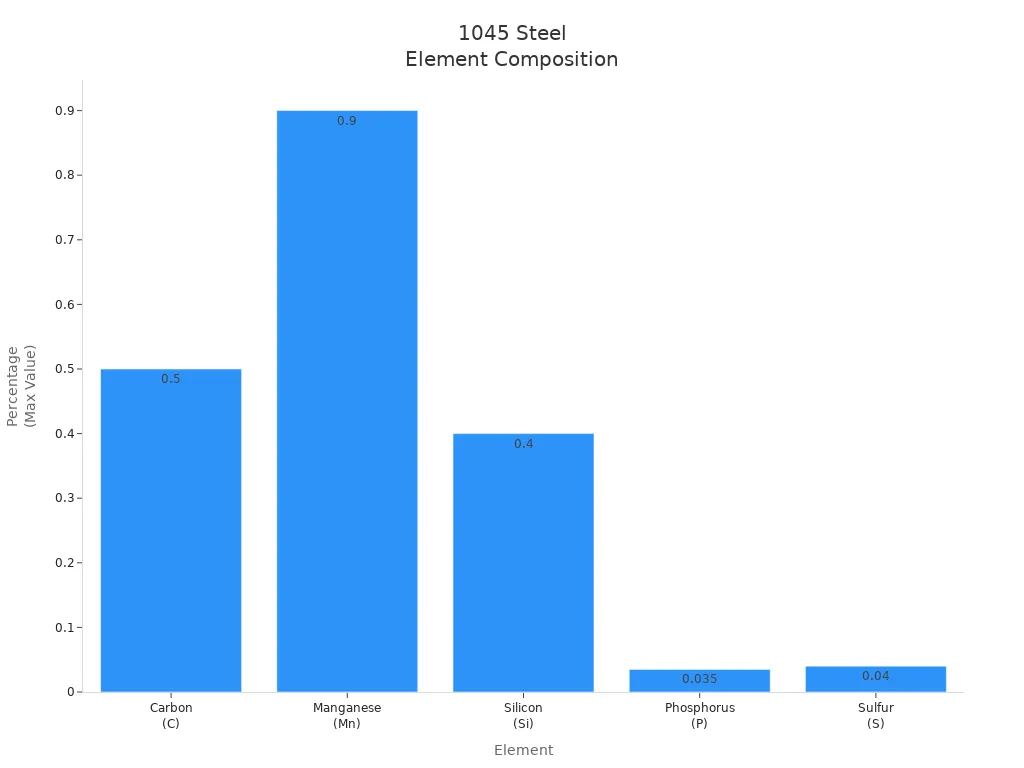
Take a look at the typical chemical makeup of 1045 steel:
Element | Percentage |
|---|---|
Carbon (C) | 0.43–0.50% |
Manganese (Mn) | 0.60–0.90% |
Silicon (Si) | 0.15–0.35% |
Phosphorus (P) | ≤0.04% |
Sulfur (S) | ≤0.05% |
The carbon content gives 1045 steel its hardness and strength. Manganese boosts toughness and helps the steel resist wear and stress. You can see how the mix of elements looks in the chart below:
You benefit from this balance because:
Carbon increases hardness and wear resistance.
Manganese improves toughness and prevents brittleness.
The combination lets 1045 steel handle stress and fatigue in demanding jobs.
When you look at 1045 steel under a microscope, you see two main structures: ferrite and pearlite. Ferrite is soft and flexible. Pearlite is harder and gives strength. The controlled carbon and manganese levels create a mix of ferrite and pearlite. This mix helps you get a steel that is strong but not too brittle.
You can rely on 1045 steel for parts that need both toughness and strength. The microstructure stays stable, so you get consistent results in every project. This makes 1045 steel a smart choice for shafts, gears, and other parts that face heavy loads.
You can count on sae 1045 steel for impressive strength and hardness. This steel stands out because it offers a balance between toughness and durability. When you use 1045 steel in its untreated state, you get a tensile strength of about 570 MPa and a hardness of 170 HB. If you choose to heat treat it, you can boost these properties even more. After normalizing, tensile strength rises to 620 MPa and hardness reaches 180 HB. When you quench and temper sae 1045 steel, you see tensile strength jump to 700–850 MPa and hardness increase to 200–240 HB.
Here is a table that shows how the properties change with different treatments:
Condition | Tensile Strength (MPa) | Hardness (HB) |
|---|---|---|
Annealed | 570 | 170 |
Normalized | 620 | 180 |
Quenched & Tempered | 700 – 850 | 200 – 240 |
You can also find sae 1045 steel wire with tensile strength around 850 MPa. This makes it perfect for heavy mechanical loads. After heat treatment, hardness can reach 56–60 HRC, so you get excellent wear resistance. These properties help you build parts that last longer and perform better under stress.
You need toughness and ductility when you work with machinery and moving parts. Sae 1045 steel gives you both. The steel keeps its toughness even after heat treatment. You can rely on it for parts that must absorb shock and resist cracking. Compared to other medium carbon steels, sae 1045 steel offers higher tensile strength and retains enough ductility for bending and shaping.
Here is a table that compares properties with other medium carbon steels:
Property | SAE 1045 Steel | Other Medium Carbon Steels |
|---|---|---|
Tensile Strength (MPa) | 620–850 | Varies, generally lower |
Ductility | Retains sufficient | Often lower than 1045 |
Toughness | High | Comparable, but varies |
You can use sae 1045 steel for gears, shafts, and crankshafts. These parts need to handle repeated stress and impact. The steel’s microstructure, with ferrite and pearlite, helps you get consistent toughness. You can shape and machine it without losing strength. This makes sae 1045 steel a smart choice for parts that must bend or twist without breaking.
You want steel that is easy to machine and weld. Sae 1045 steel gives you moderate machinability. You can cut, drill, and shape it with standard tools. The steel’s properties let you finish parts quickly and accurately. You get smooth surfaces and precise dimensions.
Machinability rating: Moderate
Weldability: Moderate, with some challenges
Welding tips: Pre-heat to 200–300°C and use post-welding heat treatment to prevent cracking
You need to take care when welding sae 1045 steel. The medium carbon content can cause thermal cracking if you do not pre-heat or treat the steel after welding. You can improve weld quality by following these steps. You get strong joints and reliable performance.
Tip: Always check the steel’s properties before machining or welding. You can adjust your process to get the best results.
You can use sae 1045 steel for many applications because it combines strength, toughness, and machinability. You get parts that work well and last longer. The steel’s properties make it a favorite for engineers and manufacturers.
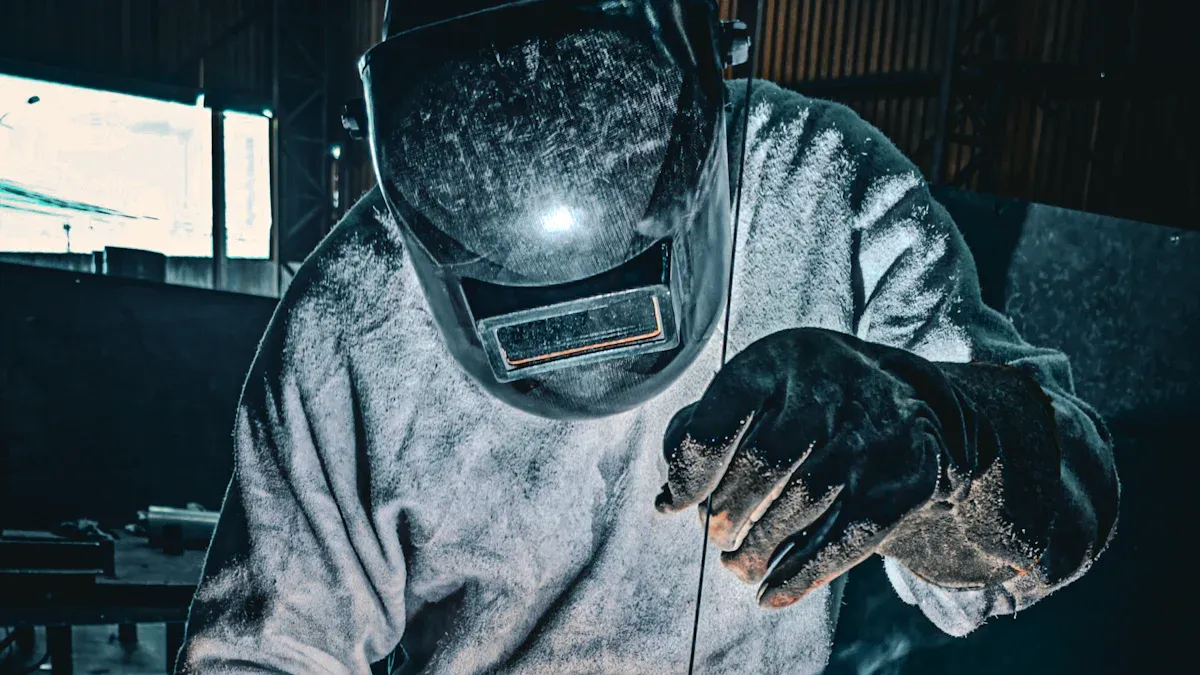
You can change how 1045 steel acts by heating it. Heat treatment helps you get the right mix of strength and toughness. There are three main ways to treat the steel. These are normalizing, quenching, and tempering. Each method uses a different temperature. Each gives you different results.
Here is a table that shows the main heat treatment methods for 1045 steel:
Heat Treatment | Temperature Range (°C) | Purpose |
|---|---|---|
Annealing | 790–870 | Improve ductility, reduce hardness |
Normalizing | 870–920 | Refine grain, enhance machinability |
Quenching | 820–860 | Increase hardness and strength |
Tempering | 400–680 | Restore toughness, reduce brittleness |
Normalizing makes the grains smaller. This helps the steel be easier to machine. It also makes it better at handling impacts. Quenching makes the steel harder and stronger. You use quenching when parts need to carry heavy loads. Tempering comes after quenching. It brings back toughness and helps parts not break easily.
Tip: Pick the heat treatment that fits your needs. Each process changes the steel in its own way.
Heat treatment changes how strong and tough 1045 steel is. You see changes in hardness, yield strength, and impact resistance. Annealing makes the steel about 20% softer. Normalizing lowers hardness by almost 10%. It also makes the steel 26% tougher. Quenching makes the steel 19% harder but 4% less tough. Tempering helps balance hardness and toughness after quenching.
You can see these changes in the table below:
Heat Treatment Process | Yield Strength Change (%) | Hardness Change (%) | Toughness Change (%) |
|---|---|---|---|
Annealing | -12.4 | -20.2 | -6.67 |
Normalizing | -6.33 | -9.6 | +26.67 |
Quenching | -2.29 | +19.15 | -4.0 |
Annealing makes 1045 steel softer and easier to shape.
Normalizing gives you higher impact resistance and better performance for moving parts.
Quenching increases hardness for parts that need to resist wear.
Tempering lets you keep strength and improve impact resistance.
You can use heat treatment to match the steel’s properties to your job. This helps you make parts that work well and last longer.
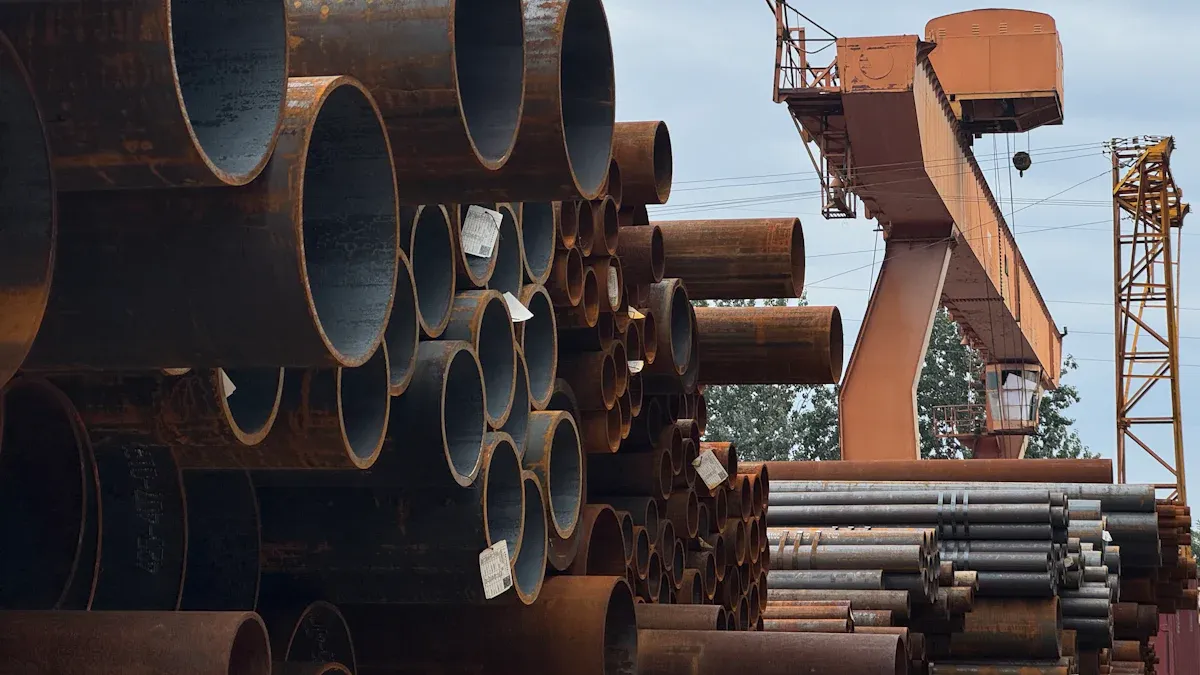
When you need a strong material for many jobs, you can pick 1045 steel. This steel is medium-carbon and is known for being strong, tough, and easy to shape. You will find it in factories, cars, machines, and on building sites. Let’s look at the main ways people use 1045 steel and why it is a good choice.
1045 steel is used a lot in factories. It is good for parts that must handle stress and lots of use. People use it for shafts, gears, pins, and bolts. These parts must stay strong and keep their shape, even when machines run all day.
Here is a table that shows where 1045 steel is used and what it needs to do:
Application Type | Performance Requirements |
|---|---|
Shafts and Axles | Good torsional strength, fatigue resistance, and machinability. |
Gears and Sprockets | Ability to handle repeated contact stresses and moderate wear while maintaining dimensional stability. |
Pins, Studs, and Bolts | Higher strength than low carbon steel, resistance to shear forces and mechanical shock. |
Tooling and Fixtures | Sufficient hardness and wear resistance for non-cutting applications, with good machinability for precision. |
General Manufacturing | Cost-effective option for CNC machining, with reasonable machinability and surface finish. |
You can trust 1045 steel for these jobs because it works well in heavy machines. The parts last longer and work better. Many factories use this steel because it is easy to shape and gives a nice finish.
Note: 1045 steel works for both small and big parts. You can use it in CNC machines or in regular workshops.
You see 1045 steel in many car and machine parts. It is a top pick for parts that must carry heavy loads and keep working under stress. You find it in axles, couplings, spindles, shafts, gears, tool holders, and hydraulic parts.
Here are some common uses for 1045 steel:
Axles in trucks and other vehicles
Couplings for machines
Spindles in machine tools
Shafts for different machines
Gears in gearboxes
Tool holders in machines
Hydraulic parts like rods and clevises
People pick 1045 steel for these parts because you can shape it very exactly. It keeps its size and shape, even after heat treatment. This steel is strong enough for parts that move or carry weight. For example, you might use it for drive shafts or gears in machines. You also see it in tool holders and spindles, where you need things to fit just right.
Tip: If you want parts that last and do not break, 1045 steel is a smart pick for your machines.
You use 1045 steel in building when you need parts that can hold heavy things and not wear out fast. It is good for connectors, pins, anchor bolts, and special bridge parts. You also use it to make tools that must be strong and tough.
Here is a table that shows how 1045 steel is used in building and tool making, and what is good about it:
Application Area | Description | Advantages |
|---|---|---|
Construction | Used for components requiring higher strength or wear resistance. | Enhanced durability and load-bearing capacity. |
Utilized in connectors, reinforcing pins, and heavy-duty anchor bolts. | Better shear strength than lower carbon steels. | |
Employed in bridge construction for specialized components. | Suitable for high-stress areas. | |
Tool Making | Used for producing tools, dies, and forging applications. | Cost-effective solution for medium-duty tooling. |
Achieves satisfactory hardness through heat treatment. | Good strength and toughness for various tools. | |
Commonly used for hammers, axes, and striking tools. | Refined grain structure and shock-absorbing body. |
1045 steel is better than low carbon steel for holding up buildings. You can use it for anchor bolts and pins that keep things together. In tool making, you get tools that can take hard hits, like hammers and axes. You can heat treat these tools to make them harder, so they last longer.
Callout: If you want a strong and low-cost material for building or tools, 1045 steel is a great choice.
You can see that 1045 steel is used in many places. It is good for car parts, machines, building, and making tools. This steel gives you the right mix of strength, toughness, and easy shaping for many jobs.
You may wonder how 1045 steel compares to 1018 steel. Both are popular choices, but they serve different needs. 1045 steel has more carbon, so it is stronger and harder. 1018 steel is softer and easier to machine or weld. You often use 1045 steel for parts that need to handle heavy loads, like crankshafts, gears, axles, and fasteners. 1018 steel works well for parts that need shaping or welding, such as brackets or simple machine parts.
Here is a table to help you see the differences:
Property | AISI 1018 (typical) | AISI 1045 (typical) |
|---|---|---|
Tensile strength (UTS) | ~440 MPa | ~625 MPa |
Yield strength | ~370 MPa | ~520–540 MPa |
Elongation (%) | ~15% | ~12% |
You can also look at the chart below to compare their strength and stretch:
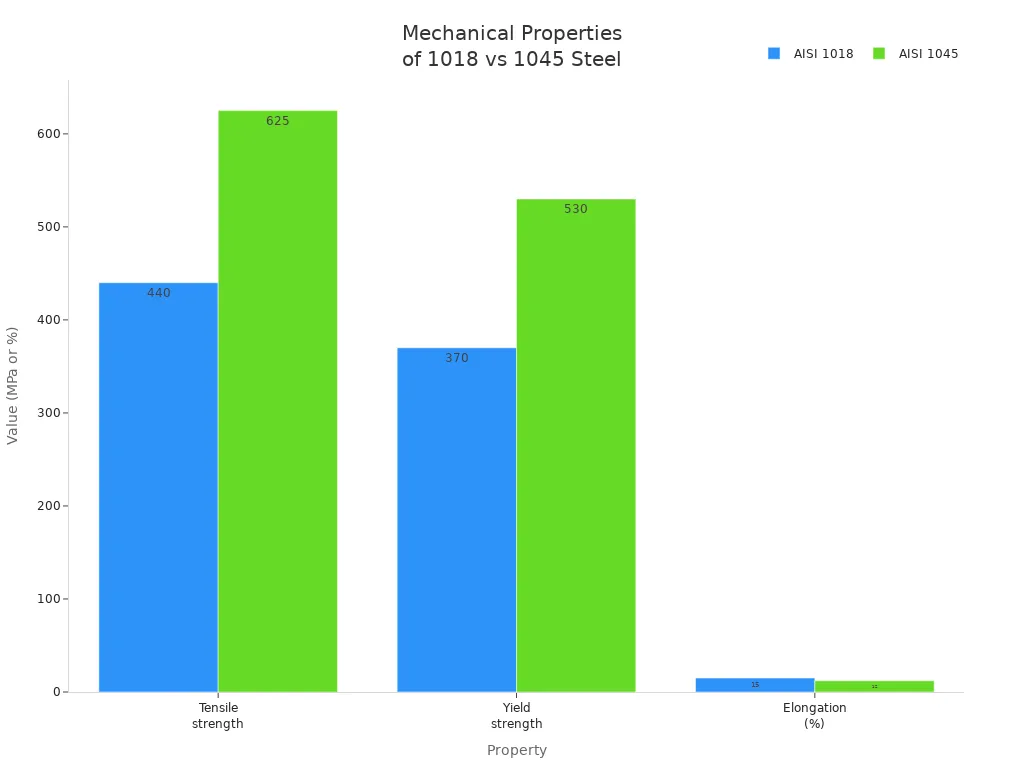
1045 steel is best when you need strength and durability. 1018 steel is better for easy fabrication.
You might also compare 1045 steel to 4140 steel. 4140 steel is an alloy steel with more strength and toughness. It responds better to heat treatment, so you can make it even harder. 1045 steel is great for general parts and tools. 4140 steel works best for high-stress jobs, like heavy machinery or parts that face lots of wear.
Property | 1045 Steel | 4140 Steel |
|---|---|---|
Heat Treatment | Less pronounced effects | More responsive, higher hardness |
Strength and Toughness | Lower | Higher |
Applications | General mechanical parts, tools | High-stress, complex conditions |
Note: Choose 4140 steel if you need extra strength for tough jobs. Pick 1045 steel for most medium-load uses.
You get many benefits when you use 1045 steel. It gives you a good mix of strength and ductility. You can machine it easily and use different heat treatments. It is cost-effective and works for many jobs.
Advantages | Drawbacks |
|---|---|
Good balance of strength and ductility | Limited corrosion resistance |
Easy to machine | Weldability needs care |
Many heat treatment options | Moderate hardenability |
Good for surface hardening | Can overheat if not careful |
Affordable compared to alloy steels |
Advantages:
Good machinability
High strength and toughness
Heat treatable
Drawbacks:
Limited corrosion resistance
Weldability issues
Tip: Use 1045 steel when you want strong, tough parts at a good price. Take care with welding and protect against rust for best results.
You see that 1045 steel gives you a strong mix of carbon and manganese. The table below shows its main elements:
Element | Percentage Range (%) |
|---|---|
Carbon (C) | 0.43 - 0.50 |
Manganese (Mn) | 0.60 - 0.90 |
Silicon (Si) | 0.15 - 0.40 |
Phosphorus (P) | ≤ 0.040 |
Sulfur (S) | ≤ 0.050 |
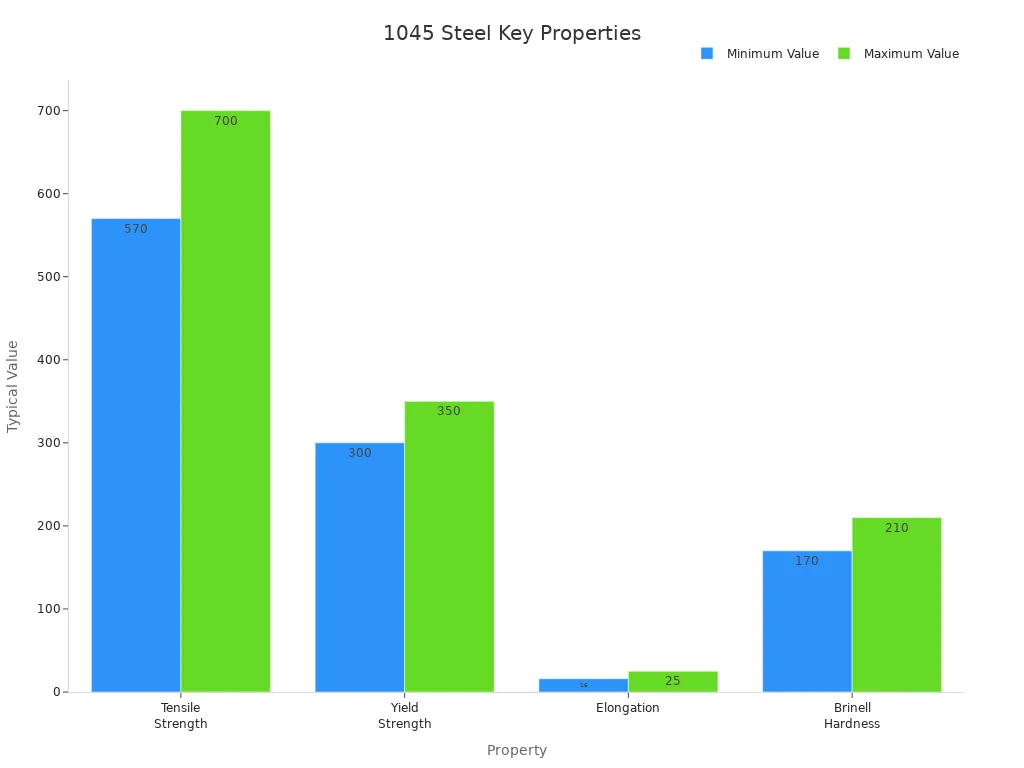
You can use heat treatments like annealing, normalizing, quenching, and tempering to change its strength and toughness. The chart below shows how it performs:
You pick 1045 steel for gears, shafts, axles, and machine parts. It works best for medium-load jobs and saves money compared to alloy steels. If you need higher strength or better weldability, you may choose 4140 or low-carbon steels.
Tip: Choose 1045 steel when you want reliable performance and good value for most mechanical parts.
You get a strong material that is easy to machine. 1045 steel offers a good balance of strength and toughness. You can use it for many parts that need to handle stress and wear.
You can weld 1045 steel, but you need to preheat it. This helps prevent cracking. After welding, you should use heat treatment to make the joint strong and reliable.
Heat treatment changes the hardness and toughness. You can make the steel harder by quenching. You can restore toughness by tempering. You choose the process based on your needs.
You find 1045 steel in shafts, gears, bolts, and machine parts. You also see it in automotive components and construction tools. It works well for medium-load jobs.
You can use 1045 steel for tools like hammers and axes. It gives you enough hardness after heat treatment. You get tools that last and resist wear.