
T: +86-0731-85185770
E: enquiry@qilumetal.com
E: enquiry@qilumetal.com
No. 18 Xiangfu Middle Road,Yuhua District, Changsha City
Views: 0 Author: Site Editor Publish Time: 2026-03-31 Origin: Site


When you compare 4140 vs 4340 steel, you see clear differences in strength and toughness. 4340 steel offers higher tensile and yield strength, along with excellent impact toughness, while 4140 steel provides good strength and hardness at a more cost-effective level. Here is a quick look at their properties:
Property | 4340 Steel | 4140 Steel |
|---|---|---|
Tensile Strength | 930-1,100 MPa | 655-850 MPa |
Yield Strength | 635 MPa | 415 MPa |
Hardness (as rolled) | 190-220 HB | 197-235 HB |
Impact Toughness | Excellent | Good |
You can find both grades in the Engineering Steel range from Hunan Qilu Steel.
4140 steel costs less. It works well for many uses like gears and shafts.
4340 steel is stronger and tougher. It is good for places with a lot of stress, like in airplanes.
Look at what is in the alloy. 4140 has more chromium. 4340 has more nickel, which makes it tougher.
You can heat treat both steels. But 4340 does better when things get really tough.
Pick the one you need. Use 4140 if you want to save money. Use 4340 if you need something strong for important parts.
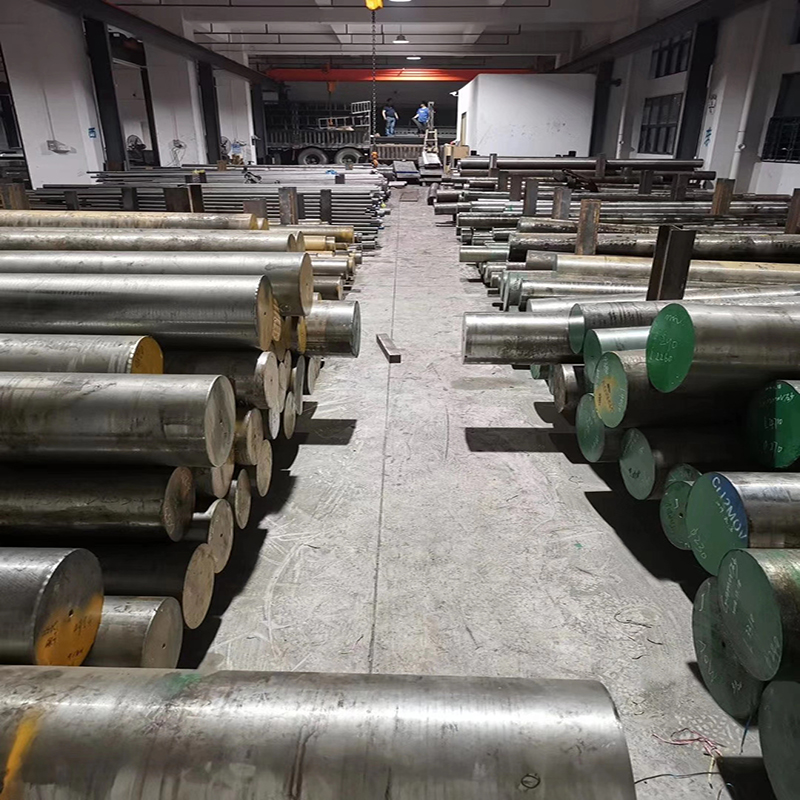
When you look at 4140 vs 4340 steel, you see important differences in their alloy makeup, mechanical properties, and cost. These differences help you choose the right material for your project. Both grades are available in the Engineering Steel range from Hunan Qilu Steel.
Here is a side-by-side comparison of 4140 vs 4340 steel. This table shows you the main differences in alloy composition, strength, and price.
Property | 4140 Steel | 4340 Steel |
|---|---|---|
Carbon Content (wt%) | 0.38 – 0.43 | 0.38 – 0.43 |
Chromium Content (wt%) | 0.80 – 1.10 | 0.70 – 0.90 |
Molybdenum Content (wt%) | 0.15 – 0.25 | 0.20 – 0.30 |
Nickel Content (wt%) | <0.25 | 1.65 – 2.00 |
Tensile Strength | 655–850 MPa | 930–1,100 MPa |
Yield Strength | 415 MPa | 635 MPa |
Hardness (as rolled) | 197–235 HB | 190–220 HB |
Impact Toughness | Good | Excellent |
Relative Price | Lower | Higher |
Tip: If you need higher strength and toughness, 4340 steel is the better choice. If you want a cost-effective option with good performance, 4140 steel works well.
You can see the biggest difference between 4140 vs 4340 in their alloying elements. Both steels have similar carbon content, but their other elements set them apart.
4140 steel contains more chromium and less nickel. This gives it good hardness and wear resistance. You will find 0.80–1.10% chromium and less than 0.25% nickel in 4140.
4340 steel has a higher nickel content, usually between 1.65% and 2.00%. Nickel increases toughness and helps the steel stay strong even at low temperatures. 4340 also has slightly more molybdenum, which boosts hardenability.
Here is a table that shows the main alloying elements:
Element | 4140 Steel (wt%) | 4340 Steel (wt%) |
|---|---|---|
Carbon | 0.38 – 0.43 | 0.38 – 0.43 |
Chromium | 0.80 – 1.10 | 0.70 – 0.90 |
Molybdenum | 0.15 – 0.25 | 0.20 – 0.30 |
Nickel | <0.25 | 1.65 – 2.00 |
Manganese | 0.75 – 1.00 | 0.60 – 0.80 |
Nickel makes a big difference in the properties of 4340 steel. You get higher toughness and better hardenability. This means 4340 can harden all the way through thick parts, while 4140 may stay softer in the center.
The cost of 4140 vs 4340 steel depends on their alloy content and processing. Here is what you need to know:
4140 steel costs less because it uses less nickel and needs less processing.
4340 steel costs more. The higher price comes from its nickel content and the extra steps needed to reach its high strength.
Steel Type | Relative Price | Main Cost Drivers |
|---|---|---|
4140 | Lower | Chromium, Molybdenum |
4340 | Higher | Nickel, Extra Processing |
You should choose 4340 steel for critical parts that need top strength and toughness, like aerospace or defense components. For general engineering, shafts, or gears, 4140 steel gives you good performance at a lower price.
Note: The comparison of 4140 and 4340 steel helps you match the right material to your needs. Always consider the working environment, required strength, and budget before you decide.
4140 steel is a medium-carbon alloy steel. It has a mix of elements that makes it strong for many uses. ASTM A29/A29M sets the usual chemical makeup. The steel has carbon, chromium, molybdenum, manganese, silicon, sulfur, and phosphorus. Each element helps change the steel properties.
Element | Percentage Range | Influence on Steel Properties |
|---|---|---|
Carbon (C) | 0.38% – 0.43% | Makes steel harder and stronger. Too much can make it less bendable. |
Chromium (Cr) | 0.80% – 1.10% | Helps steel get harder and resist rust. |
Molybdenum (Mo) | 0.15% – 0.25% | Makes steel stronger and better with heat. |
Manganese (Mn) | 0.60% – 0.90% | Adds strength and helps steel last longer. |
Silicon (Si) | 0.20% – 0.35% | Helps clean steel and makes it stronger. |
Sulfur (S) | ≤ 0.040% | Low sulfur keeps steel tough. |
Phosphorus (P) | ≤ 0.035% | Low phosphorus stops steel from breaking easily. |
4140 steel is known for high strength and toughness. You can change its hardness and strength with heat treatment. When quenched and tempered, it shows different steel properties:
Condition | Approx. Hardness | Yield Strength | Tensile Strength | Notes |
|---|---|---|---|---|
QT to ~30 HRC | ~30 HRC | 760–895 MPa | 895–1030 MPa | Good mix of strength and toughness |
QT to ~40 HRC | ~40 HRC | 965–1100 MPa | 1100–1240 MPa | More strength, less toughness |
QT to ~50–55 HRC | 50–55 HRC | Very high | Very high | Used for small, thin parts |
4140 steel is tougher than A36 and 1045 steel. It is not as tough as 4340 steel.
Tip: 4140 steel machines well when annealed. Its machinability rating is about 65%. If hardness goes up, it gets harder to machine. Pick the right condition for your job.
4140 steel is used in many industries because it is reliable. You see it in cars, planes, and big machines. Here are some common uses:
Gears and shafts
Axles and spindles
High-performance bearings
Parts that get stressed in machines
Structural parts in vehicles and aircraft
You can find 4140 steel in the Engineering Steel range from Hunan Qilu Steel. This helps you get good material for your project.
You will find that 4340 steel stands out because of its unique mix of elements. The most important difference is the higher nickel content. Nickel helps boost toughness and impact resistance. Here is a table showing the typical chemical composition of 4340 steel according to ASTM A29/A29M:
Element | Composition Range (%) |
|---|---|
C | 0.38–0.43 |
Si | 0.15–0.35 |
Mn | 0.60–0.80 |
P (≤) | 0.035 |
S (≤) | 0.04 |
Ni | 1.65–2.00 |
Cr | 0.70–0.90 |
Mo | 0.20–0.30 |
The higher nickel content in 4340 steel gives you several benefits:
You get greater toughness and ductility, which means the steel can handle heavy impacts.
The steel keeps its strength even in cold temperatures.
Corrosion resistance stays moderate, so you may need extra protection in harsh environments.
4340 steel is famous for its high tensile strength and toughness. You can use it in parts that face extreme stress. The steel’s properties change with heat treatment. Here is a table showing how the mechanical values look in different conditions:
Condition | Tensile Strength (MPa) | Yield Strength (MPa) | Elongation (%) | Izod Impact (J) | Brinell Hardness |
|---|---|---|---|---|---|
T | 850–1000 | 635 | 13 | 40 | 248–302 |
U | 930–1080 | 740 | 12 | 47 | 269–331 |
V | 1000–1150 | 835 | 12 | 47 | 293–352 |
W | 1080–1230 | 925 | 11 | 41 | 311–375 |
X | 1150–1300 | 1005 | 10 | 34 | 341–401 |
Y | 1230–1380 | 1080 | 10 | 24 | 363–429 |
Z | 1555– | 1125 | 5 | 10 | 444– |
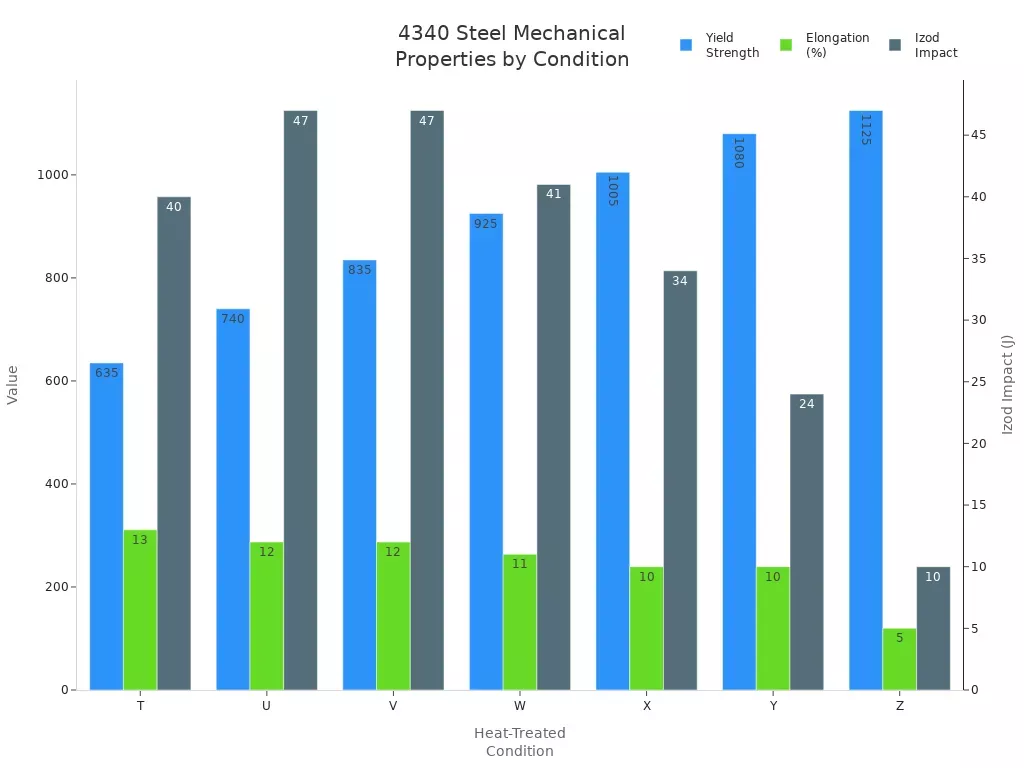
4340 steel performs better than 4140 steel in low temperatures. The nickel content helps it absorb more energy before breaking. You can trust this steel for parts that must not fail, even in freezing weather.
Tip: If you need steel for extreme conditions, 4340 steel from Hunan Qilu Steel’s Engineering Steel range is a smart choice.
You will see 4340 steel in many industries that need strong and tough materials. It is popular in aerospace industries, military, and heavy industry. Here are some common uses:
Torsion bars and crankshafts
Sprockets and gears
Aircraft landing gear and structural parts
High-performance automotive components
4340 steel is the go-to material for parts that face high stress and impact. You can find it in the Engineering Steel product line from Hunan Qilu Steel. This steel helps you build reliable and long-lasting components.
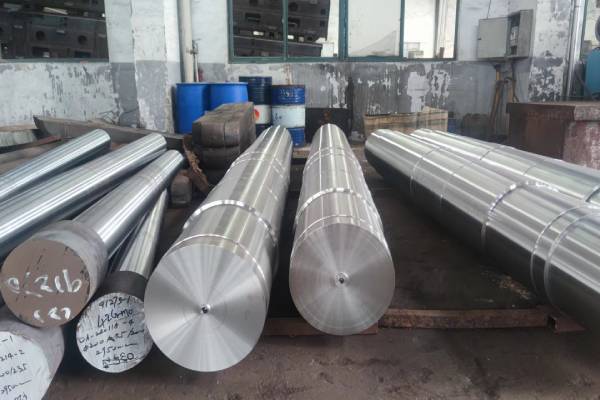
4140 steel is a good pick for many jobs. It is used when you want strong parts that do not cost too much. You see it in cars for crankshafts, gear shafts, and bolts. Factories use it for gears, spindles, and big fasteners. 4140 steel is also found in structural bolts, couplings, and machine parts. Experts say 4140 steel works well in cars, oil and gas, and building projects. It has good fatigue strength and resists wearing out. This makes it great for gears and crankshafts. It is also used in power parts and mining machines.
Industry | Common Applications |
|---|---|
Automotive | Crankshafts, gear shafts, bolts |
Manufacturing | Gears, spindles, fasteners |
Construction | Structural bolts, couplings |
Tip: 4140 steel is easy to machine. You can shape and drill it without much trouble. It is a smart choice for parts that need medium strength and toughness.
4340 steel is best for jobs that need very strong and tough parts. It is used in airplane landing gear, big machines, and fast cars. You find it in crankshafts, gears, and bolts that face hard work. 4340 steel is also used in mining tools, big presses, and machine parts. It has higher fatigue strength and impact resistance. This makes it the top pick for parts that must not break under heavy loads.
Aerospace applications: Landing gear, shaft parts
Automotive: Gears, crankshafts, axles
Heavy machinery: Mining equipment, construction machinery
Note: 4340 steel is harder to machine and costs more. But it gives you better performance for important parts.
You should think about price, how easy it is to machine, and heat treatment before you choose. 4140 steel costs less and is easier to cut. You can use normal tools for most jobs. 4340 steel is harder and gets hotter when you cut it. You need strong tools and tight setups. 4340 steel costs more, so finished parts can be 30% to 50% more expensive.
Steel Type | Machinability | Heat Treatment | Cost |
|---|---|---|---|
4140 | Excellent | 50-55 HRC | Lower |
4340 | Challenging | 48-52 HRC | Higher |
Both steels can be heat treated. You can quench and temper them at 900°C to 950°C. 4140 steel gets harder, so it is good for parts that wear out. 4340 steel is better at handling stress and hits. Pick the steel that fits your job, money, and what you need the part to do.
Key things to think about: what is in the steel, how strong it is, how you treat it with heat, if you can weld it, what you need it for, and how much you can spend.
You can spot the main differences between 4140 and 4340 steel in this table:
Property | 4140 Steel | 4340 Steel |
|---|---|---|
Main Alloy | Chromium-molybdenum | Nickel-chromium-molybdenum |
Hardness | Good | Higher |
Durability | Good | Excellent |
Shock Resistance | Moderate | Superior |
Machinability | Easier | More difficult |
Best Use | General applications | High-stress applications |
4140 steel is a smart choice for strong parts that cost less. 4340 steel is best when you need extra strength and toughness. Make sure you pick the steel that fits your project. Hunan Qilu Steel gives you good quality for both types.
You will notice that 4340 steel contains more nickel. This gives it higher toughness and strength. 4140 steel costs less and works well for general uses.
You can weld both steels, but you must preheat them. This step helps prevent cracking. Use low-hydrogen electrodes for best results.
You can heat treat both grades. 4340 steel responds better to deep hardening. You get higher strength and toughness after heat treatment.
You can find both grades in the Engineering Steel range from Hunan Qilu Steel. This supplier offers reliable quality for demanding projects.