
T: +86-0731-85185770
E: enquiry@qilumetal.com
E: enquiry@qilumetal.com
No. 18 Xiangfu Middle Road,Yuhua District, Changsha City
Views: 0 Author: Site Editor Publish Time: 2026-07-24 Origin: Site


Choosing the right alloy for high-stress applications directly dictates component lifespan and manufacturing yield. Gears, camshafts, and heavy-duty fasteners face relentless mechanical punishment daily. A single unexpected material failure can stall your production lines indefinitely. Engineers routinely struggle to balance extreme surface hardness against essential core toughness.
You need a reliable material capable of resisting intense surface wear while absorbing heavy shock loads internally. Standard carbon steels simply crack under impact or wear down far too quickly in these demanding environments. This comprehensive guide establishes 8620 as the definitive standard for case-hardened components.
We explore the specific evaluation criteria you must apply when sourcing and specifying this versatile alloy. You will learn exactly how strict chemistry control and predictable heat treatment processes guarantee successful implementation. Transition your material research into actionable sourcing strategies today.
8620 steel is optimal for parts requiring heavy case hardening without sacrificing internal core toughness.
Direct comparisons with 4140 or 1045 should be based on specific load requirements, not just raw material costs.
Machinability is excellent in the annealed state, but post-machining carburizing requires precise dimensional allowances for distortion.
Vetting an 8620 steel supplier requires mandatory verification of Mill Test Reports (MTRs), chemistry tolerances, and global standard equivalencies.
Equipment failures in high-torque environments routinely stem from improper material specification. Brittle core materials snap under sudden impact. Conversely, insufficient surface hardness leads to rapid abrasive wear. You must identify an alloy capable of solving both challenges simultaneously. This is precisely where 8620 excels as a foundational industrial steel choice.
The success of 8620 relies on its highly engineered chemical composition. Nickel provides exceptional internal toughness and resistance to fatigue. Chromium increases the overall hardening depth during heat treatment. Molybdenum maintains structural strength even under elevated operational temperatures. Together, these elements allow the material to form a diamond-hard outer case while keeping a ductile, shock-absorbing core.
Before committing to procurement, evaluate your project against these operational requirements. Use the following criteria to confirm if 8620 fits your exact engineering needs.
Will the final component undergo a carburizing or case-hardening process?
Does the application demand high shock-load resistance combined with surface wear resistance?
Do your current carbon steel parts suffer from fatigue cracking or premature tooth wear?
Are you manufacturing ring gears, pinions, camshafts, or heavy-duty fasteners?
Evaluating cheaper, lower-alloy alternatives often creates a false sense of economy. You must measure the cost-to-outcome ratio carefully. Calculate the initial material price alongside required heat treatment costs. Then, weigh these expenses against the expected operational lifespan of the component. Upgrading to 8620 prevents costly field failures and expensive unplanned maintenance downtime.
Always review historical failure data from previous component iterations. Identify whether past parts failed due to surface galling or internal fatigue. This data validates the decision to upgrade your material grade.
Selecting the optimal steel grade requires a direct comparison against standard alternatives. Engineers frequently debate between 8620, 4140, and 1045. Each alloy serves distinct mechanical purposes. Understanding these differences prevents catastrophic design errors.
The primary decision lens here focuses on case hardening versus through hardening. Grade 4140 is a medium-carbon alloy designed for uniform hardness throughout its entire cross-section. It provides exceptional overall yield strength. However, 4140 lacks the extreme surface wear resistance generated by case hardening.
Choose 8620 to achieve maximum surface wear resistance paired with internal shock absorption. Choose 4140 when your application requires high yield strength across the entire cross-sectional area of the part.
This comparison pits a low-carbon alloy against a traditional medium-carbon steel. Grade 1045 offers moderate strength and acceptable machinability at a very economical price point. It works well for low-stress shafts or basic structural components.
You should use 1045 strictly for cost-sensitive, moderate-stress applications. You must upgrade to 8620 when fatigue resistance, shock absorption, and deep case hardening become non-negotiable requirements.
| Material Grade | Carbon Content | Hardening Method | Primary Benefit | Ideal Application |
|---|---|---|---|---|
| 8620 | 0.18% - 0.23% | Carburizing (Case Hardening) | Tough core, highly wear-resistant surface | Gears, camshafts, pinions |
| 4140 | 0.38% - 0.43% | Through Hardening | High uniform tensile strength | Axles, high-stress shafts |
| 1045 | 0.43% - 0.50% | Induction Hardening / Quenching | Cost-effective moderate strength | Standard machinery parts |
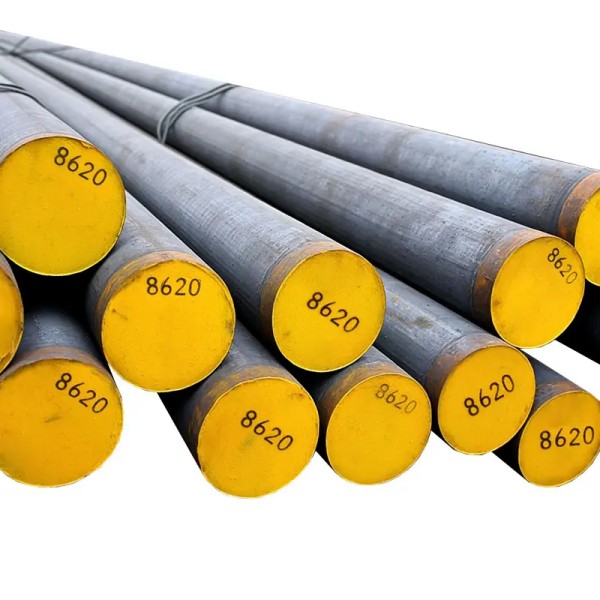
Raw material specifications directly dictate your machining efficiency and heat-treat predictability. Missing crucial details during the ordering phase leads to ruined tooling and warped parts.
You must select the most appropriate starting material format. Options typically include cold-drawn alloy bar stock, hot-rolled configurations, or custom blanks. High-volume CNC turning operations generally benefit from the tight dimensional tolerances of cold-drawn bars. Conversely, large, complex components requiring specific directional strength benefit immensely from custom forged steel processing.
The state of the steel upon delivery impacts your initial production costs. You should prioritize ordering materials in the annealed or as-rolled condition. Annealed 8620 provides an optimal microstructure for initial CNC machining. This specific delivery condition maximizes your cutting tool life and reduces spindle load.
Unpredictable heat treatment results usually stem from loose chemical controls. Tight adherence to the ASTM A29 standard remains critical. The exact percentages of Nickel, Chromium, and Molybdenum must fall within highly specific windows. Even minor deviations cause the carburizing process to yield inconsistent case depths.
Always specify a fine grain structure (typically McQuaid-Ehn grain size 5 or finer) on your purchase orders. Fine grain structures minimize internal warping and distortion during the aggressive heating and cooling cycles of the carburizing process.
Buyers often neglect to specify hardenability bands. Ordering standard 8620 instead of the guaranteed 8620H grade can result in batch-to-batch hardness variations. Always specify the "H" grade for critical, high-volume automotive or aerospace applications.
Successful procurement only solves half the engineering puzzle. Manufacturing teams must understand the specific behavioral traits of 8620 during machining and subsequent heat treatment.
Operators widely consider 8620 to possess excellent machinability. It generally rates at approximately 65% of standard B1112 free-machining steel. However, its low carbon content can cause chip control issues. The material tends to tear rather than shear cleanly if you use incorrect feeds and speeds. Ensure your programmers utilize proper tooling geometries featuring positive rake angles to maintain tight surface finishes.
Carburizing introduces significant thermal stress into the component. You must acknowledge the inherent risk of dimensional distortion during case hardening. Thin-walled sections or asymmetrical parts remain especially vulnerable to severe warping during the final quench.
You cannot eliminate thermal distortion entirely, but you can control it. Engineering departments must implement specific mitigation practices.
Leave dedicated grinding allowances (typically 0.005" to 0.010") on critical dimensions before heat treatment.
Specify fixture quenching for parts prone to bending or twisting.
Mask off areas (like internal threads) where case hardening is undesirable.
Ensure smooth transitional radii in the part design to prevent stress concentrations.
Unlike higher carbon alloys, 8620 offers reasonable weldability. However, you cannot simply strike an arc without preparation. The alloy requires strict pre-heating (usually around 300°F) to prevent hydrogen-induced cracking in the Heat Affected Zone (HAZ). Furthermore, you must conduct post-weld stress relief processes to restore structural integrity before the final heat treatment cycle.
The quality of your final component heavily depends on the integrity of your supply chain. Identifying a trustworthy metallurgical partner ensures predictable manufacturing runs.
Material traceability acts as your primary insurance policy. You must enforce a non-negotiable requirement for comprehensive Mill Test Reports (MTRs) with every shipment. These documents detail the exact chemical composition, mechanical properties, and specific heat lots of the steel. Never accept material lacking transparent, verifiable origin documentation.
Modern supply chains operate globally. Ensure your chosen partner understands equivalent international specifications. A capable supplier knows that JIS SNCM220, DIN 20NiCrMo2-2, and standard 8620 represent highly similar chemical profiles. This fluency prevents sourcing bottlenecks when navigating international markets.
Assess the inventory models of your prospective partners. Seek out a dedicated 8620 steel supplier capable of providing custom cut-to-length services. Suppliers demanding excessively large Minimum Order Quantities (MOQs) tie up your working capital and complicate agile manufacturing strategies.
Watch for distinct warning signs during the vetting process. Immediately disqualify suppliers exhibiting an inability to guarantee heat lot consistency. Beware of brokers who obscure the original mill sources or fail to provide requested testing documentation promptly. Consistent material quality forms the foundation of reliable manufacturing.
Successful 8620 procurement represents a delicate balance of correct application matching, rigorous specification, and predictable supplier quality. This alloy delivers unmatched performance for heavy-duty gears, shafts, and fasteners. However, achieving its legendary wear resistance demands strict adherence to chemical tolerances and heat treatment protocols. Avoid the temptation to swap this material for cheaper carbon steels in high-torque environments.
Your next steps should involve standardizing your internal material specifications. Encourage your engineering and procurement teams to finalize precise dimensional tolerances, grain size requirements, and heat-treat expectations. Consolidate these details before requesting targeted quotes or scheduling metallurgical consultations. Proactive specification guarantees long-term manufacturing success.
A: After proper carburizing, quenching, and tempering, 8620 steel typically achieves a surface hardness between 50 and 60 HRC. The internal core remains much softer, usually around 20 to 30 HRC. This dual-property state provides the essential shock absorption required for heavy-duty applications.
A: Yes. The "H" designation stands for guaranteed hardenability. While standard 8620 specifies exact chemical composition limits, 8620H guarantees the steel will respond to heat treatment within specific hardness bands. We highly recommend the "H" grade for consistent high-volume manufacturing.
A: While you can technically use it in the annealed or as-rolled condition, doing so defeats the primary purpose of the alloy. It is specifically designed for carburizing. Without heat treatment, it lacks the necessary surface hardness to resist heavy mechanical wear.
A: Viable temporary substitutes include 4320, 8615, or sometimes 8622. Grade 4320 offers higher core strength due to increased nickel content, while 8615 provides slightly lower carbon. You must always conduct a thorough engineering review before substituting any material to ensure performance matches.