
T: +86-0731-85185770
E: enquiry@qilumetal.com
E: enquiry@qilumetal.com
No. 18 Xiangfu Middle Road,Yuhua District, Changsha City
Views: 0 Author: Site Editor Publish Time: 2026-07-01 Origin: Site


Selecting the right metal ultimately determines component survival. High-stress environments always demand materials built for extreme wear and sudden impacts. Soft metals fail rapidly under heavy friction. Fully hardened metals fracture easily upon sudden impact. Engineers require a highly reliable balance. This specific balance defines 8620 steel perfectly.
We classify it as a low-carbon, nickel-chromium-molybdenum alloy. Its primary industrial value lies in its exceptional core toughness. It combines this inner strength seamlessly with high surface wear resistance when carburized. You will find it in heavy-duty machinery across the globe.
This article serves a clear and practical objective. We will provide engineers and procurement teams with essential technical data. You will discover practical comparative frameworks. We will also detail specific sourcing criteria. You require these actionable insights to properly evaluate this material for demanding, high-stress applications.
Optimal for Case Hardening: 8620 is specifically engineered to respond well to carburizing, achieving a hard outer case (up to HRC 60-63) while maintaining a ductile core.
Superior to Carbon Steel: The addition of Ni, Cr, and Mo gives it better hardenability and core strength compared to standard low-carbon grades like 1018.
Versatile Supply Forms: Readily available in hot-rolled and cold-drawn bars, making it a standard engineering steel for gears, shafts, and fasteners.
Procurement Standard: Typically certified under ASTM A29 or SAE J404 standards; verifying Mill Test Reports (MTRs) is critical for demanding industrial applications.
The performance of any metal relies entirely on its elemental makeup. A carefully controlled chemical balance separates basic carbon metals from high-performance alloys. By understanding these percentages, we can predict how the metal will behave under extreme thermal stress.
Standard Chemical Composition of 8620 Steel
| Element | Symbol | Composition Percentage (%) |
|---|---|---|
| Carbon | C | 0.18 - 0.23% |
| Manganese | Mn | 0.70 - 0.90% |
| Nickel | Ni | 0.40 - 0.70% |
| Chromium | Cr | 0.40 - 0.60% |
| Molybdenum | Mo | 0.15 - 0.25% |
Each alloying element performs a highly specific metallurgical function. Manufacturers rely on this exact recipe to guarantee predictable results. We can break down the role of the primary alloying elements:
Nickel: This element improves low-temperature toughness. It drastically increases overall impact resistance.
Chromium: Chromium actively enhances hardenability. It also significantly boosts surface wear resistance.
Molybdenum: This addition maintains uniform hardness across varying cross-sections. It effectively mitigates temper brittleness during thermal cycles.
This formulation holds a critical engineering implication. The specific balance ensures the material does not become excessively brittle. When manufacturers subject this alloy steel to intense heat, the core remains highly ductile. The low carbon content prevents the internal structure from hardening too much. Consequently, it absorbs heavy shock loads seamlessly without shattering.
Engineers evaluate materials based on proven mechanical baselines. Before any thermal manipulation, the metal exhibits specific strengths. We generally evaluate these properties in an annealed or as-rolled condition. These numbers provide a reliable starting point for manufacturing design.
Standard ASM and MatWeb benchmarks reveal consistent baseline mechanical properties. You can expect Tensile Strength to range between 530 and 900 MPa. Yield Strength typically falls between 385 and 600 MPa. Elongation percentages indicate excellent ductility before processing. Furthermore, machinability is highly favorable. Experts rate its machinability at approximately 65% of 1212 free-machining steel. This rating allows manufacturers to cut and shape complex parts efficiently.
The true value of this case hardening steel emerges during the carburizing cycle. The case hardening process follows a strict thermal procedure. Operators heat the components to between 1650°F and 1700°F. They perform this heating inside a carbon-rich environment. The heated metal surface actively absorbs the carbon gas. Operators then quench the metal rapidly to lock in the newly formed microstructure.
This cycle yields a remarkable dual-property structure. The exterior transforms into a high-hardness shell. This surface provides outstanding wear resistance. Conversely, the core remains unexposed to the extra carbon. It stays soft and ductile. It delivers vital impact resistance to prevent sudden fractures.
However, we must address a notable implementation risk. Improper heat treatment can easily lead to dimensional distortion. The metal moves slightly during rapid quenching. Therefore, post-treatment grinding is often required. Engineers must plan for this secondary operation when designing tight-tolerance components.
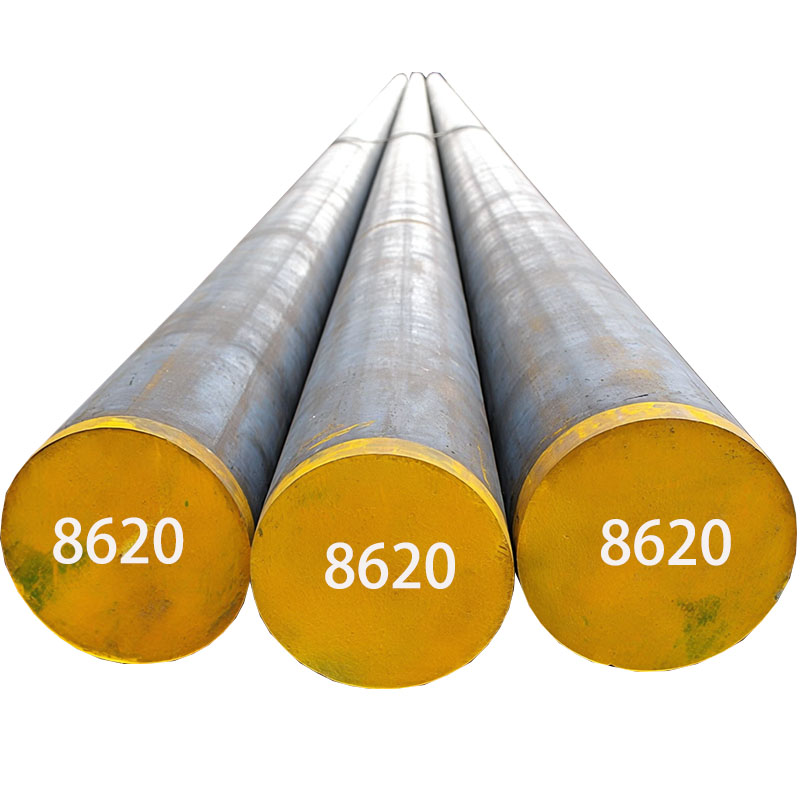
Global manufacturing requires clear material cross-referencing. An engineer in Germany must specify the same material as a designer in Japan. Standards organizations worldwide recognize this formulation under different names. Understanding these equivalents prevents costly sourcing errors.
We track several common global grade cross-references:
North America: UNS G86200
Europe (DIN / EN): 21NiCrMo2 (1.6523)
Japan (JIS): SNCM220
Supplier networks globally stock this 8620 steel in multiple configurations. Choosing the right supply form impacts your initial machining strategies. It also influences your raw material budget.
Hot rolled bar represents the most cost-effective option. It proves highly suitable for parts requiring extensive rough machining. You will remove the rough outer layer before heat treatment anyway. Therefore, the less precise surface finish does not matter.
Cold finished or drawn bar offers tighter dimensional tolerances. It delivers a notably better surface finish right off the truck. It also provides slightly higher baseline mechanical properties due to the cold working process. Manufacturers select this form for automated CNC turning operations.
Forgings and billets serve heavy-duty industrial needs. Suppliers provide these massive blocks for large-scale production. Engineers mandate forged structures for high-fatigue industrial components. The forging process aligns the internal grain structure. This alignment maximizes physical endurance.
Engineers face a specific business problem daily. They must design moving parts that survive harsh mechanical environments. Ideal applications involve parts experiencing continuous friction. They also endure heavy surface loads. Most importantly, they suffer sudden impact shocks. Choosing the wrong metal guarantees a catastrophic failure.
This material dominates several primary industrial sectors. We can classify the primary use cases into three major categories:
Power Transmission: Gearboxes rely heavily on this alloy. Ring gears, pinions, and splined shafts require extreme tooth strength. The hard surface prevents rapid tooth wear. The soft core prevents the teeth from snapping under heavy torque.
Heavy Machinery: Earthmoving equipment demands rugged materials. Manufacturers specify this grade for heavy-duty pins, bushings, and camshafts. These components endure constant abrasion and massive physical shock simultaneously.
Oil & Gas / Automotive: High-stress fasteners hold these industries together. We also see widespread use in collets and hand tools. The material guarantees these tools will not shatter when dropped or struck heavily.
We evaluate success criteria simply. Adoption should always be driven by a specific engineering need. The application must require a high-wear surface. Simultaneously, it must not sacrifice the component's ability to absorb shock. This dual capability effectively prevents catastrophic brittle failure in the field.
Material selection rarely happens in a vacuum. Procurement teams constantly weigh various options. Comparing similar grades highlights the specific advantages of each metal. We will analyze three common alternatives frequently compared against our primary subject.
Material Comparison Chart
| Steel Grade | Primary Characteristic | Best Application Fit | Relative Pricing |
|---|---|---|---|
| 1018 Carbon | High Machinability, Soft Core | Low-stress pins, brackets | Low |
| 8620 Alloy | Case Hardening, Tough Core | Gears, splines, shafts | Moderate |
| 4140 Alloy | Through-Hardening, High Strength | Axles, structural supports | Moderate |
| 9310 Alloy | Extreme Core Toughness | Aerospace, extreme racing | High |
The primary decision lens here revolves around cost versus performance. 1018 is undeniably cheaper. It is also slightly easier to machine due to the lack of complex alloys. However, it completely lacks the core strength of the alloyed alternative. It also lacks advanced hardenability. You should use 1018 for simple, low-stress components. You must mandate the alloy grade for any high-torque or high-impact applications.
This comparison forces a choice between through-hardening and case hardening. 4140 acts as a widely popular medium-carbon steel. Manufacturers designed it for high overall strength across the entire cross-section. We call this through-hardening. Choose our primary alloy grade only when surface wear acts as the main failure mode. You must also select it when preserving core ductility remains non-negotiable.
Here, we view the decision through a commercial versus aerospace lens. 9310 offers vastly superior core toughness. It achieves this via a significantly higher nickel content. However, this upgrade comes at a major cost premium. For daily manufacturing, it represents overkill. The 86XX series remains the practical, highly cost-effective standard for 90% of industrial gear applications.
Sourcing metal correctly requires precise language. Vague purchase orders invite disastrous manufacturing outcomes. Specifying the exact condition on the order prevents costly rework. You must clarify the importance of calling out exact conditions. A proper order should read: "8620 Hot Rolled, Annealed, Machine Straightened." This clarity eliminates supplier guesswork.
Compliance and traceability form the backbone of safe industrial manufacturing. You must actively mandate Mill Test Reports (MTRs) for every delivery. These reports verify the exact chemical chemistry of that specific batch. They also detail the inclusion ratings. Furthermore, you must verify strict adherence to ASTM A29 or A29M standards. This verification guarantees the steel will react predictably during heat treatment.
Supplier evaluation requires looking beyond basic material price per pound. You should assess suppliers based on their actual inventory depth. Sizing availability prevents unnecessary internal machining waste. You must also demand strict lot traceability from the warehouse to your shop floor. Finally, evaluate their ability to provide pre-machining services. Saw cutting and rough turning capabilities effectively reduce your internal manufacturing bottlenecks. A strong supplier of engineering steel acts as a true production partner.
We can confidently summarize the core engineering value of this material. It stands as the premier choice for case-hardened components. It successfully delivers an uncompromising balance. It merges extreme surface wear resistance with vital impact toughness. This combination keeps critical industrial machinery running smoothly.
Successful implementation requires careful upfront alignment. You must align your mechanical design with your heat treatment vendor's actual capabilities. You must also enforce strict material sourcing standards. Missing any of these steps compromises the final component.
Take decisive action before your next production run. Encourage your buyers to consult directly with a qualified metallurgist. Review supplier sizing catalogs carefully based on your specific dimensional and tolerance requirements. Proper planning today prevents catastrophic mechanical failures tomorrow.
A: Yes, it can be welded prior to heat treatment using standard methods. However, pre-heating and post-weld stress relieving are highly recommended. This extra thermal care prevents cracking due to its specialized alloy content.
A: The interior core will typically harden to HRC 25-35. Meanwhile, a properly carburized exterior case can successfully achieve an impressive HRC 60-63.
A: It is generally supplied in an as-rolled or annealed condition. This state remains highly machinable. Operators almost always perform the required machining steps before initiating the case hardening process.
A: We use this term because its specific alloy composition is engineered precisely. It easily meets strict, repeatable mechanical properties. Manufacturers require these exact properties for load-bearing and power-transmitting components.