
T: +86-0731-85185770
E: enquiry@qilumetal.com
E: enquiry@qilumetal.com
No. 18 Xiangfu Middle Road,Yuhua District, Changsha City
Views: 0 Author: Site Editor Publish Time: 2026-11-21 Origin: Site


A suspension spring may spend most of its life moving through a modest range of travel and still be judged by what happens during a few severe impacts. It needs the specified load–deflection response, resistance to permanent set, and enough fatigue life for the loads it repeats. Selecting alloy spring steel for that job starts with the duty cycle and the finished section. Those details guide the choice between 5160 and 6150, the starting stock, and the way the spring will be formed and heat treated. The completed spring still needs to be tested against the design requirements.
List the normal working load and travel, the highest permitted load, and how often the spring is expected to cycle. Include shock events, operating temperature, and exposure to road salt or moisture. Separate a recurring load from a rare overload in the design record. Each can influence a different acceptance test.
Translate those inputs into the spring geometry. A leaf spring carries bending stress that varies along the leaf and across its thickness. The working wire or bar in a helical spring is loaded mainly in torsion. Locate the areas where the spring is most highly stressed and where holes, surface marks, or changes in section might become significant. The material supplier needs the stock section. The spring manufacturer also needs the finished geometry and duty cycle.
Set the load–deflection requirement alongside the limits for permanent set. The first describes how the spring responds within its working travel. The second addresses whether it returns to an acceptable position after the specified load has been removed. A suspension design can meet one requirement and miss the other. Writing the two requirements separately helps identify the appropriate test and corrective action.
Compare candidate grades using the actual section, the required heat-treated condition, and the cooling capability of the production process. Hardenability describes how readily a steel can develop the desired hardened structure through a section. It informs the review of a thick leaf or large bar, where the center and surface cool at different rates.
5160 spring steel is a chromium alloy steel worth evaluating for heavily loaded springs. 6150 spring steel adds vanadium to the grade design and provides another candidate for demanding spring service. Compare the grade requirements and available hardenability data under the specifications being considered. Confirm how the spring maker will verify the resulting condition in the representative section.
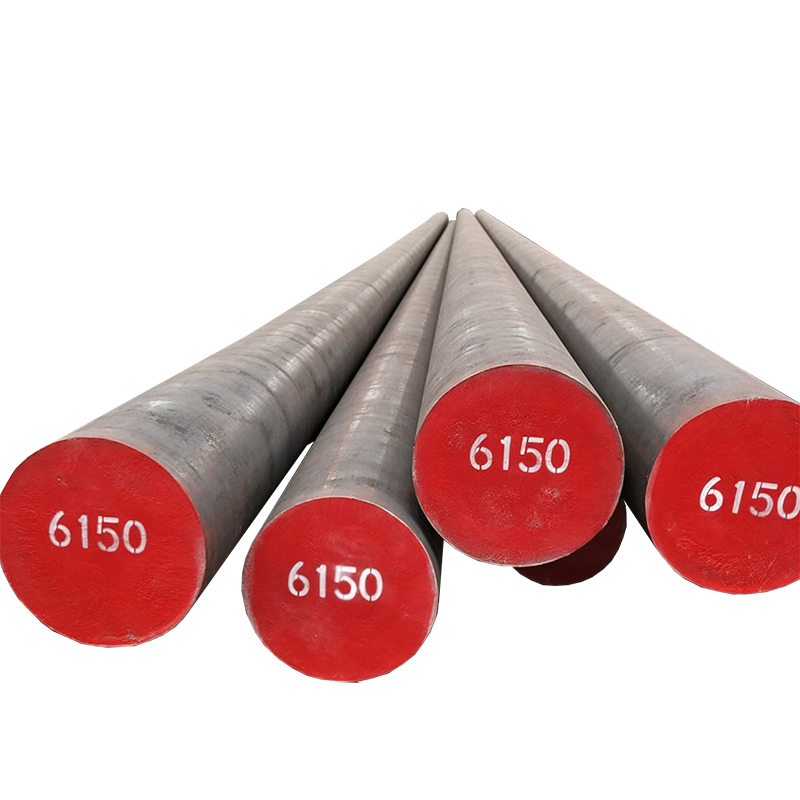
Hunan Qilu Steel lists cold-drawn, hot-rolled, and forged bar options for these alloy spring steel families, together with plate forms. Use those options to plan the starting section. A bar order for a coiled part needs a suitable diameter and a surface condition compatible with forming. A flat section needs enough material for cleanup and the intended edge geometry. Check the product form, dimensions, finish, and delivery condition together because they determine what work remains before forming.
 |  |
Specify the incoming finish by working backward from the surface the spring will have in service. Qilu lists finish and tolerance options for spring steel stock. Use the relevant option to state what the spring maker will receive and what cleanup is expected. A visible seam, score, or sharp edge in a highly stressed region deserves attention before it becomes part of a finished spring.
Forming and heat treatment determine the final geometry and material condition. High-temperature processing can leave a decarburized surface layer, so an application sensitive to surface fatigue should specify how that layer is assessed. Quenching and tempering need to produce the required condition throughout the relevant section. A bulk hardness check and a surface examination provide different information and should be planned accordingly.
Where the spring design uses shot peening, define the process and verification requirements for the surfaces it is meant to treat. Shot peening can introduce compressive residual stress that helps resist fatigue crack initiation. Surface defects, corrosion exposure, and process variation still need to be managed. Consider coating or other protection in the context of the spring’s service and the full manufacturing sequence.
Use the finished spring to validate the combined effect of material, geometry, and processing. A mill certificate helps confirm the material supplied. The spring test indicates how the manufactured component responds to its intended loads.
What to verify on a heavy-duty spring
Service requirement | Variable to review | Verification |
|---|---|---|
Normal working travel | Spring geometry, section dimensions, and material modulus | Load–deflection test across the specified range |
Recovery after a high load | Stress level, material strength, and heat-treated condition | Permanent-set measurement after the specified load history |
Repeated suspension cycles | Stress range, surface quality, and manufacturing controls | Fatigue test under the agreed loading conditions |
Service in a corrosive environment | Surface protection and exposure conditions | Coating checks and service-relevant qualification where specified |
For a suspension spring that sees regular travel and occasional large shocks, record the acceptance criteria for working deflection separately from the overload and fatigue checks. Include the test fixture and loading assumptions when comparing results. If an early failure occurs, record where it started and whether the spring first showed permanent set, surface damage, or a crack.
For a leaf-spring trial, select a representative section and use production tooling where practical. Record the formed dimensions before heat treatment and the accepted dimensions afterward. If a tested spring takes an excessive set, use the hardness and geometry checks to investigate whether the section, material condition, or applied load differed from the design. If the spring retains its shape but fails early in cycling, examine the fracture location and nearby surface condition before moving to a different alloy.
Agree on how a material or process change will be introduced. A change from rolled to drawn stock can alter the incoming surface condition and the work required before forming. A change in section can alter the hardening response of the same alloy. Where those changes matter to the spring design, qualify them on a representative spring and associate the resulting test record with the stock and production lot.
Decide which results can support repeat orders. Dimensions and material identification can be checked for each delivery as specified. Fatigue testing often belongs to the agreed qualification or production verification plan for the spring. Fix the test geometry, loading range, and conditions so later results can be compared with the original approval.
Cross-standard names are useful for finding candidate stock. Approve a substitution by comparing the actual grade specifications, including composition limits, product form, and required condition. Where the design relies on hardenability or a specific test result, make that requirement explicit rather than relying on a similar grade designation.
Put the section dimensions, surface condition, applicable tolerance, delivery condition, and traceability requirements on the order. Record the agreed test requirements for the finished spring separately. Keep the material heat identification with the production lot so that a later fatigue or set result can be traced back to the steel and processing history.
When several alloy spring steel lots are running at once, carry the material identity through cut lengths, blanks, and formed pieces using the shop’s traceability method. If the identification is lost during forming or heat treatment, an early fatigue result becomes harder to investigate. Maintaining that link also lets the spring maker compare a different stock finish or section against the qualified lot when reviewing a later change.
Choose alloy spring steel by linking the spring’s duty cycle to its section, heat-treated condition, and surface quality. Hunan Qilu Steel manufactures and supplies 5160 and 6150 stock in a range of bar and plate forms, which lets the spring maker choose a starting section that fits the forming route. Write the material requirements so they can be verified at receipt. Then validate the completed spring against the actual deflection, permanent-set, and fatigue requirements. Those results establish whether the selected grade and manufacturing process work together for the application.
Fatigue life also depends on working stress, toughness, surface condition, corrosion, and process quality. Specify a hardness range compatible with the spring design and validate it through representative testing.
Spring rate describes how load changes with deflection. Permanent set is the residual change in shape or height after unloading. A design review should specify how each is measured.
Depending on the specification, the inspection can use a prepared cross-section, a hardness traverse, or another agreed method. Identify the surface and acceptance criterion before testing.
Evaluate protection when the spring sees repeated salt exposure, especially where coating damage, trapped moisture, or abrasion is likely. Review the coating system and qualification with the spring manufacturer.