
T: +86-0731-85185770
E: enquiry@qilumetal.com
E: enquiry@qilumetal.com
No. 18 Xiangfu Middle Road,Yuhua District, Changsha City
Views: 0 Author: Site Editor Publish Time: 2026-03-17 Origin: Site


You can find 1045 steel in many factories around the world. 1045 carbon steel is a type of medium-carbon steel. People also call it AISI 1045, C45, S45C, or 080M40. 1045 steel gives you good strength, toughness, and is easy to shape. If you pick 1045 carbon steel, you get a material that works for many things. It is important to know about 1045 steel because its features help you choose the right material for your project. 1045 carbon steel is known for its good mechanical performance. Many industries trust 1045 steel. Some common uses for 1045 carbon steel are:
Automotive and transportation: gears, axles, steering parts
Tooling and machinery: couplings, pins, shafts
Construction: supports, fasteners
Oil & gas and heavy equipment: pump shafts, drilling collars
If you want to know more about 1045 Steel Properties, you will see why engineers and builders use 1045 carbon steel for important parts.
1045 steel is a strong and tough material. It works well for parts like gears and shafts.
The chemical makeup has 0.45% carbon and manganese. These elements help the steel last longer and resist wearing out.
Heat treatment can change how 1045 steel acts. This lets people adjust it for different projects.
Welding 1045 steel needs special care. Preheating helps stop cracks and makes joints strong.
Picking 1045 steel gives good value and performance. It is a dependable choice for jobs needing medium to high strength.
You will find that 1045 carbon steel contains a precise mix of elements. This mix gives 1045 steel its special properties. The main elements are carbon and manganese. The carbon content in 1045 carbon steel is about 0.45%. This amount places 1045 steel in the medium-carbon steel group. You can see how 1045 carbon steel compares to other grades in the chart below:
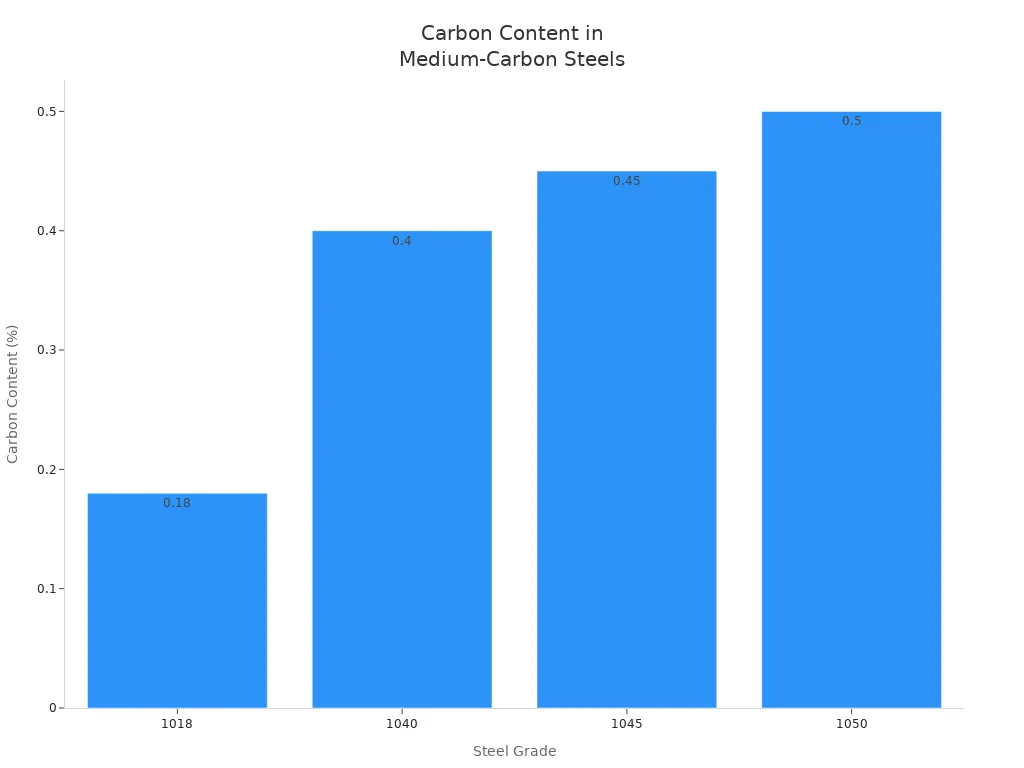
Manganese is another key element. In 1045 carbon steel, manganese ranges from 0.60% to 0.90%. This range helps 1045 steel become tougher and more resistant to wear. The table below shows the typical chemical standards for 1045 carbon steel in different countries:
Country | USA | Europe | China | British | Japan |
|---|---|---|---|---|---|
Standard | ASTM A29 | EN10083-2 | GB/T699 | BS970 | JIS G4051 |
Grade | 1045 | C45/1.0503 | 45# | 080M40 | S45C |
The chemical makeup of 1045 carbon steel affects how you use it. The 0.45% carbon content gives 1045 steel a good balance of strength and flexibility. You can use 1045 carbon steel for parts that need to handle stress but also need to resist breaking. The manganese content, between 0.60% and 0.90%, makes 1045 steel tougher. It also helps the steel resist wear, so you can use 1045 carbon steel in moving parts like gears and shafts.
You will notice that 1045 carbon steel works well in many industries because of this balance. The steel’s composition lets you shape, cut, and heat treat it for different needs. When you choose 1045 steel, you get a material that stands up to heavy use and keeps its shape. This makes 1045 carbon steel a smart choice for engineers and builders who want reliable performance.
You can learn a lot about 1045 steel properties by looking at its physical features. 1045 carbon steel has a density that helps you understand how heavy it is for its size. The density of 1045 steel changes slightly depending on the source, but most values are close. You can see the numbers in the table below:
Source | Density (g/cm³) |
|---|---|
Fushun Special Steel | 7.87 |
Langhe Industry | 7.85 |
Make It From | 7.8 |
When you work with 1045 carbon steel, you need to know its melting point. This tells you how hot the steel must get before it turns into a liquid. Most sources say the melting point starts around 1420 °C and finishes at 1460 °C. Some reports show 1433 °C as a typical value. You can use this information when you plan welding or heat treatment.
The modulus of elasticity is another important part of 1045 steel properties. This value shows how much the steel stretches when you pull on it. 1045 carbon steel has a modulus of elasticity of 200 GPa (29,000 ksi). This is similar to other steels, so you can expect 1045 steel to act like other medium-carbon steels when you bend or stretch it.
You also need to know about hardness. The Brinell hardness for 1045 carbon steel in its normalized condition ranges from 170 to 210. This means 1045 steel can resist dents and scratches better than low-carbon steels. You can use 1045 steel for parts that need to stay strong and keep their shape.
Tip: When you choose 1045 carbon steel, you get a material that is strong, tough, and easy to work with. These physical properties make 1045 steel a smart choice for many projects.
The microstructure of 1045 carbon steel is a key part of 1045 steel properties. You will find two main parts inside the steel: ferrite and pearlite. Ferrite is soft and gives the steel flexibility. Pearlite is harder and adds strength. The mix of ferrite and pearlite helps 1045 steel balance toughness and hardness.
When you heat treat 1045 carbon steel, you can change its microstructure. Annealing makes the steel softer and easier to machine. This is helpful when you need to shape the steel with precision. If you use normalizing, quenching, or tempering, you can make 1045 steel tougher and less brittle. These processes help 1045 steel resist impacts and stay strong in cold conditions.
The medium-carbon content in 1045 carbon steel gives you a balance between hardness and machinability. You can use 1045 steel for parts that need to last a long time and handle stress. This balance is important for gears, shafts, and other parts that must be both durable and precise.
Ferrite gives flexibility.
Pearlite adds strength.
Heat treatment improves toughness and machinability.
You can rely on 1045 steel properties to deliver performance in many situations. The microstructure lets you shape, cut, and treat 1045 carbon steel for different needs. You get a material that stands up to heavy use and keeps its shape.
When you choose 1045 steel, you get a material with strong mechanical properties. These properties help you decide if this steel fits your project. You can see how 1045 steel performs in strength, hardness, toughness, ductility, and weldability.
Tensile strength tells you how much force the steel can handle before it breaks. Yield strength shows when the steel starts to bend or change shape. 1045 steel gives you reliable values for both. You can check the table below for typical numbers:
Type | Value (MPa) | Value (psi) |
|---|---|---|
Ultimate Strength | 565 | 81,900 |
Yield Strength | 310 | 45,000 |
Tensile Strength | 570 - 700 | N/A |
You can see that 1045 steel has a tensile strength between 570 and 700 MPa. The yield strength usually falls between 310 and 500 MPa. These values mean you can use 1045 steel for parts that need to hold up under stress. If you need a material that will not bend or break easily, 1045 steel is a smart choice.
Heat treatment changes these mechanical properties. When you heat and cool 1045 steel in special ways, you can make it stronger or tougher. Quenching and tempering can boost the strength and make the steel harder. Normalizing can also improve the toughness. You can pick the right process for your needs.
Hardness measures how well the steel resists dents and scratches. Toughness shows how well the steel absorbs energy without breaking. 1045 steel gives you a good mix of both. You can use this steel for gears, shafts, and other parts that need to last.
After heat treatment, 1045 steel can reach a hardness of up to 55 HRC. This high hardness makes it great for wear-resistant parts. If you use normalizing, you can increase the toughness by about 26.67%. Quenching makes the steel harder but can lower the toughness by 4%. Annealing makes the steel softer and reduces toughness by 6.67%. You can see how each process changes the mechanical properties:
Quenching: Raises hardness, lowers toughness.
Tempering: Reduces brittleness, improves toughness.
Normalizing: Boosts toughness the most.
Annealing: Makes steel softer, lowers toughness.
Note: You can adjust the mechanical properties of 1045 steel by choosing the right heat treatment. This helps you match the steel to your project.
Ductility means the steel can stretch or bend without breaking. Weldability tells you how easy it is to join pieces together. 1045 steel gives you a good balance of ductility and strength. You can use it for parts that need to flex a little but still stay strong.
1045 carbon steel has about 0.45% carbon. This amount gives you strength and keeps enough ductility for many uses. Compared to other medium-carbon steels, 1045 steel stands out for its good ductility, especially after heat treatment. You can use it for moving parts that face shocks or changing loads. The steel will not break easily under these conditions.
Weldability is fair for 1045 steel. You can weld it, but you need to use the right methods. Preheating and slow cooling help prevent cracks. If you follow these steps, you can join 1045 steel parts safely.
You can count on 1045 steel for reliable mechanical properties. The steel gives you strength, hardness, toughness, and ductility. You can change these properties with heat treatment to fit your needs. This makes 1045 steel a top choice for many engineering projects.
When you look at 1045 steel and 1018 steel, you see some big differences. 1045 steel has more carbon. This gives it higher strength and hardness. You use 1045 steel when you need parts that can handle more stress. 1018 steel has less carbon. It is softer and easier to shape. You pick 1018 steel for parts that need good formability and weldability. If you want to make gears or shafts, 1045 steel works better. For simple parts like brackets or rods, 1018 steel is a good choice.
Now, try comparing 1045 steel with 4140 steel. 4140 steel has more alloying elements like chromium and molybdenum. These elements make 4140 steel stronger and more resistant to wear. You use 4140 steel for heavy-duty parts that face high stress or impact. 1045 steel gives you a balance of strength and toughness. It is easier to machine than 4140 steel. If you need a part that is strong but not too hard to work with, 1045 steel is a smart pick. For parts like axles or crankshafts, both steels work, but 4140 steel handles tougher jobs.
You can see the main differences in the table below. This helps you choose the right steel for your project.
Property | 1018 Steel | 1045 Steel | 4140 Steel |
|---|---|---|---|
Carbon Content | 0.18% | 0.45% | 0.40% |
Strength | Low | Medium | High |
Hardness | Low | Medium | High |
Machinability | High | Good | Moderate |
Weldability | Excellent | Fair | Fair |
Applications | Rods, Brackets | Shafts, Gears | Axles, Crankshafts |
Tip: When comparing 1045 steel to other grades, always think about the job your part must do. This helps you pick the best material for your needs.

You will see 1045 steel in many industries. This material works well for parts that need both strength and toughness. You can use 1045 steel to make gears, shafts, and axles. Many factories choose 1045 steel for bolts, studs, and machine parts. When you need tools that can handle shock, like hammers and axes, 1045 steel is a smart pick. You will also find 1045 steel in automotive parts, such as crankshafts and connecting rods. This steel grade helps you build equipment that lasts a long time and stands up to heavy use.
Tip: If you want a material that can handle stress and wear, 1045 steel gives you reliable performance in moving parts.
Here are some common uses for 1045 steel:
Gears
Shafts
Axles
Bolts
Studs
Machine parts
Hammers
Axes
You can get 1045 steel in many shapes and sizes. This makes it easy to match your project needs. Qilu offers 1045 steel as bars, plates, and forgings. Bars work well for parts that need strength and hardness. Plates give you size accuracy and are good for high-speed machines. Forgings let you create parts with strong grain structure. This process makes 1045 steel even tougher and better at absorbing shocks.
Product Form | Description |
|---|---|
Bars | Used in many applications that need strength and hardness. |
Plates | Offers size accuracy and works well in high-speed uses. |
Forgings | Great for making parts with good forgeability and near-final shapes. |
Qilu can supply 1045 steel in cold drawn bars, hot rolled bars, hot forged bars, and plates. You can also ask for custom shapes and sizes. Qilu’s advanced equipment and skilled team help you get the right 1045 steel for your job.
Note: When you choose 1045 steel from Qilu, you get quality material in the form that fits your project best.
When you pick 1045 steel, you get many good things. Its mechanical properties help with tough jobs. Here are some strengths you will notice:
It has the highest strength and hardness of carbon steels.
It shows great wear resistance and toughness for hard jobs.
The yield strength is about 570-700 MPa. Brinell hardness is between 170-210 HB.
You can change the hardness with heat treatment. This makes 1045 steel good for medium or high-strength uses.
People use 1045 steel in cars, machines, and factory equipment.
It gives a good mix of strength, toughness, and machinability.
It can be surface hardened, so parts last longer.
1045 steel costs less than alloy steels.
It resists wear but still has enough ductility for machining.
Many engineers and makers choose 1045 steel often.
Tip: 1045 steel works well for parts that get used a lot and need to stay strong for a long time.
Here is a table that compares 1045 steel to other medium-carbon and alloy steels:
Attribute | 1045 (Medium Carbon Steel) | 1040 (Medium Carbon Steel) | 1050 (Medium Carbon Steel) | 4140 (Alloy Steel) | 4340 (Alloy Steel) |
|---|---|---|---|---|---|
Tensile Strength (MPa) | 620–850 | 550–750 | 650–900 | 900–1100 | 1000–1300 |
Weldability | Moderate | Good | Low | Moderate | Fair |
Corrosion Resistance | Low | Low | Low | Moderate | Moderate–High |
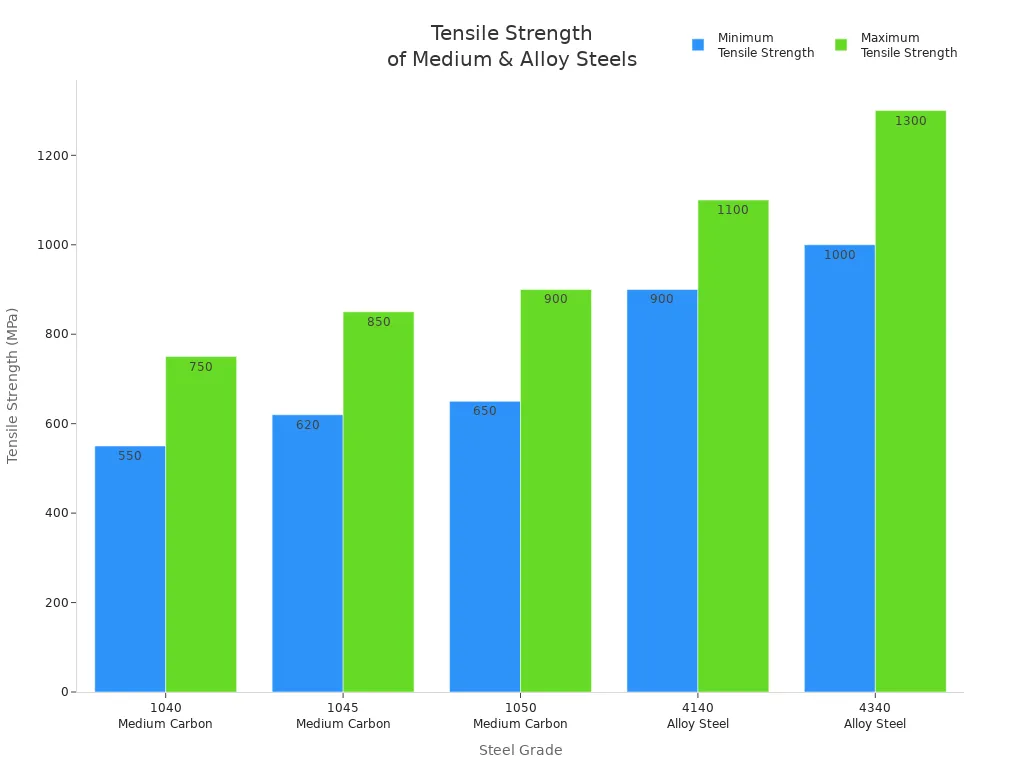
You should know the limits of 1045 steel before you use it. 1045 steel does not resist rust well. If it gets wet or touches chemicals, it can rust. You need to use coatings or treatments to protect it. Welding 1045 steel is harder than welding lower-carbon steels. More carbon means it can crack or bend when welded. You should preheat the steel and use stress relief after welding to help. 1045 steel has medium hardenability. It can get too hot during heat treatment if you are not careful. You need to handle it with care to avoid problems.
Note: You can fix most weaknesses of 1045 steel if you prepare and treat it the right way.
You can count on 1045 steel for a strong mix of toughness, strength, and easy machining. 1045 steel works well in high-stress jobs because it handles wear and keeps its shape. You can use 1045 steel for gears, shafts, and parts that face friction. 1045 steel lets you change its properties with heat treatment, so you get what you need for your project. When you pick 1045 steel, you get a cost-effective choice for many uses.
Check the size and shape of 1045 steel for your job.
Pick 1045 steel when you need high tensile strength.
Think about machinability and wear resistance.
Use 1045 steel for parts under stress or friction.
Choose 1045 steel if you want a reliable material for medium to high strength.
Look at heat treatment options for better performance.
Make sure the surface finish fits your needs.
Balance cost and performance with 1045 steel.
Match 1045 steel properties to your project’s needs.
Trust 1045 steel for parts that must last.
You use 1045 steel for parts that need strength and toughness. Common examples include gears, shafts, axles, and bolts. Many industries choose it for machine parts that must last.
You can weld 1045 steel, but you need to preheat it and cool it slowly. This helps prevent cracks. Always follow proper welding steps for best results.
Property | 1045 Steel | Stainless Steel |
|---|---|---|
Strength | High | Medium-High |
Corrosion | Low | High |
Cost | Lower | Higher |
You get more strength with 1045 steel, but stainless steel resists rust better.
Yes, you can machine 1045 steel with ease. It gives you a smooth finish and holds its shape well. Use sharp tools for best results.
Qilu offers 1045 steel as bars, plates, and forgings. You can ask for cold drawn, hot rolled, or custom sizes to fit your project.