
T: +86-0731-85185770
E: enquiry@qilumetal.com
E: enquiry@qilumetal.com
No. 18 Xiangfu Middle Road,Yuhua District, Changsha City
Views: 0 Author: Site Editor Publish Time: 2026-08-06 Origin: Site


Steel round bar is one of the most widely used semi‑finished metal products for machinery, construction, mining, automotive and heavy‑industry manufacturing. Two dominant production routes are hot‑rolled round bar and forged round bar. Many buyers get confused: which one delivers better toughness? When should I pay extra for forging? Can hot‑rolled replace forged bar? What size limits exist for each process?
This comprehensive guide breaks down everything you need to know about hot rolled and forged steel round bars, helping you make an informed purchasing decision.
A steel round bar is a solid, cylindrical piece of steel that serves as a fundamental raw material across countless industries. Its circular cross-section makes it ideal for applications requiring uniform strength and rotation, such as shafts and axles. Round bars are typically measured by their diameter and are available in a wide range of sizes, from a few millimeters to over 400mm.
They are used in construction for structural support and reinforcement, in the automotive industry for critical components like axles and fasteners, and in general engineering for manufacturing machine parts, gears, and tools.
The primary distinction between a hot rolled and a forged steel round bar lies in how it is shaped.
Hot rolling is a continuous mass‑production method. Steel billets are heated above recrystallization temperature around 1100‑1250°C. The hot billet runs through series rolling mill stands. Repeated roll compression and elongation shape the billet into round bar, then cool down in air or controlled cooling line. The final bar often has a rough, dark "mill scale" surface and slightly less precise dimensional tolerances compared to other methods.
Features: fully continuous production, high hourly output, fast lead time. Metal grains stretch along rolling direction. It is the standard mass‑supply round bar for general‑purpose steel grades.
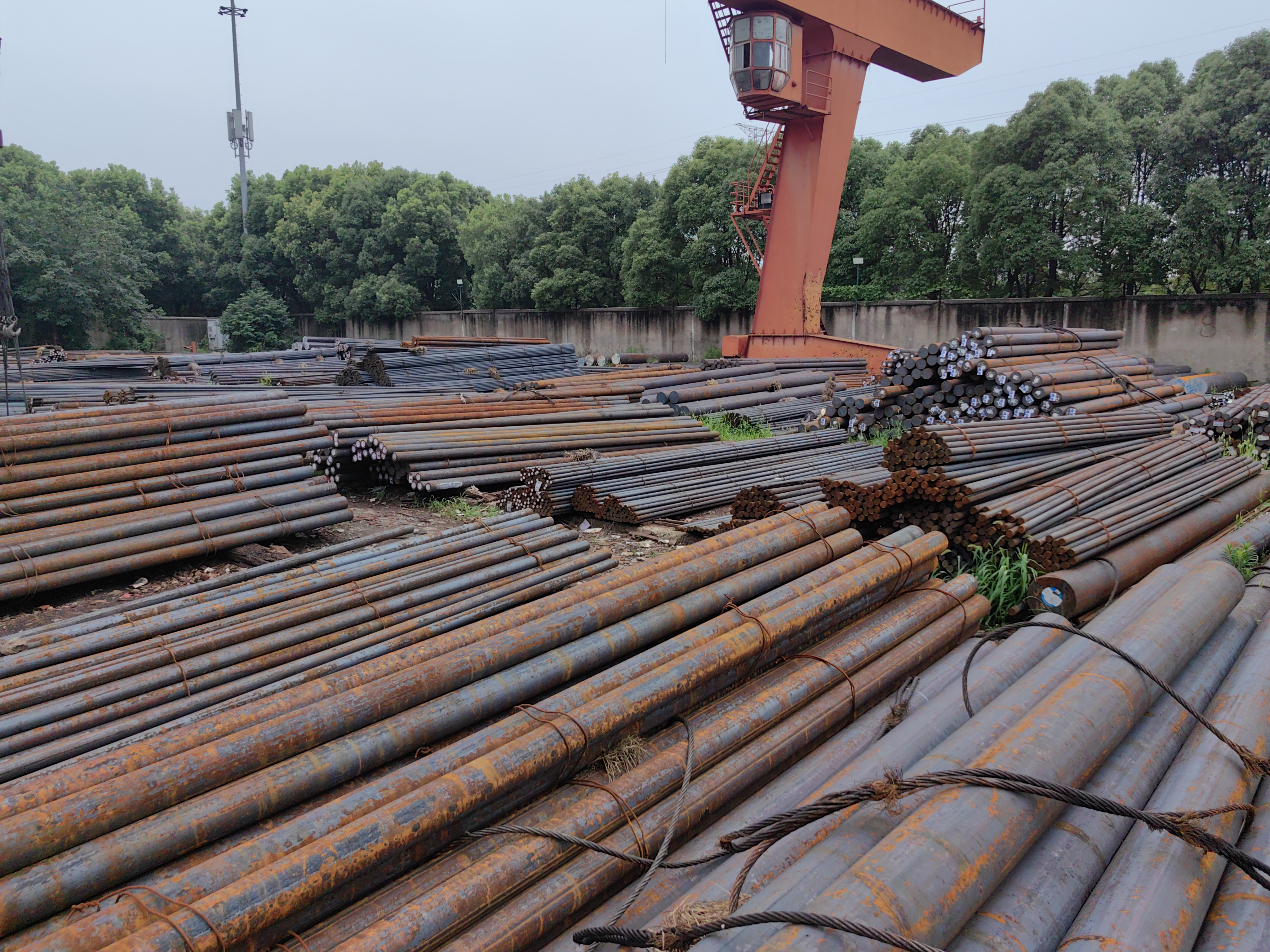
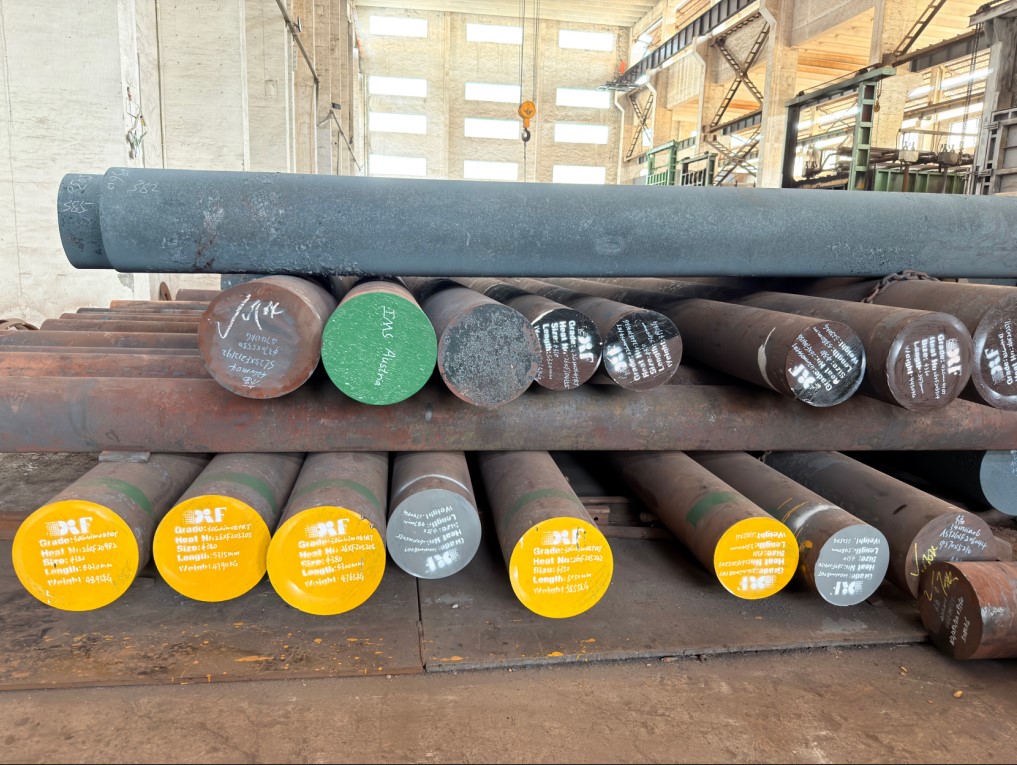
Forging, on the other hand, shapes the heated steel using compressive forces, such as hammering or pressing. This process is more labor-intensive and uses specialized equipment. Forging does more than just shape the metal; it refines its internal grain structure. The mechanical force aligns the grain flow to follow the contour of the bar, eliminating internal voids and creating a denser, stronger product. The resulting surface is typically smoother and more uniform, often supplied in a peeled condition to reduce the need for extensive machining
Features: batch‑type discontinuous production, slower production cycle, more working steps. Forging breaks coarse cast grains and builds continuous forging grain flow following part contour.
| Feature | Hot Rolled Steel Round Bar | Forged Steel Round Bar |
| Manufacturing Process | Heating and passing through rollers | Heating and shaping with compressive force (hammer/press) |
| Grain Structure | Unaligned, standard structure | Aligned and refined grain flow, enhancing strength |
| Strength & Toughness | Good, suitable for general applications | Superior strength, impact resistance, and toughness |
| Surface Finish | Rough, dark, and may have mill scale | Smoother, more uniform; often peeled for precision |
| Dimensional Accuracy | Lower precision; looser tolerances | Higher precision; tighter tolerances |
| Cost | More cost‑effective, especially for high volumes | More expensive due to labor and energy costs |
| Typical Diameter Range | Commonly up to 350mm | Capable of much larger diameters (up to 1000mm or more) |
Grain structure: uniform rolling grain along rolling direction. Minor micro‑porosity and residual stress may remain inside.
Strength & toughness: meets standard mechanical requirements for general engineering use. Good for static load. Fatigue performance is average.
Defect risk: occasional inner segregation, tiny voids inherited from casting billet, which will not affect low‑stress components.
Grain structure: dense and compact metal matrix. Forging action eliminates most internal casting defects. Grain flow distributes continuously following bar shape.
Strength & toughness: for same steel grade and same diameter, tensile strength, yield strength, impact toughness and fatigue resistance are 10%‑30% higher than hot‑rolled counterparts. Great for dynamic load, shock load and high‑pressure working conditions.
Internal soundness: less internal porosity, fewer inclusions, better ultrasonic test passing rate. Forged bars are preferred when UT inspection is required.
Dimension tolerance: wider tolerance range. Normal hot‑rolled tolerance is per EN / ASTM hot‑rolled bar standards. It cannot achieve tight tolerance directly. Usually needs further turning or grinding for precise dimensions.
Surface condition: typical hot‑rolled oxide scale on surface. Surface decarburization layer exists. Surface finish is rough. Pickling or shot blasting can remove scale.
Size range: commonly covers small‑to‑medium diameters, normally from 10 mm up to around 250‑300 mm, depending on mill capacity. Suitable for mass small‑medium size orders.
Dimension tolerance: as forged surface, tolerance is also relatively broad, yet for large diameter heavy bars, forging can produce sizes that hot rolling mills cannot reach. Forged bars still require machining to get finished sizes.
Surface condition: heavy forging oxide skin, possible local surface unevenness. Decarburization layer is also present. Subsequent machining is necessary for finished parts.
Size range: excels at large diameter bars. Can produce 200 mm up to over 1000 mm round bar. Also works for small batch special‑size blanks which hot rolling cannot economically produce. Small‑diameter forged bar is available but costs much higher.
Hot rolled steel round bar: low unit cost. High volume production, short lead time. Supports both large MOQ and regular stock items. Most common carbon and alloy steel grades keep stock in warehouse.
Forged steel round bar: higher price, normally 20%‑60% above hot‑rolled bar for identical grade & size. Longer production lead time due to multi‑heating and forging passes. MOQ is higher for custom forging; stock forged bar options are limited.
Understanding the use cases is key to making the right choice.
Hot rolled round bars are the workhorse of the steel industry, chosen for their cost-effectiveness and adequate mechanical properties for a wide range of applications.
Construction: Structural support, building frameworks, bridges, and reinforcement bars.
Automotive: Axles, shafts, and other critical but less demanding automotive parts.
General Engineering: Manufacturing of machinery components, fasteners, bolts, and general industrial equipment.
Manufacturing: Ideal for producing tools and other general-purpose items where appearance is not a critical factor.
Forged round bars are selected for high-stakes, high-stress applications where failure is not an option.
Oil & Gas: Components used in drilling and extraction equipment that must withstand extreme pressure and corrosive environments.
Aerospace: Critical parts like aircraft engine components, landing gear, and structural elements require the superior strength-to-weight ratio and reliability of forgings.
Heavy Machinery: Large industrial equipment, gears, spindles, and connecting rods where parts are subject to heavy loads and constant vibration.
High-End Automotive: Drive shafts, crankshafts, and other performance-critical powertrain components.
When sourcing steel round bars, ask yourself these questions to ensure you get the right product for your needs.
For general structural work where weldability and cost are key, a hot rolled bar is likely perfect.
For a high-load, high-fatigue application where failure is critical, you need the strength and reliability of a forged bar.
Determine the required strength, hardenability, and corrosion resistance. For example, choose A36 for general fabrication, 1045 for wear resistance, or 8620 for high-strength, quenched and tempered components.
Hot rolled bars are sufficient for rough sizing.
If your project involves precision machining and tight tolerances, a forged (or cold-drawn) bar will be more cost-effective in the long run due to reduced machining time and waste.
Hot rolled bars are more budget-friendly for large volumes.
Be prepared for a higher upfront cost for forged bars, justified by their superior performance.
The choice of grade is crucial. Here are some common grades for each type:
Hot rolled round bars cover a wide range of grades from plain carbon steels to alloy structural steels. 45# steel (equivalent to AISI 1045) is a medium carbon steel widely used for shafts, gears, and fasteners after quenching and tempering. For alloy steels, 40Cr provides good hardenability and wear resistance for automotive shafts and load-bearing components. 20# steel serves as a low-carbon option for cold extrusion and carburizing applications due to its excellent plasticity and weldability.
Forged round bars typically use higher-strength alloy steels to meet demanding requirements for toughness and fatigue resistance. 42CrMo (equivalent to AISI 4140) is one of the most widely used forging grades, offering exceptional strength, hardenability, and toughness for heavy-duty shafts, gears, connecting rods, and oil drill pipe joints. For extreme conditions, 34CrNiMo6 (equivalent to AISI 4340) delivers tensile strength exceeding 890MPa, making it ideal for aerospace landing gear parts and high-stress shafts. GCr15 (equivalent to AISI 52100) is a high-carbon chromium bearing steel that, after forging, achieves dense microstructure and refined grain flow to extend bearing fatigue life.
A1: Not recommended for high‑load dynamic working conditions. If your part only bears static load and no strict UT requirement, hot‑rolled bar works. For shock, cyclic fatigue, high‑pressure service, hot‑rolled bar cannot replace forged bar even with same steel grade chemical composition. Chemical composition is same, but internal grain and defect status create performance gap.
A2: Forged bar has superior internal quality, yet it comes with higher cost and longer lead time. For ordinary static‑load parts, hot‑rolled bar is sufficient and more cost‑effective. “Better” depends on your working condition, inspection requirement and budget.
A3: Hot‑rolled bar may show UT indications from inherited casting micro‑defects. Forged bar gets much better UT pass rate because forging compresses and closes internal voids and shrinkage cavities. Projects requiring 100% ultrasonic inspection mostly specify forged round bar.
A4: Chemical composition stays the same. The difference comes from grain refinement and defect elimination by forging deformation. Forging refines coarse cast grain, improves toughness and strength values.
A5: No. Machining only removes surface material. It cannot change the original internal metal grain and inner defects of hot‑rolled raw bar. Internal performance gap cannot be eliminated by turning or grinding.
A6: Most hot rolling mills cannot handle extra‑large diameters. Forged round bar is the primary solution for heavy large‑size round blanks.
Hot rolled steel round bar is your cost‑effective choice for mass‑production, medium‑small diameter, static‑load applications. Forged steel round bar delivers dense internal structure, higher toughness and fatigue resistance for heavy‑duty, high‑stress, large‑diameter and strict‑inspection projects.
When you source round bars, do not only check steel grade chemistry. Clarify working load, required inspection standard, diameter range and budget, then decide between hot rolled or forged solution.
If you need hot rolled or forged steel round bar quotation, welcome to contact Qilu Steel for grade selection, technical support and reliable supply.