
| Availability: | |
|---|---|
| Quantity: | |
16MnCr5
Qilu
DIN 16MnCr5 (1.7131) is a classic Mn-Cr series low-alloy carburizing steel, renowned for its excellent hardenability, uniform hardness distribution after heat treatment and balanced mechanical properties. It forms a hard surface & tough core structure after carburizing and low-temperature tempering, which perfectly meets the performance requirements of mechanical parts under dynamic load and wear conditions. It has corresponding equivalent grades in major national standard systems worldwide, such as ASTM 5115 in the American standard and 16CrMnH/20CrMnTi in the Chinese standard, and is widely used in automotive manufacturing, mechanical processing, precision mold and other industries.
DIN 16MnCr5 1.7131 has matching alternative grades in the US, European and Chinese standard systems, with close composition and performance, which can be replaced according to actual production and design requirements.
Country | USA | Europe | China |
Standard | ASTM A29 | EN10084 | GB/T3077 |
Grade | 5115 | 16MnCr5/1.7131 | 16CrMnH/20CrMnTi |
The chemical composition of DIN 16MnCr5 1.7131 is precisely optimized to balance hardenability, toughness and machinability, and the impurity content is strictly controlled to ensure the stability of material performance. The detailed comparison with equivalent grades is as follows:
Grade | C | Si | Mn | P | S | Cr |
5115 | 0.13-0.18 | 0.15-0.35 | 0.70-0.90 | 0.035Max | 0.040Max | 0.70-0.90 |
16MnCr5/1.7131 | 0.14-0.19 | 0.40Max | 1.00-1.30 | 0.025Max | 0.035Max | 0.80-1.10 |
20CrMnTi | 0.17-0.23 | 0.17-0.37 | 0.80-1.10 | 0.030Max | 0.030Max | 1.00-1.30 |
The mechanical properties of 16MnCr5 1.7131 show obvious differences with the change of size and heat treatment process. The following are the standard performance indexes specified in EN 10084 and ISO 683-11, which are the core reference for material selection and processing.
Size range | Tensile strength |
d≤16 | 1000Mpa Min |
16<d≤40 | 800Mpa Min |
40<d≤100 | 500Mpa Min |
Size range | Tensile strength | Yield strength | Alongation | Impact value At RT/J |
d=16 | 880-1230Mpa | 600Mpa Min | 9% Min | 25J Min |
d=30 | 770-1120Mpa | 520Mpa Min | 10% Min | 25J Min |
d=63 | 650-1000Mpa | 450Mpa Min | 11% Min | 25J Min |
All test pieces of 16MnCr5 case-hardening steel shall be sampled at 1/4 of the diameter/thickness below the heat-treated surface in accordance with EN 10084; special sampling requirements shall be implemented in accordance with the buyer-seller contract.
The hardness of 16MnCr5 1.7131 can be adjusted according to the processing needs, and the standard hardness range of different heat treatment states is as follows:
Heat Treatment | Hardness |
Treated to improve shearability (+S) | HB255Max |
Soft annealed (+A) | HB207Max |
Treated to hardness range(+TH) | 156-207HBW |
Treated to ferrite-pearlite structure and hardness range(+FP) | 140-187HBW |
Normalized(+N) | 138-187HBW |
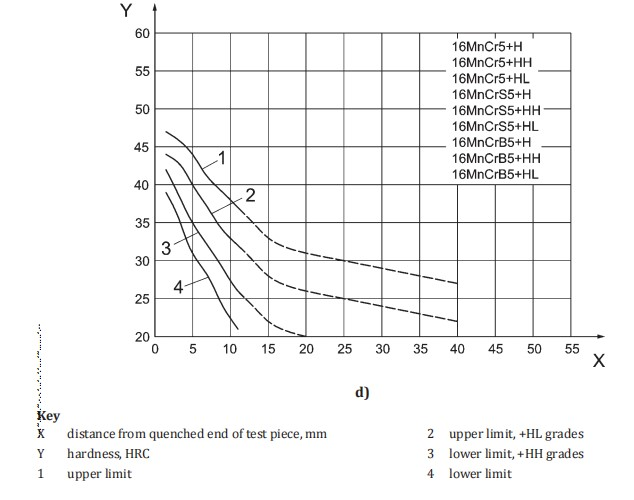
When ordered with normal (+H), high (+HH) or low (+HL) hardenability requirements, the hardness values at different distances from the quenched end meet the following standards (the core index for judging the hardenability of large-section parts):
| Distance in mm from quenched end | ||||||||||||||
Distance | 1.5 | 3 | 5 | 7 | 9 | 11 | 13 | 15 | 20 | 25 | 30 | 35 | 40 | |
Hardness In HRC + H | max | 47 | 46 | 44 | 41 | 39 | 37 | 35 | 33 | 31 | 30 | 29 | 28 | 27 |
min | 39 | 36 | 31 | 28 | 24 | 21 | / | / | / | / | / | / | / | |
Hardness In HRC + HH | max | 47 | 46 | 44 | 41 | 39 | 37 | 35 | 33 | 31 | 30 | 29 | 28 | 27 |
min | 42 | 39 | 35 | 32 | 29 | 26 | 24 | 22 | 20 | / | / | / | / | |
Hardness In HRC + HL | max | 44 | 43 | 40 | 37 | 34 | 32 | 30 | 28 | 26 | 25 | 24 | 23 | 22 |
min | 39 | 36 | 31 | 28 | 24 | 21 | / | / | / | / | / | / | / | |
Scatter bands for the Rockwell - C hardness in the end quench hardenability test.
Qilu Steel provides a full range of 16MnCr5 1.7131 products including hot rolled bar, hot forged bar, hot rolled plate and hot forged block, with complete specifications and stable stock, and can be customized according to customer requirements.
Product type | Size range | Length |
Hot rolled bar | Φ14-Φ280mm | 6000-9000mm |
Hot forged bar | Φ140-Φ1200mm | 3000-5800mm |
Hot rolled plate/sheet | T:20-120mm; W:410-810mm | 2000-5800mm |
Hot Forged block | T: 80-800mm; W: 100-2500mm | 2000-5800mm |
Surface Finish | Turned | Milled | Grinding(Best) | Polished(Best) | Peeled(Best) | Black Forged | Black Rolled |
Tolerance | +0/+3mm | +0/+3mm | +0/+0.05mm | +0/+0.05mm | +0/+0.1mm | +0/+5mm | +0/+1mm |
Straighness | 1mm/1000mm max. | 3mm/1000mm max. | |||||
Monthly stock of hot rolled and forged bars of 16MnCr5 1.7131 exceeds ten thousand tons, with the following regular stock diameters:
14, 16, 18, 20, 22, 25, 28, 30, 32, 35, 38, 40, 42, 45, 50, 55, 60, 65, 70, 75, 80, 85, 90, 95, 100, 105, 110, 115, 120, 130, 140, 150, 160, 170, 180, 190, 200, 210, 220, 230, 240, 250, 260, 270, 280mm
Note : Stock specifications and quantities are updated in real time according to sales and production. For the latest stock information, please contact our sales staff directly.
Forging is the key process to improve the compactness and mechanical properties of 16MnCr5 1.7131. The standard forging process parameters are strictly followed to avoid defects such as internal cracks and loose structure:
Preheating: Put the 16MnCr5 ingot into the furnace and preheat to 600-700℃ (eliminate internal stress, avoid thermal shock).
Heating to initial forging temperature: Continue heating the ingot to 1150-1200℃ and keep warm evenly.
Forging operation: The final forging temperature shall not be lower than 850-900℃ (ensure the plasticity of the steel, avoid cold forging cracks).
Post-forging cooling: Cool in air or furnace (slow cooling to eliminate forging stress, prevent surface cracking).
The heat treatment process of 16MnCr5 1.7131 is designed for its alloy characteristics, and the parameters can be appropriately adjusted according to the part size and performance requirements. The core process and key temperature are as follows:
| Process | Temperature | Cooling Method | Core Purpose |
| Soft Annealing | 790-810℃ | Furnace cooling | Reduce hardness, improve machinability |
| Normalizing | 880-900℃ | Air cooling | Refine grains, eliminate structural defects, prepare for carburizing |
| Process | Temperature Range | Matching Process |
| End Quench Test Austenitizing | 870℃ | Standard hardenability test |
| Carburizing | 880-980℃ | Determine holding time according to carburizing layer depth |
| Core-hardening | 860-900℃ | Match with carburizing process, ensure core strength |
| Case-hardening | 780-820℃ | Ensure surface hardness and wear resistance |
Heating: Heat the steel to 820-850℃ and keep warm evenly (the lower temperature is for water quenching, the upper temperature is for oil quenching).
Quenching: Quench in water or oil (according to part size and deformation requirements).
Tempering: Temper at 150-200℃ in the furnace and keep warm.
Post-tempering cooling: Take out of the furnace and cool in air (eliminate quenching stress, stabilize surface hardness and core toughness).
Remark : The above parameters are for guidance only, and the specific process shall be optimized according to the actual production equipment and part requirements.
16MnCr5 1.7131 has moderate weldability, and its weldability is mainly affected by carbon content and alloy elements (Mn, Cr):
Carbon content is 0.14-0.19% (<0.25%), which avoids serious deterioration of weldability caused by high carbon content.
Mn and Cr elements improve the strength and hardness of steel, but will increase the risk of welding cracks if no protective measures are taken.
Weld before carburizing heat treatment (the weld seam is easy to crack after carburizing).
Preheat the base metal to 150-200℃ before welding (reduce the temperature difference between weld seam and base metal, avoid cold cracks).
Adopt slow cooling after welding (eliminate welding stress).
Complex welding structures are not recommended; priority is given to mechanical connection for high-load parts.
16MnCr5/1.7131 is often compared with mainstream carburizing steels such as 20CrMnTi, ASTM 5115, 20CrNiMo (1.6582) and 15CrMn in material selection. The following is a comprehensive comparison from the aspects of composition, performance, cost and application, to provide a clear material selection reference for different production needs:
| Comparison Index | 16MnCr5/1.7131 | ASTM 5115 | 20CrMnTi | 20CrNiMo (1.6582) | 15CrMn |
| Core Alloy System | Mn-Cr | Mn-Cr | Mn-Cr-Ti | Cr-Ni-Mo | Mn-Cr |
| Carbon Content (%) | 0.14-0.19 | 0.13-0.18 | 0.17-0.23 | 0.17-0.23 | 0.12-0.18 |
| Hardenability | Excellent (oil-quenching diameter ≥30mm) | Good (oil-quenching diameter ≥25mm) | Excellent (Ti-refined grains) | Superb (Ni-Mo synergism, ≥40mm) | General (oil-quenching diameter ≥20mm) |
| Surface Hardness (HRC) after carburizing | 58-62 | 56-60 | 58-64 | 60-64 | 55-59 |
| Core Toughness (Impact Value at RT) | ≥25J | ≥22J | ≥28J | ≥40J (super high) | ≥20J |
| Heat Treatment Deformation | Small (≤0.05mm) | Small | Extremely small (Ti element) | Small | General |
| Machinability | Excellent (HB≤207 after annealing) | Good | Good (slight sticking knife) | General (high alloy content) | Excellent (low carbon) |
| Raw Material Cost | Medium | Medium-Low | Medium | High (Ni/Mo alloy) | Low |
| Key Advantages | Balanced performance, strict impurity control, good low-temperature toughness | Wide component tolerance, easy procurement | Ultra-low deformation, suitable for precision parts | Super high core toughness, heavy load resistance | Low cost, suitable for light load parts |
| Typical Application | Gears, worm gears, bushings, plastic molds, low-temperature parts | General mechanical gears, ordinary shafts, non-precision bushings | High-precision automotive gears, synchronizer rings, precision drive shafts | Heavy-duty gears, wind power parts, high-load engineering machinery | Light-load gears, small shafts, low-precision accessories |
| Replacement Suggestion | Can replace ASTM5115/15CrMn for medium/high load | Replaceable for light/medium load 16MnCr5 | Alternative for 16MnCr5 (precision parts) | Irreplaceable for 16MnCr5 (only for heavy load) | Only replaceable for light load 16MnCr5 |
16MnCr5 1.7131 is widely used in various industries due to its excellent carburizing performance, good hardenability and balanced "hard surface & tough core" mechanical properties, and is the core material for manufacturing parts bearing dynamic loads, wear and impact:
Gear Manufacturing : Automobile, construction machinery and industrial equipment gears, worm gears, differential gears, synchronizer gear rings and other core transmission parts.
Automotive Industry : Drive shafts, gasoline bushings, turbine oil seals, hub bearing rings and other automotive core parts requiring high strength and wear resistance.
Mechanical Manufacturing : High-load mechanical parts such as bearings, pin shafts, couplings, camshafts and clutch plates.
Mold & Tool Industry : Plastic molds (especially high glass fiber reinforced plastic injection molds), sealing bushings, chain rollers and other precision accessories requiring high surface hardness and wear resistance.
Heavy Equipment Industry : Key parts of mining machinery, agricultural machinery and heavy engineering machinery requiring high strength and wear resistance.
Low-Temperature Equipment : Transmission parts and sealing components of low-temperature industrial equipment (-40℃~200℃) due to good low-temperature toughness.
A1: The two are core equivalent grades of Mn-Cr carburizing steel, with the same application scenario. The slight difference is in chemical composition: 16MnCr5 has higher Mn (1.00-1.30%) and Cr (0.80-1.10%) content and stricter P/S control, with better hardenability and low-temperature toughness; ASTM 5115 has wider component tolerance, lower procurement cost and is more suitable for general mechanical parts. The two can be completely replaced for ordinary parts, and the original design grade is recommended for high-precision parts.
A2: Yes, 20CrMnTi is the most common Chinese standard alternative grade for 16MnCr5. 20CrMnTi contains Ti element, which can refine grains and reduce heat treatment deformation to the minimum, more suitable for high-precision automotive gears and ultra-precision transmission parts; 16MnCr5 has better low-temperature toughness and higher Mn content, more suitable for low-temperature working condition parts and large-section medium-load parts. The replacement can be determined according to part precision, working condition and production cost.
A3: The carburizing layer depth is determined according to the working load of the parts: light-load parts (sealing bushings, small gears) are 0.5-0.8mm; medium-load parts (transmission gears, worm gears) are 0.8-1.2mm; heavy-load parts (engineering machinery gears, drive shafts) are 1.2-2.0mm. The holding time of carburizing process is adjusted according to the required depth (generally 1h for 0.2mm depth).
A4: The soft annealing state (+A, HB≤207) has the best cutting performance, with no obvious sticking knife and edge collapse during processing. It is recommended to use cemented carbide cutting tools, control the cutting speed at 80-120m/min, and add emulsified cutting fluid to avoid workpiece overheating and improve the surface finish of parts (up to Ra1.6μm after fine processing).
A5: The choice of quenching medium is based on part size and deformation requirements: small parts (d≤30mm) with low deformation requirements can use water quenching (heating temperature 820-830℃) to ensure hardenability; medium and large parts (d>30mm) or high-precision parts with strict deformation requirements use oil quenching (heating temperature 830-850℃), which can reduce quenching deformation to ≤0.05mm while ensuring the hardenability of large-section parts.
A6: 20CrNiMo has super high core toughness and hardenability, but the raw material cost is much higher (about 30% higher than 16MnCr5). Choose 16MnCr5 for medium-load, normal temperature/low temperature, general precision parts (such as ordinary gears, bushings, plastic molds), which has high cost performance; choose 20CrNiMo only for heavy-load, high-impact, ultra-large section parts (such as wind power gears, heavy engineering machinery transmission parts) where 16MnCr5 cannot meet the toughness requirements.
Inquire Now: Qilu Steel has a stable supply of 16MnCr5 1.7131 with complete specifications and can provide personalized processing services such as cutting, forging, heat treatment and surface finishing according to customer requirements.
DIN 16MnCr5 (1.7131) is a classic Mn-Cr series low-alloy carburizing steel, renowned for its excellent hardenability, uniform hardness distribution after heat treatment and balanced mechanical properties. It forms a hard surface & tough core structure after carburizing and low-temperature tempering, which perfectly meets the performance requirements of mechanical parts under dynamic load and wear conditions. It has corresponding equivalent grades in major national standard systems worldwide, such as ASTM 5115 in the American standard and 16CrMnH/20CrMnTi in the Chinese standard, and is widely used in automotive manufacturing, mechanical processing, precision mold and other industries.
DIN 16MnCr5 1.7131 has matching alternative grades in the US, European and Chinese standard systems, with close composition and performance, which can be replaced according to actual production and design requirements.
Country | USA | Europe | China |
Standard | ASTM A29 | EN10084 | GB/T3077 |
Grade | 5115 | 16MnCr5/1.7131 | 16CrMnH/20CrMnTi |
The chemical composition of DIN 16MnCr5 1.7131 is precisely optimized to balance hardenability, toughness and machinability, and the impurity content is strictly controlled to ensure the stability of material performance. The detailed comparison with equivalent grades is as follows:
Grade | C | Si | Mn | P | S | Cr |
5115 | 0.13-0.18 | 0.15-0.35 | 0.70-0.90 | 0.035Max | 0.040Max | 0.70-0.90 |
16MnCr5/1.7131 | 0.14-0.19 | 0.40Max | 1.00-1.30 | 0.025Max | 0.035Max | 0.80-1.10 |
20CrMnTi | 0.17-0.23 | 0.17-0.37 | 0.80-1.10 | 0.030Max | 0.030Max | 1.00-1.30 |
The mechanical properties of 16MnCr5 1.7131 show obvious differences with the change of size and heat treatment process. The following are the standard performance indexes specified in EN 10084 and ISO 683-11, which are the core reference for material selection and processing.
Size range | Tensile strength |
d≤16 | 1000Mpa Min |
16<d≤40 | 800Mpa Min |
40<d≤100 | 500Mpa Min |
Size range | Tensile strength | Yield strength | Alongation | Impact value At RT/J |
d=16 | 880-1230Mpa | 600Mpa Min | 9% Min | 25J Min |
d=30 | 770-1120Mpa | 520Mpa Min | 10% Min | 25J Min |
d=63 | 650-1000Mpa | 450Mpa Min | 11% Min | 25J Min |
All test pieces of 16MnCr5 case-hardening steel shall be sampled at 1/4 of the diameter/thickness below the heat-treated surface in accordance with EN 10084; special sampling requirements shall be implemented in accordance with the buyer-seller contract.
The hardness of 16MnCr5 1.7131 can be adjusted according to the processing needs, and the standard hardness range of different heat treatment states is as follows:
Heat Treatment | Hardness |
Treated to improve shearability (+S) | HB255Max |
Soft annealed (+A) | HB207Max |
Treated to hardness range(+TH) | 156-207HBW |
Treated to ferrite-pearlite structure and hardness range(+FP) | 140-187HBW |
Normalized(+N) | 138-187HBW |
When ordered with normal (+H), high (+HH) or low (+HL) hardenability requirements, the hardness values at different distances from the quenched end meet the following standards (the core index for judging the hardenability of large-section parts):
| Distance in mm from quenched end | ||||||||||||||
Distance | 1.5 | 3 | 5 | 7 | 9 | 11 | 13 | 15 | 20 | 25 | 30 | 35 | 40 | |
Hardness In HRC + H | max | 47 | 46 | 44 | 41 | 39 | 37 | 35 | 33 | 31 | 30 | 29 | 28 | 27 |
min | 39 | 36 | 31 | 28 | 24 | 21 | / | / | / | / | / | / | / | |
Hardness In HRC + HH | max | 47 | 46 | 44 | 41 | 39 | 37 | 35 | 33 | 31 | 30 | 29 | 28 | 27 |
min | 42 | 39 | 35 | 32 | 29 | 26 | 24 | 22 | 20 | / | / | / | / | |
Hardness In HRC + HL | max | 44 | 43 | 40 | 37 | 34 | 32 | 30 | 28 | 26 | 25 | 24 | 23 | 22 |
min | 39 | 36 | 31 | 28 | 24 | 21 | / | / | / | / | / | / | / | |
Scatter bands for the Rockwell - C hardness in the end quench hardenability test.

Qilu Steel provides a full range of 16MnCr5 1.7131 products including hot rolled bar, hot forged bar, hot rolled plate and hot forged block, with complete specifications and stable stock, and can be customized according to customer requirements.
Product type | Size range | Length |
Hot rolled bar | Φ14-Φ280mm | 6000-9000mm |
Hot forged bar | Φ140-Φ1200mm | 3000-5800mm |
Hot rolled plate/sheet | T:20-120mm; W:410-810mm | 2000-5800mm |
Hot Forged block | T: 80-800mm; W: 100-2500mm | 2000-5800mm |
Surface Finish | Turned | Milled | Grinding(Best) | Polished(Best) | Peeled(Best) | Black Forged | Black Rolled |
Tolerance | +0/+3mm | +0/+3mm | +0/+0.05mm | +0/+0.05mm | +0/+0.1mm | +0/+5mm | +0/+1mm |
Straighness | 1mm/1000mm max. | 3mm/1000mm max. | |||||
Monthly stock of hot rolled and forged bars of 16MnCr5 1.7131 exceeds ten thousand tons, with the following regular stock diameters:
14, 16, 18, 20, 22, 25, 28, 30, 32, 35, 38, 40, 42, 45, 50, 55, 60, 65, 70, 75, 80, 85, 90, 95, 100, 105, 110, 115, 120, 130, 140, 150, 160, 170, 180, 190, 200, 210, 220, 230, 240, 250, 260, 270, 280mm
Note : Stock specifications and quantities are updated in real time according to sales and production. For the latest stock information, please contact our sales staff directly.
Forging is the key process to improve the compactness and mechanical properties of 16MnCr5 1.7131. The standard forging process parameters are strictly followed to avoid defects such as internal cracks and loose structure:
Preheating: Put the 16MnCr5 ingot into the furnace and preheat to 600-700℃ (eliminate internal stress, avoid thermal shock).
Heating to initial forging temperature: Continue heating the ingot to 1150-1200℃ and keep warm evenly.
Forging operation: The final forging temperature shall not be lower than 850-900℃ (ensure the plasticity of the steel, avoid cold forging cracks).
Post-forging cooling: Cool in air or furnace (slow cooling to eliminate forging stress, prevent surface cracking).
The heat treatment process of 16MnCr5 1.7131 is designed for its alloy characteristics, and the parameters can be appropriately adjusted according to the part size and performance requirements. The core process and key temperature are as follows:
| Process | Temperature | Cooling Method | Core Purpose |
| Soft Annealing | 790-810℃ | Furnace cooling | Reduce hardness, improve machinability |
| Normalizing | 880-900℃ | Air cooling | Refine grains, eliminate structural defects, prepare for carburizing |
| Process | Temperature Range | Matching Process |
| End Quench Test Austenitizing | 870℃ | Standard hardenability test |
| Carburizing | 880-980℃ | Determine holding time according to carburizing layer depth |
| Core-hardening | 860-900℃ | Match with carburizing process, ensure core strength |
| Case-hardening | 780-820℃ | Ensure surface hardness and wear resistance |
Heating: Heat the steel to 820-850℃ and keep warm evenly (the lower temperature is for water quenching, the upper temperature is for oil quenching).
Quenching: Quench in water or oil (according to part size and deformation requirements).
Tempering: Temper at 150-200℃ in the furnace and keep warm.
Post-tempering cooling: Take out of the furnace and cool in air (eliminate quenching stress, stabilize surface hardness and core toughness).
Remark : The above parameters are for guidance only, and the specific process shall be optimized according to the actual production equipment and part requirements.
16MnCr5 1.7131 has moderate weldability, and its weldability is mainly affected by carbon content and alloy elements (Mn, Cr):
Carbon content is 0.14-0.19% (<0.25%), which avoids serious deterioration of weldability caused by high carbon content.
Mn and Cr elements improve the strength and hardness of steel, but will increase the risk of welding cracks if no protective measures are taken.
Weld before carburizing heat treatment (the weld seam is easy to crack after carburizing).
Preheat the base metal to 150-200℃ before welding (reduce the temperature difference between weld seam and base metal, avoid cold cracks).
Adopt slow cooling after welding (eliminate welding stress).
Complex welding structures are not recommended; priority is given to mechanical connection for high-load parts.
16MnCr5/1.7131 is often compared with mainstream carburizing steels such as 20CrMnTi, ASTM 5115, 20CrNiMo (1.6582) and 15CrMn in material selection. The following is a comprehensive comparison from the aspects of composition, performance, cost and application, to provide a clear material selection reference for different production needs:
| Comparison Index | 16MnCr5/1.7131 | ASTM 5115 | 20CrMnTi | 20CrNiMo (1.6582) | 15CrMn |
| Core Alloy System | Mn-Cr | Mn-Cr | Mn-Cr-Ti | Cr-Ni-Mo | Mn-Cr |
| Carbon Content (%) | 0.14-0.19 | 0.13-0.18 | 0.17-0.23 | 0.17-0.23 | 0.12-0.18 |
| Hardenability | Excellent (oil-quenching diameter ≥30mm) | Good (oil-quenching diameter ≥25mm) | Excellent (Ti-refined grains) | Superb (Ni-Mo synergism, ≥40mm) | General (oil-quenching diameter ≥20mm) |
| Surface Hardness (HRC) after carburizing | 58-62 | 56-60 | 58-64 | 60-64 | 55-59 |
| Core Toughness (Impact Value at RT) | ≥25J | ≥22J | ≥28J | ≥40J (super high) | ≥20J |
| Heat Treatment Deformation | Small (≤0.05mm) | Small | Extremely small (Ti element) | Small | General |
| Machinability | Excellent (HB≤207 after annealing) | Good | Good (slight sticking knife) | General (high alloy content) | Excellent (low carbon) |
| Raw Material Cost | Medium | Medium-Low | Medium | High (Ni/Mo alloy) | Low |
| Key Advantages | Balanced performance, strict impurity control, good low-temperature toughness | Wide component tolerance, easy procurement | Ultra-low deformation, suitable for precision parts | Super high core toughness, heavy load resistance | Low cost, suitable for light load parts |
| Typical Application | Gears, worm gears, bushings, plastic molds, low-temperature parts | General mechanical gears, ordinary shafts, non-precision bushings | High-precision automotive gears, synchronizer rings, precision drive shafts | Heavy-duty gears, wind power parts, high-load engineering machinery | Light-load gears, small shafts, low-precision accessories |
| Replacement Suggestion | Can replace ASTM5115/15CrMn for medium/high load | Replaceable for light/medium load 16MnCr5 | Alternative for 16MnCr5 (precision parts) | Irreplaceable for 16MnCr5 (only for heavy load) | Only replaceable for light load 16MnCr5 |
16MnCr5 1.7131 is widely used in various industries due to its excellent carburizing performance, good hardenability and balanced "hard surface & tough core" mechanical properties, and is the core material for manufacturing parts bearing dynamic loads, wear and impact:
Gear Manufacturing : Automobile, construction machinery and industrial equipment gears, worm gears, differential gears, synchronizer gear rings and other core transmission parts.
Automotive Industry : Drive shafts, gasoline bushings, turbine oil seals, hub bearing rings and other automotive core parts requiring high strength and wear resistance.
Mechanical Manufacturing : High-load mechanical parts such as bearings, pin shafts, couplings, camshafts and clutch plates.
Mold & Tool Industry : Plastic molds (especially high glass fiber reinforced plastic injection molds), sealing bushings, chain rollers and other precision accessories requiring high surface hardness and wear resistance.
Heavy Equipment Industry : Key parts of mining machinery, agricultural machinery and heavy engineering machinery requiring high strength and wear resistance.
Low-Temperature Equipment : Transmission parts and sealing components of low-temperature industrial equipment (-40℃~200℃) due to good low-temperature toughness.
A1: The two are core equivalent grades of Mn-Cr carburizing steel, with the same application scenario. The slight difference is in chemical composition: 16MnCr5 has higher Mn (1.00-1.30%) and Cr (0.80-1.10%) content and stricter P/S control, with better hardenability and low-temperature toughness; ASTM 5115 has wider component tolerance, lower procurement cost and is more suitable for general mechanical parts. The two can be completely replaced for ordinary parts, and the original design grade is recommended for high-precision parts.
A2: Yes, 20CrMnTi is the most common Chinese standard alternative grade for 16MnCr5. 20CrMnTi contains Ti element, which can refine grains and reduce heat treatment deformation to the minimum, more suitable for high-precision automotive gears and ultra-precision transmission parts; 16MnCr5 has better low-temperature toughness and higher Mn content, more suitable for low-temperature working condition parts and large-section medium-load parts. The replacement can be determined according to part precision, working condition and production cost.
A3: The carburizing layer depth is determined according to the working load of the parts: light-load parts (sealing bushings, small gears) are 0.5-0.8mm; medium-load parts (transmission gears, worm gears) are 0.8-1.2mm; heavy-load parts (engineering machinery gears, drive shafts) are 1.2-2.0mm. The holding time of carburizing process is adjusted according to the required depth (generally 1h for 0.2mm depth).
A4: The soft annealing state (+A, HB≤207) has the best cutting performance, with no obvious sticking knife and edge collapse during processing. It is recommended to use cemented carbide cutting tools, control the cutting speed at 80-120m/min, and add emulsified cutting fluid to avoid workpiece overheating and improve the surface finish of parts (up to Ra1.6μm after fine processing).
A5: The choice of quenching medium is based on part size and deformation requirements: small parts (d≤30mm) with low deformation requirements can use water quenching (heating temperature 820-830℃) to ensure hardenability; medium and large parts (d>30mm) or high-precision parts with strict deformation requirements use oil quenching (heating temperature 830-850℃), which can reduce quenching deformation to ≤0.05mm while ensuring the hardenability of large-section parts.
A6: 20CrNiMo has super high core toughness and hardenability, but the raw material cost is much higher (about 30% higher than 16MnCr5). Choose 16MnCr5 for medium-load, normal temperature/low temperature, general precision parts (such as ordinary gears, bushings, plastic molds), which has high cost performance; choose 20CrNiMo only for heavy-load, high-impact, ultra-large section parts (such as wind power gears, heavy engineering machinery transmission parts) where 16MnCr5 cannot meet the toughness requirements.
Inquire Now: Qilu Steel has a stable supply of 16MnCr5 1.7131 with complete specifications and can provide personalized processing services such as cutting, forging, heat treatment and surface finishing according to customer requirements.