
T: +86-0731-85185770
E: enquiry@qilumetal.com
E: enquiry@qilumetal.com
No. 18 Xiangfu Middle Road,Yuhua District, Changsha City
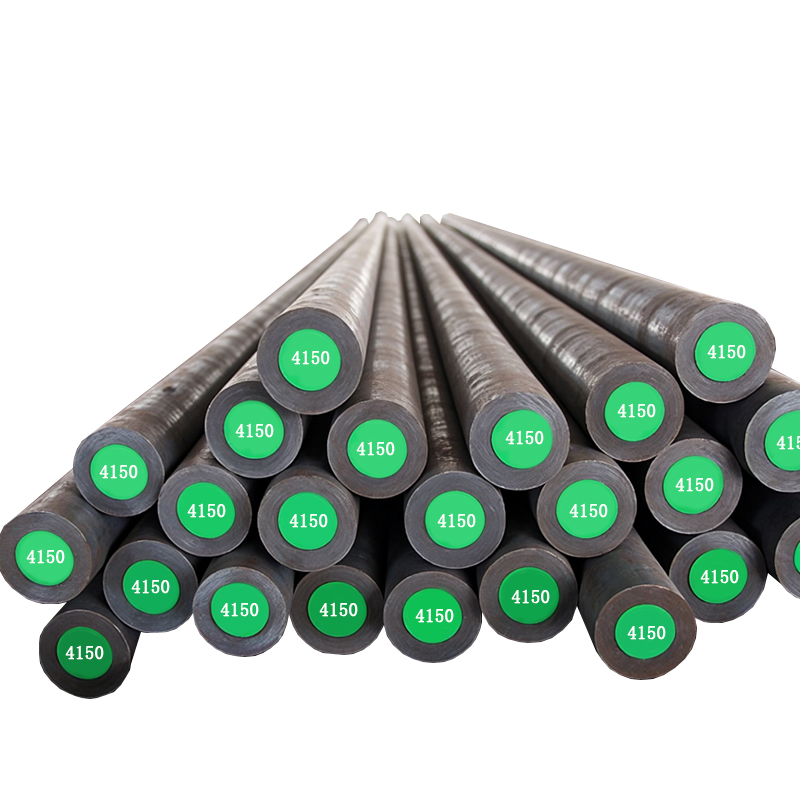 |


Grade: DIN 50CrMo4/1.7228
Equivalent Steel: ASTM 4150, GB 50CrMo
DIN 50CrMo4 (Material Number 1.7228) is a high-grade quenched and tempered alloy steel defined by a precise chromium-molybdenum composition. Its chemistry features a carbon content of 0.46-0.54%, which provides the core hardness and strength after heat treatment. Key alloying elements include chromium (0.90-1.20%) for enhanced hardenability and corrosion resistance, and molybdenum (0.15-0.30%) to refine grain structure and maintain material toughness at elevated temperatures. With low residual elements like phosphorus (≤0.025%) and sulfur (≤0.035%) per EN 10083-3, this composition ensures excellent internal cleanliness, fatigue resistance, and uniform response to quenching and tempering, making it ideal for highly stressed engineering components.
| Quantity: | |
|---|---|
4150
Qilu
AISI 4150 and its European equivalent DIN 50CrMo4 (Material Number 1.7228) are premium chromium-molybdenum (Cr-Mo) alloy steels, specifically designed for quenching and tempering. This process unlocks exceptional mechanical properties, making it the material of choice for critical components in automotive, heavy machinery, aerospace, and oil & gas industries where high stress, fatigue, and wear resistance are paramount.
As a specialized manufacturer, Hunan Qilu Steel provides this versatile alloy in a wide range of forms—including hot-rolled bars, cold-drawn bars, and custom open-die forgings—with over 10,000 tons in stock. Our material conforms to major international standards like EN 10083-3, EN 10250-3, and ASTM A29/A29M, ensuring seamless integration into global supply chains.
Country | USA | Europe | China |
Standard | ASTM A29 | EN10083-3 | GB/T3077 |
Grade | 4150 | 50CrMo4/1.7228 | 50CrMo |
Grade | C | Si | Mn | P | S | Cr | Mo |
4150 | 0.48-0.53 | 0.15-0.35 | 0.75-1.00 | 0.035Max | 0.040Max | 0.80-1.10 | 0.15-0.25 |
50CrMo4/1.7228 | 0.46-0.54 | 0.40Max | 0.50-0.80 | 0.025Max | 0.035Max | 0.90-1.20 | 0.15-0.30 |
50CrMo | 0.46-0.54 | 0.17-0.37 | 0.50-0.80 | 0.030Max | 0.030Max | 0.90-1.20 | 0.15-0.30 |
Key Highlight: DIN 50CrMo4 1.7228 features a wider molybdenum range (0.15-0.30%) than AISI 4150, making it more suitable for high-temperature applications such as industrial furnace components and exhaust systems.
Mechanical performance scales with material size, optimized for versatility across precision small parts and heavy-duty large components. All values comply with EN 10083-3 & EN 10250-3 standards, with sampling conducted 12.5mm below the heat-treated surface (per EN 10083-1).
Mechanical properties for 50CrMo4 quenching and tempering alloy steel according to EN10083-3.
Size range | Tensile strength | Yield strength | Alongation | Area of reduction | Impact value At RT/J |
d≤16 t≤8 | 1100-1300Mpa | 900Mpa Min | 9% Min | 40% Min | / |
16<d≤40 8<t≤20 | 1000-1200Mpa | 780Mpa Min | 10% Min | 45%Min | 30J Min |
40<d≤100 20<t≤60 | 900-1100Mpa | 700Mpa Min | 12% Min | 50%Min | 30J Min |
100<d≤160 60<t≤100 | 850-1000Mpa | 650Mpa Min | 13% Min | 50%Min | 30J Min |
160<d≤250 100<t≤160 | 800-950Mpa | 550Mpa Min | 13% Min | 50%Min | 30J Min |
Longitudinal (L) and transverse (Tr) properties are optimized for uniform performance across forging orientations, with sampling at 4/T below the surface (20mm min, 80mm max).
Size range | Tensile strength | Yield strength | Alongation | Impact value at RT/J | ||
L | Tr | L | Tr | |||
d≤160 | 800Mpa Min | 550Mpa Min | 13% Min | 9% Min | 25J Min | 14J Min |
160<d≤330 | 750Mpa Min | 540Mpa Min | 14% Min | 10% Min | 20J Min | 12J Min |
330<d≤660 | 700Mpa Min | 490Mpa Min | 15% Min | 11% Min | 15J Min | 10J Min |
50CrMo4 responds exceptionally well to heat treatment, allowing precise customization of hardness and toughness for specific use cases. Hardenability is consistent across sizes, with restricted grade options (+HL, +HH) for strict industrial applications.
| Process | Temperature Range | Cooling Method | Hardness Result | Core Application |
| Soft Annealing (+A) | 820-860℃ | Furnace-cooled | HB ≤248 | Pre-machining (reduces tool wear) |
| Normalizing (+H) | 850-900℃ | Air-cooled | Refined grain structure | Improves machinability/forgability |
| Quenching & Tempering (+QT) | 820-870℃ (soak) | Oil-quenched → 540-680℃ temper (air-cooled) | HRC 28-32 (common) | Balanced strength/ductility for most structural parts |
| Flame/Induction Hardening | 850-900℃ (surface only) | Local quench → 180-220℃ light temper | HRC ≤58 | Surface wear resistance (gear teeth, bearing surfaces) |
For critical thick-component applications, restricted hardenability grades ensure deep, uniform hardening:
+HH Grade: Minimum HRC 42 at 50mm from the quenched end (ideal for heavy forgings)
+HL Grade: Lower hardenability for precision machining with minimal distortion
+H Grade: Standard hardenability for general industrial use
Detailed hardenability values (HRC) at different distances from the quenched end are available in our technical datasheet (request via sales team).
Distance in mm from quenched end | ||||||||||||||||
Distance | 1.5 | 3 | 5 | 7 | 9 | 11 | 13 | 15 | 20 | 25 | 30 | 35 | 40 | 45 | 50 | |
Hardness In HRC + H | max | 65 | 65 | 64 | 64 | 63 | 63 | 63 | 62 | 61 | 60 | 58 | 57 | 55 | 54 | 54 |
min | 58 | 58 | 57 | 55 | 54 | 53 | 51 | 48 | 45 | 41 | 39 | 38 | 37 | 36 | 36 | |
Hardness In HRC + HH | max | 65 | 65 | 64 | 64 | 63 | 63 | 63 | 62 | 61 | 60 | 58 | 57 | 55 | 54 | 54 |
min | 60 | 60 | 59 | 58 | 57 | 56 | 55 | 53 | 50 | 47 | 45 | 44 | 43 | 42 | 42 | |
Hardness In HRC + HL | max | 63 | 63 | 62 | 61 | 60 | 60 | 59 | 57 | 56 | 54 | 52 | 51 | 49 | 48 | 48 |
min | 58 | 58 | 57 | 55 | 54 | 53 | 51 | 48 | 45 | 41 | 39 | 38 | 37 | 36 | 36 | |
Scatter bands for the Rockwell - C hardness in the end quench hardenability test.

We offer a comprehensive range of product forms to match diverse manufacturing workflows, with tight tolerances for precision applications and cost-effective options for large-scale production. Real-time stock updates are available for all standard sizes.
Product type | Size range | Length |
Cold drawn bar | Φ3-Φ80mm | 6000-9000mm |
Hot rolled bar | Φ16-Φ310mm | 6000-9000mm |
Hot forged bar | Φ100-Φ1200mm | 3000-5800mm |
Hot rolled plate/sheet | T:3-200mm; W:1500-2500mm | 2000-5800mm |
Hot Forged block | T: 80-800mm; W: 100-2500mm | 2000-5800mm |
Surface Finish | Turned | Milled | Grinding(Best) | Polished(Best) | Peeled(Best) | Black Forged | Black Rolled |
Tolerance | +0/+3mm | +0/+3mm | +0/+0.05mm | +0/+0.05mm | +0/+0.1mm | +0/+5mm | +0/+1mm |
Straighness | 1mm/1000mm max. | 3mm/1000mm max. | |||||
Hot Rolled Bar Sizes:
20, 22, 25, 28, 30, 32, 35, 40, 45, 50, 55, 60, 65, 70, 75, 80, 85, 90, 95, 100, 110, 120mm
In China, most of clients will use 42CrMo4 instead of 50CrMo4, so the stocks for 50CrMo4 is small.
DIN 50CrMo4 is a versatile alloy steel trusted for critical components where high strength, fatigue resistance, and heat stability are non-negotiable. Its applications are tailored to leverage its core mechanical properties across key industries:
Powertrain: Crankshafts, camshafts, and drive shafts (high fatigue resistance: ≥30J impact value at RT prevents cyclic load cracking)
Suspension: Torsion bars, connecting rods, and universal joints (HRC 28-32 hardness absorbs road vibrations without deformation)
Differentials: Gear sets and axle shafts (flame-hardened surfaces up to HRC 58 resist wear from constant meshing)
Hydraulic Systems: High-pressure cylinders and piston rods (700Mpa min yield strength prevents bursting under extreme pressure)
Mining Equipment: Connector pins, gearboxes, and drill bits (0.9-1.2% Cr provides corrosion resistance to dust/moisture)
Agricultural Machinery: Stamping dies and lifting arms (≥13% elongation for large sizes resists bending/cracking)
Landing Gear: Struts and brackets (1100-1300Mpa tensile strength for small sizes supports aircraft weight during takeoff/landing)
Engine Components: High-strength fasteners and casings (QT-treated HRC 28-32 maintains clamping force at high temperatures)
Missile/Defense Parts: Structural components (high strength-to-weight ratio and impact resistance)
Upstream: Drill pipe joints and wellhead equipment (0.15-0.30% Mo enhances heat resistance for high-temperature drilling fluids)
Downstream: Valves, flanges, and pipeline connectors (low P/S content ≤0.025%/≤0.035% avoids brittleness in cold offshore conditions)
Refining: Furnace tubes and heat exchangers (heat stability and oxidation resistance)
Clients frequently compare DIN 50CrMo4 1.7228 with other Cr-Mo steels (e.g., 42CrMo4) and high-carbon steels. Below is a side-by-side comparison of key properties and use cases to guide material selection:
| Aspect | DIN 50CrMo4 1.7228 | DIN 42CrMo4 1.7225 | Key Takeaway |
| Carbon Content | 0.46-0.54% | 0.38-0.45% | 50CrMo4 has higher carbon for superior strength/hardness |
| Molybdenum Range | 0.15-0.30% | 0.15-0.25% | 50CrMo4 offers better heat resistance |
| Max Tensile Strength | 1300Mpa | 1100Mpa | 50CrMo4 is ideal for high-load applications |
| Max Hardness (HRC) | 58 | 55 | 50CrMo4 has superior surface wear resistance |
| Primary Applications | Crankshafts, landing gear, drill pipes | Brackets, axles, general structural parts | 42CrMo4 is more cost-effective for low/medium-stress use cases |
AISI 4140 features a lower carbon content (0.38-0.43%) than AISI 4150, resulting in lower tensile strength (max 1000Mpa) and hardness (max HRC 50).
AISI 4150 is the preferred choice for high-stress applications, while AISI 4140 is used for general engineering parts with moderate load requirements.
40Cr is a low-alloy steel with no molybdenum, leading to poor heat resistance and hardenability compared to 50CrMo4.
50CrMo4 outperforms 40Cr in high-temperature and fatigue-prone applications, with 30% higher tensile strength after heat treatment.
A1: Weldability is poor due to its high carbon content (0.46-0.54%)—above the 0.25% threshold where weld cracking risk rises significantly. However, welding is possible with strict pre- and post-weld treatments:
Preheating: Heat base metal to 200-300℃ to reduce thermal stress
Consumables: Use low-hydrogen electrodes (e.g., E8018-B2) to avoid hydrogen-induced cracking
Post-Weld Heat Treatment (PWHT): Temper at 600-650℃ to soften the heat-affected zone (HAZ) and restore toughness
A2: All products come with EN 10204 3.1 certificates (material test reports) including:
Chemical composition analysis (OES testing)
Mechanical property data (tensile, yield, elongation, impact)
Hardness test results (HB/HRC)
Surface inspection reports (UT/visual testing)
Custom testing (e.g., NDT, corrosion resistance, fatigue testing) is available upon request.
A3: The right heat treatment for DIN 50CrMo4 (1.7228) depends entirely on your component's final performance requirements. Here is a guideline based on common objectives:
Pre-machining: Soft annealing (+A) (HB ≤248) to minimize tool wear
Structural parts (balance of strength/ductility): Quenching & tempering (+QT) (HRC 28-32)
Surface wear resistance (gear teeth/bearings): QT + flame/induction hardening (HRC 55-58)
Heavy forgings (deep hardening): +HH grade hardenability with oil quenching
A4: Yes, we can provide basic machining services such as milling, sawing to length, and turning to produce rough-machined components or cut your material to exact specifications, saving you time in your initial processing stages. Please inquire with your requirements.
For custom size inquiries, technical support, or to request a detailed datasheet, contact us.