T: +86-0731-85185770
E: enquiry@qilumetal.com
E: enquiry@qilumetal.com
No. 18 Xiangfu Middle Road,Yuhua District, Changsha City
 |


| Quantity: | |
|---|---|
1.2767
Qilu
DIN 45NiCrMo16 (1.2767) is a high-performance nickel-chromium-molybdenum alloy cold work tool steel, standardized under DIN EN ISO 4957. It is widely recognized for its exceptional combination of high toughness, deep hardenability, and good wear resistance. Compared to conventional cold work steels, 1.2767 offers superior core strength after heat treatment, making it particularly suitable for heavy-duty industrial components subject to high impact and cyclic loading.
Its American equivalent, ASTM 6F7, and Chinese grade 5CrNi4Mo share similar metallurgical characteristics, allowing global interchangeability for engineering and tooling applications.
Country | ISO | Germany | China | USA |
Standard | ISO 4957 | DIN 17350 | GB/T 1299 | ASTM A681 |
Grade | 45NiCrMo16 | 45NiCrMo16/1.2767 | 5CrNi4Mo | 6F7 |
Grade | C | Si | Mn | Cr | Mo | P | S | Ni |
45NiCrMo16/ 1.2767 | 0.40-0.50 | 0.10-0.40 | 0.20-0.50 | 1.20-1.50 | 0.15-0.35 | 0.030Max | 0.030Max | 3.80-4.30 |
Heat Treatment | Hardness |
Annealed (+A) | HB285Max |
| Hardening and Tempering (+HT) | HRC52 Min |
| Quenched and tempred (+QT) | HRC28-32(Common Range) |
Ultrasonic Test: EN 10226‑3 Class III or SEP 1921‑84 D/D
Melting Routes: EF + LF + VD; EF + LF + VD + ESR
Forging: Start 1050–1150°C, finish ≥ 850°C; furnace or sand cooling
Heat to 830–850°C, hold thoroughly
Furnace cool ≤ 20°C/h to below 500°C, then air cool
Target: ≤ HB 285 for improved machinability
Preheat: 650°C
Austenitize: 840–860°C (salt bath or controlled furnace)
Quench medium: Oil
Temper: 170–190°C, air cool
Double tempering recommended for stress relief and dimensional stability

Above curve in figure is a rough guide to the tempering behaviour of steels.
Product type | Size range | Length |
Hot rolled bar | Φ10-Φ190mm | 2000-5800mm |
Hot forged bar | Φ200-Φ600mm | 2000-5800mm |
Hot rolled plate/sheet | T:10-60mm; W:310-810mm | 2000-5800mm |
Hot forged plate | T:70-250mm; W:310-810mm | 2000-5800mm |
Hot Forged block | T: 260-500mm; W: 300-1000mm | 2000-5800mm |
Surface Finish | Turned | Milled | Grinding(Best) | Polished(Best) | Peeled(Best) | Black Forged | Black Rolled |
Tolerance | +0/+3mm | +0/+3mm | +0/+0.05mm | +0/+0.05mm | +0/+0.1mm | +0/+5mm | +0/+1mm |
Straighness | 1mm/1000mm max. | 3mm/1000mm max. | |||||
Heavy‑duty stamping, blanking, and shearing dies for thick plates and high‑strength steel
Cold heading and cold extrusion dies for high‑strength bolts, nuts, pins
High‑stress forming dies, embossing dies, and coinage dies
Large injection mold bases and mold inserts for abrasive filled plastics (e.g., 30% GF)
High‑performance gears, drive shafts, and transmission parts for heavy machinery
High‑strength bolts and fasteners for engines, pressure vessels, and offshore equipment
Precision gauges, fixtures, and measuring tools requiring long‑term stability
Parts requiring high core toughness and surface hardness
Components subject to repeated impact and fatigue loads
Tooling for automotive, aerospace, and general machinery industries
| Property | 1.2767 | 1.2344 (H13) |
| Main Use | Cold work, high toughness | Hot work, thermal fatigue |
| Toughness | Excellent | Good |
| High‑temp strength | Moderate | Excellent |
| Wear resistance | Good | Very good |
| Best For | Cold stamping, large molds, structural parts | Die casting, hot extrusion, hot trimming |
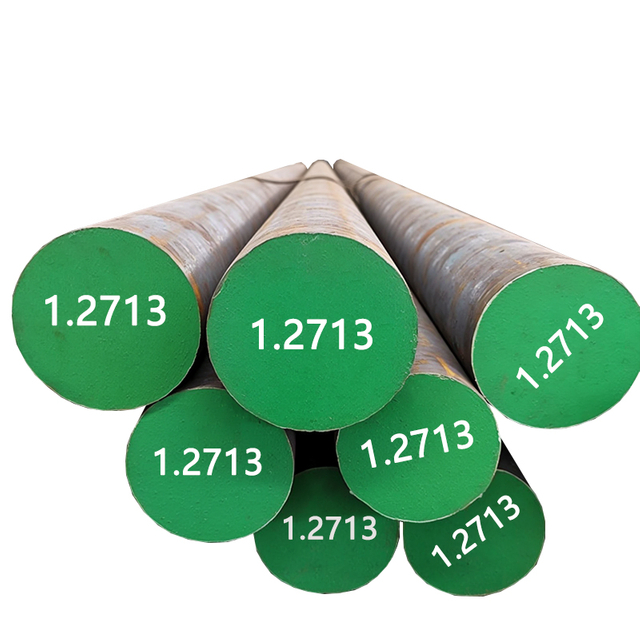
| Feature | 1.2767 | 5CrNiMo (1.2713) |
| Ni content | ~4.0% | ~1.0% |
| Hardenability | Excellent for large sections | Good |
| Impact toughness | Higher | Good |
| Application | Large, high‑load molds & structures | Forging dies, moderate loads |
1.2767: Higher toughness, lower risk of chipping/cracking; ideal for thick‑plate blanking and high‑impact cold work
D2: Higher wear resistance but lower toughness; better for high‑abrasion, low‑impact applications
A1: Unlike high-carbon, high-chromium steels such as D2, 1.2767 offers significantly higher toughness and impact resistance due to its nickel alloying. It is less prone to cracking under heavy shock loads, making it more suitable for large forming dies and heavy-duty structural parts.
A2: Yes. Its combination of wear resistance and toughness makes it an excellent choice for mold cavities and cores that process glass-filled or highly abrasive plastics. Proper heat treatment ensures high surface hardness while maintaining core toughness to resist cracking under injection pressure.
A3: For optimal toughness, harden from 840–860°C and temper in the range of 200–300°C. Lower tempering (170–190°C) yields higher surface hardness (≥52 HRC), while higher tempering improves impact toughness for core components.
A4: Yes, but care is needed. Preheating (200–300°C) is recommended for welding, followed by slow cooling and post-weld stress relief. For EDM, ensure a proper tempering cycle after machining to remove the re-cast layer and minimize micro-cracking risks.
Contact & Inquiry: For stock check, pricing, mill test certificates (MTC), or custom processing solutions, please send your inquiry with quantity, size, and usage. We will respond within 24 hours.