T: +86-0731-85185770
E: enquiry@qilumetal.com
E: enquiry@qilumetal.com
No. 18 Xiangfu Middle Road,Yuhua District, Changsha City
 |


| Quantity: | |
|---|---|
A2
Qilu
DIN X100CrMoV5 (1.2363) is a widely specified high‑carbon, high‑chromium cold work tool steel complying with DIN EN ISO 4957. It delivers an outstanding balance of high hardness, excellent wear resistance, good hardenability, moderate corrosion resistance, and excellent dimensional stability after proper heat treatment.
This grade is globally recognized with equivalent standards:
ASTM A681: A2
JIS G4404: SKD12
GB/T 1299: Cr5Mo1V
It is engineered for high‑load precision molds, long‑life cutting tools, and components requiring stable dimensions and resistance to temper softening.
Air‑hardening: Low distortion, roughly 1/4 the deformation of conventional oil‑hardening tool steels.
Wear resistance: Between oil‑hardening grades (e.g., O1) and high‑carbon high‑chromium grades (e.g., D2).
Toughness: Superior to Cr12, 9Mn2V, and many high‑chromium cold work steels.
Dimensional stability: Minimal change during heat treatment, ideal for complex precision dies.
Machinability & grindability: Better than high‑chromium 12% grades like D2 / 1.2379.
Secondary hardening: Stable hardness at service temperatures up to ~400°C.
Country | ISO | Germany | China | Japan | USA |
Standard | ISO 4957 | DIN 17350 | GB/T 1299 | JIS G4404 | ASTM A681 |
Grade | X100CrMoV5 | X100CrMoV5/1.2363 | Cr5Mo1V | SKD12 | A2 |
Grade | C | Si | Mn | Cr | Mo | P | S | V |
Cr5Mo1V | 0.95-1.05 | 0.50Max | 1.00Max | 4.75-5.50 | 0.90-1.40 | 0.030Max | 0.030Max | 0.15-0.50 |
X100CrMov5/ 1.2363 | 0.95-1.05 | 0.10-0.40 | 0.40-0.80 | 4.80-5.50 | 0.90-1.20 | 0.030Max | 0.030Max | 0.15-0.35 |
SKD12 | 0.95-1.05 | 0.10-0.40 | 0.40-0.80 | 4.80-5.50 | 0.90-1.20 | 0.030Max | 0.030Max | 0.15-0.35 |
A2 | 0.95-1.05 | 0.10-0.50 | 0.40-1.00 | 4.75-5.50 | 0.90-1.40 | 0.030Max | 0.030Max | 0.15-0.50 |
Melting route: EF + LF + VD or EF + LF + VD + ESR
Forging: Preheat 700–800°C; Start 1050–1100°C; Finish 850–900°C; Furnace / sand cooling
Ultrasonic test: EN 10228‑3 Class III or SEP 1921‑84 D/D
Heat Treatment | Hardness |
Annealed (+A) | HB241Max |
| Cold-drawn condition | HB262Max |
| Quenched and tempred (+QT) | HRC28-32(Common Range) |
Heat to 840–860°C, hold, cool slowly in furnace
Result: Soft for machining, uniform structure
Preheat: ~788°C
Austenitize: 960–980°C (salt bath / vacuum furnace)
Quench: Air cool
Temper: 170–190°C, air cool
Working hardness: 58–62 HRC

Above curve in figure is a rough guide to the tempering behaviour of steels.
Product type | Size range | Length |
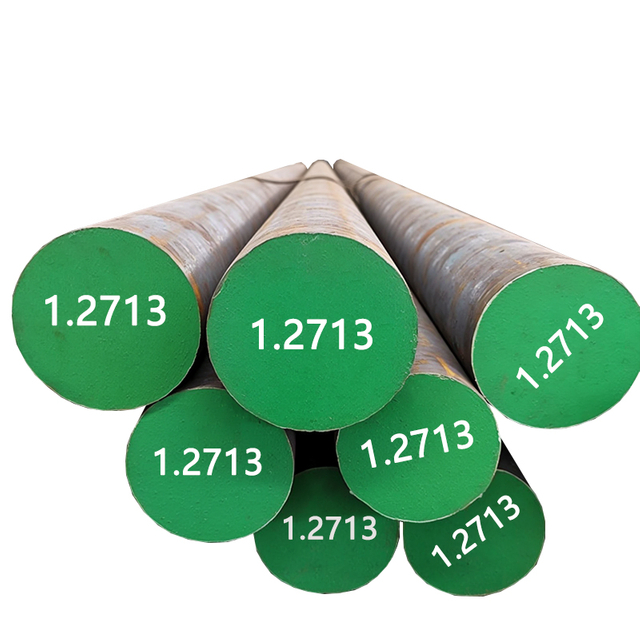
Hot rolled bar | Φ10-Φ190mm | 2000-5800mm |
Hot forged bar | Φ200-Φ600mm | 2000-5800mm |
Hot rolled plate/sheet | T:10-60mm; W:310-810mm | 2000-5800mm |
Hot forged plate | T:70-250mm; W:310-810mm | 2000-5800mm |
Hot Forged block | T: 260-500mm; W: 300-1000mm | 2000-5800mm |
Surface Finish | Turned | Milled | Grinding(Best) | Polished(Best) | Peeled(Best) | Black Forged | Black Rolled |
Tolerance | +0/+3mm | +0/+3mm | +0/+0.05mm | +0/+0.05mm | +0/+0.1mm | +0/+5mm | +0/+1mm |
Straighness | 1mm/1000mm max. | 3mm/1000mm max. | |||||
Punching, blanking, piercing dies
Bending, drawing, flanging dies
Coining, embossing, jewelry dies
Cold forging & extrusion dies for fasteners
Shear blades, paper cutters, shredder blades
Metal working knives, thread rolling dies
Gauges, plug gauges, ring gauges, templates
Guide pins, guide bushes, bearings, rollers
A2: Better toughness, lower distortion, easier machining/grinding
D2: Higher wear resistance, higher chromium, higher hardness retention
Use A2 when toughness and dimensional stability are critical
Use D2 for extreme abrasive wear with low impact
A2: Air‑hardening, less distortion, better toughness, higher hardenability
O1: Oil‑hardening, lower cost, simpler heat treatment
A2 is the modern upgrade for precision dies
A2: Significantly better toughness, finer carbides, less cracking risk
SKD11: Higher wear resistance but more brittle
A2 preferred for medium–high impact punching & forming
A1: A2 (ASTM A681) and DIN 1.2363 (X100CrMoV5) are essentially equivalent grades with nearly identical chemical compositions and mechanical properties. They can be used interchangeably in most cold work applications.
A2: Yes. 1.2363 (DIN), A2 (ASTM), SKD12 (JIS), and Cr5Mo1V (GB) are equivalent grades with nearly identical chemistry and performance.
A3: After proper quenching and low‑temperature tempering, hardness typically reaches 58–62 HRC, sometimes up to 63 HRC.
A4: Choose A2 for balanced wear resistance + toughness + low distortion
Choose O1 for low‑cost, simple oil‑hardening tools
Choose D2 for maximum abrasive wear with minimal impact
Need a quote or customized size? Contact us for competitive pricing and fast delivery.