T: +86-0731-85185770
E: enquiry@qilumetal.com
E: enquiry@qilumetal.com
No. 18 Xiangfu Middle Road,Yuhua District, Changsha City
 |


| Quantity: | |
|---|---|
1.2365
Qilu
DIN 1.2365 is a premium chromium-molybdenum-vanadium hot work tool steel standardized under German DIN 17350, engineered for extreme high-temperature industrial applications. Its alloy composition (Cr, Mo, V) delivers outstanding mechanical properties that resist softening, thermal cracking and wear under continuous high-heat and cyclic stress conditions—making it a top choice for die-casting, forging and extrusion manufacturing. Due to its balanced properties, several countries have developed equivalent grades, including: H10 from the American standard ASTM A681, 32CrMoV12-28 from the International standard ISO 4957, SKD7 from the Japan standard JIS G4404, 4Cr3Mo3SiV from the China standard GB/T 1299.
This steel grade has been globally standardized with equivalent grades across major industrial countries, ensuring universal compatibility and sourcing flexibility for international manufacturing projects. It is produced via advanced steelmaking processes to guarantee chemical homogeneity and structural integrity, meeting the strictest industrial quality standards for heavy-duty tooling.
Country | USA | ISO | Germany | China | Japan |
Standard | ASTM A681 | ISO 4957 | DIN17350 | GB/T1299 | JIS G4404 |
Grade | H10 | 32CrMoV12-28 | X32CrMoV33/1.2365 | 4Cr3Mo3SiV | SKD7 |
Grade | C | Si | Mn | P | S | Cr | Mo | V |
H10 | 0.35-0.45 | 0.80-1.25 | 0.20-0.70 | 0.030Max | 0.030Max | 3.00-3.75 | 2.00-3.00 | 0.25-0.75 |
32CrMoV12-28 | 0.28-0.35 | 0.10-0.40 | 0.15-0.45 | 0.030Max | 0.020Max | 2.70-3.20 | 2.50-3.00 | 0.40-0.70 |
X32CrMoV33/1.2365 | 0.28-0.35 | 0.10-0.40 | 0.15-0.45 | 0.030Max | 0.030Max | 2.70-3.20 | 2.60-3.00 | 0.40-0.70 |
4Cr3Mo3SiV | 0.35-0.45 | 0.80-1.20 | 0.25-0.70 | 0.030Max | 0.030Max | 3.00-3.75 | 2.00-3.00 | 0.25-0.75 |
SKD7 | 0.28-0.35 | 0.10-0.40 | 0.15-0.45 | 0.030Max | 0.020Max | 2.70-3.20 | 2.50-3.00 | 0.40-0.70 |
1.2365 exhibits consistent hardness across different heat treatment conditions, with a minimum tempered hardness of HRC46 to ensure long tool life under heavy loads:
Heat Treatment | Hardness |
Annealed (+A) | HB229Max |
Cold-drawn condition | HB255Max |
Hardening and Tempering (+HT) | HRC46 Min |
When quenched at 1040°C and oil-cooled, 1.2365 (32CrMoV12-28) maintains excellent hardness retention up to 600°C, with hardness gradually decreasing as tempering temperature rises—critical for applications with sustained high-heat exposure.
We offer 1.2365 in a full range of hot-rolled and hot-forged forms, with precise dimensional tolerances and surface finishes to meet diverse manufacturing needs.
Product type | Size range | Length |
Hot rolled bar | Φ10-Φ190mm | 2000-5800mm |
Hot forged bar | Φ200-Φ600mm | 2000-5800mm |
Hot rolled plate/sheet | T:10-60mm; W:310-810mm | 2000-5800mm |
Hot forged plate | T:70-250mm; W:310-810mm | 2000-5800mm |
Hot Forged block | T: 260-500mm; W: 300-1000mm | 2000-5800mm |
Surface Finish | Turned | Milled | Grinding(Best) | Polished(Best) | Peeled(Best) | Black Forged | Black Rolled |
Tolerance | +0/+3mm | +0/+3mm | +0/+0.05mm | +0/+0.05mm | +0/+0.1mm | +0/+5mm | +0/+1mm |
Straighness | 1mm/1000mm max. | 3mm/1000mm max. | |||||
All 1.2365 products undergo ultrasonic testing in accordance with EN10228-3 Class III or Sep 1921-84 D/D to detect internal defects and ensure structural integrity for heavy-duty applications.
We use state-of-the-art steelmaking processes to ensure chemical purity and structural homogeneity, with optional electroslag remelting (ESR) for ultra-high purity requirements:
EF+LF+VD (Electric Furnace + Ladle Furnace + Vacuum Degassing)
EAF+LF+VD (Electric Arc Furnace + Ladle Furnace + Vacuum Degassing)
EF+LF+VD+ESR (Ultra-purity grade for critical applications)
EAF+LF+VD+ESR (Ultra-purity grade for critical applications)
Preheating: 600-650°C, slow and uniform heating to eliminate internal stress
Forging Temperature: Initial 1050-1100°C, minimum finishing temperature 850°C (prevents grain coarsening)
Cooling: Sand cooling after forging to reduce thermal stress and avoid cracking
Post-forging Treatment: Stress relief annealing to ensure machinability
Proper heat treatment is critical to unlocking 1.2365's full performance potential. We recommend the following standardized processes for optimal results:
Heating temperature: 840-860°C
Furnace cooling: ≤30°C/h to below 500°C
Final cooling: Air cooling to room temperature
Result: Uniform hardness (HB≤229), excellent machinability for complex tool fabrication
Preheating: 788°C (single-stage preheating to avoid thermal shock)
Austenitizing: 1030-1050°C in salt bath furnace (uniform heating for consistent hardenability)
Quenching: Oil cooling (fast cooling to achieve full hardness without cracking)
Tempering: 540-560°C (tempering twice for stress relief)
Final cooling: Air cooling
Result: HRC≥46, excellent combination of hardness, toughness and thermal fatigue resistance

Above curve in figure is the tempering properties of the steel.
1.2365 is the ideal material for high-temperature tooling and molds across multiple industries, leveraging its balanced properties of toughness, wear resistance and thermal cracking resistance:
Die Casting Molds: Core pins, cavity inserts, sprue bushings, ejector pins, slide blocks, die holders (for aluminum, zinc and magnesium alloy die casting)
Forging Molds: Hammer forging dies, press forging dies, punches, concave dies, forging blanks (for carbon steel and alloy steel forging)
Extrusion Molds: Extrusion cylinders, bushings, extrusion rods, mold inserts (for metal profile extrusion)
Hot runner system components, die nuts, precision mold inserts (for high-temperature plastic injection molding)
Hot Stamping Dies: Stainless steel plate hot stamping, high-strength steel forming dies
Rolls: High-temperature rolling mill aids, calendering rolls
Wear Parts: Hot shear blades, cutting tools for high-temperature materials, furnace fixtures
| Property | 1.2365 / H10 / SKD7 | H13 / 1.2344 / SKD61 |
| Alloy focus | Higher Mo, balanced toughness | Higher Cr & V, maximum wear resistance |
| Hot hardness | Very good, stable to 600°C | Excellent, better at extreme temps |
| Thermal fatigue | Best for thermal shock & heat checking | Very good, but more wear‑oriented |
| Toughness | Higher, less prone to cracking | Good, but lower than 1.2365 |
| Wear resistance | Good | Superior for long‑run high‑wear dies |
| Best used for | Complex cores, forging dies, tools prone to cracking | High‑production extrusion, die‑casting, long‑life molds |
Choose 1.2365 if you need toughness, crack resistance, and thermal stability.
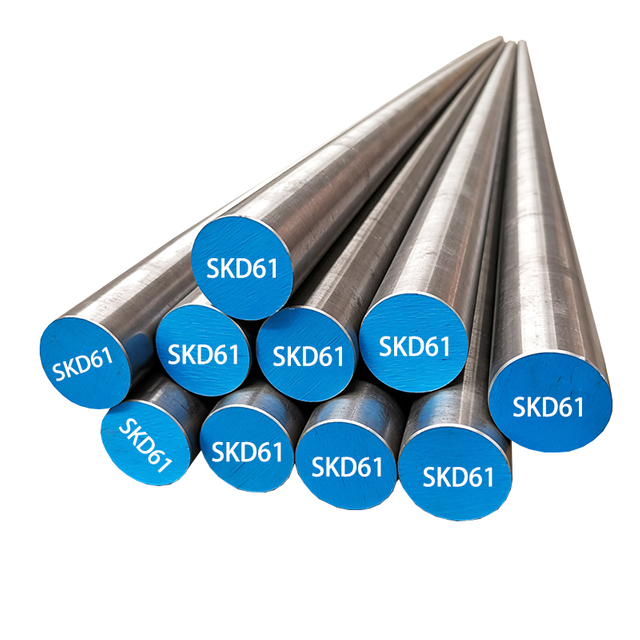
Choose H13 / SKD61 if you prioritize wear resistance and maximum hot strength.
A1: The key difference lies in the alloy balance. H13 has higher chromium and vanadium, offering superior wear resistance and high-temperature strength. H10 has a slightly lower alloy content, which gives it higher toughness and ductility. Choose H10 for tools where cracking or chipping is a primary concern (e.g., complex cores). Choose H13 for applications demanding maximum wear resistance and hot hardness (e.g., long-run extrusion dies).
A2: Yes, 1.2365 can be welded with proper preheating (300-400°C) and post-weld tempering (500-550°C) to avoid cracking. We recommend using matching alloy welding rods and minimal heat input during welding.
A3: The grades are functionally interchangeable for most applications. Choose based on regional supply standards and manufacturing specifications: SKD7 for Japanese manufacturing projects, H10 for American standards, and 1.2365 for European/German standards.
A4: While 1.2365 has good hardness, it is not optimized for cold work applications (e.g., cold stamping, blanking). For cold work tooling, choose dedicated cold work steels with higher carbon and chromium content for better wear resistance.
A5: Store in a dry, well-ventilated warehouse with relative humidity ≤60%. For long-term storage, apply anti-rust oil and wrap with waterproof plastic film—especially for polished/ground surfaces.
Inquire Now for detailed pricing, custom specifications and technical data sheets. Our sales and engineering team is ready to provide personalized solutions for your hot work tooling needs.