
English 
T: +86-0731-85185770
E: enquiry@qilumetal.com
E: enquiry@qilumetal.com
No. 18 Xiangfu Middle Road,Yuhua District, Changsha City
 |


30CrNiMo8 /1.6580 is a high-grade alloy steel commonly used in European standards EN 10083-3 and EN 10250-3. Due to its excellent mechanical properties after quenching and tempering, it is widely applied in industries requiring high strength and toughness, such as aerospace, heavy machinery, automotive components (gears, shafts), and defense equipment, so you could find its equivalent steel from different country standard, such as 823M30 from British standard BS970.
30CrNiMo8 (1.6580) is a premium quenched and tempered (QT) alloy steel offering superior strength and toughness compared to standard Cr-Mo steels like 42CrMo4. Its nickel content enhances impact resistance, making it ideal for extreme conditions. For equivalent materials.
| Quantity: | |
|---|---|
DIN 30CrNiMo8 (1.6580) is a high-grade quenching and tempering (QT) alloy steel compliant with European standards EN 10083-3 and EN 10250-3, designed for industries demanding exceptional strength, toughness, and fatigue resistance. Unlike standard chromium-molybdenum (Cr-Mo) steels (e.g., 42CrMo4), its optimized composition—including a balanced blend of chromium, nickel, and molybdenum—delivers superior impact resistance and structural stability, even in extreme operating conditions.
A key advantage of this alloy is its global standard equivalence: it aligns with BS 823M30 under the British BS 970 standard, making it a versatile choice for international projects requiring consistent material performance. Hunan Qilu Steel Co., Ltd., a leading Chinese manufacturer, supplies this alloy in a wide range of forms (cold drawn bars, hot rolled bars, forged bars, plates, and blocks) with extensive stock—including monthly inventories of over 10,000 tons of hot rolled and forged bars—to meet urgent production needs.
What sets DIN 30CrNiMo8 (1.6580) apart is its post-quenching-and-tempering mechanical properties: tensile strength reaching up to 1450 Mpa (for small sizes), yield strength as high as 1050 Mpa, and minimum elongation of 9%, ensuring it can withstand heavy loads, dynamic stresses, and harsh environments. These attributes make it a preferred material for critical components in aerospace, defense, energy, and heavy machinery sectors.
The chemical makeup of DIN 30CrNiMo8 (1.6580) is precisely calibrated to enhance strength, toughness, and heat resistance. Each element plays a critical role in optimizing the alloy’s behavior:
Element | Content Range | Key Function |
Carbon (C) | 0.26-0.34% | Enhances hardness and tensile strength; controls martensite formation during quenching. |
Silicon (Si) | Max 0.4% | Improves oxidation resistance and strengthens the ferrite phase. |
Manganese (Mn) | 0.3-0.6% | Boosts hardenability and reduces brittleness. |
Phosphorus (P) | Max 0.035% | Minimized to avoid reduced toughness and cold cracking. |
Sulfur (S) | Max 0.035% | Controlled to prevent hot brittleness during forging. |
Chromium (Cr) | 1.8-2.2% | Enhances corrosion resistance, hardenability, and wear resistance. |
Molybdenum (Mo) | 0.3-0.5% | Increases high-temperature strength and reduces temper brittleness. |
Nickel (Ni) | 1.8-2.2% | Significantly improves impact toughness and ductility, critical for low-temperature or dynamic-load applications. |
This composition ensures the alloy maintains structural integrity even after rigorous heat treatment and long-term use.
Mechanical performance of DIN 30CrNiMo8 (1.6580) varies by cross-sectional size (diameter for bars, thickness for plates), as larger sizes require adjustments to heat treatment to ensure uniform properties. Below are the key mechanical properties per EN 10083-3 (for standard QT processing):
Small sizes (d≤16mm / t≤8mm): Tensile strength = 1250-1450 Mpa; Yield strength = Min 1050 Mpa; Elongation = Min 9%; Area reduction = Min 40%.
Medium sizes (16<d≤40mm / 8<t≤20mm): Tensile strength = 1250-1450 Mpa; Yield strength = Min 1050 Mpa; Elongation = Min 9%; Area reduction = Min 40%; Impact value (RT) = Min 30 J.
Large sizes (40<d≤100mm / 20<t≤60mm): Tensile strength = 1000-1300 Mpa; Yield strength = Min 900 Mpa; Elongation = Min 10%; Area reduction = Min 45%; Impact value (RT) = Min 35 J.
Extra-large sizes (100<d≤160mm / 60<t≤100mm): Tensile strength = 1000-1200 Mpa; Yield strength = Min 800 Mpa; Elongation = Min 11%; Area reduction = Min 50%; Impact value (RT) = Min 45 J.
For open-die forgings (per EN 10250-3), even sizes up to 660mm maintain impressive properties: tensile strength = Min 800 Mpa, yield strength = Min 590 Mpa, and impact value (RT) = Min 40 J—making it suitable for heavy-duty forged components like wind turbine shafts.
DIN 30CrNiMo8 (1.6580) offers flexible hardness options to match application needs, with hardenability tailored to ensure uniform properties across cross-sections:
Flame/Induction Hardening: Achieves a surface hardness of 53 HRC, ideal for components requiring wear-resistant surfaces (e.g., gears, shafts).
Soft Annealing (+A): Maximum hardness of 248 HB, facilitating machining and forming before final heat treatment.
Quenching & Tempering (+QT): Common hardness range of 28-32 HRC, balancing strength and ductility for most structural applications.
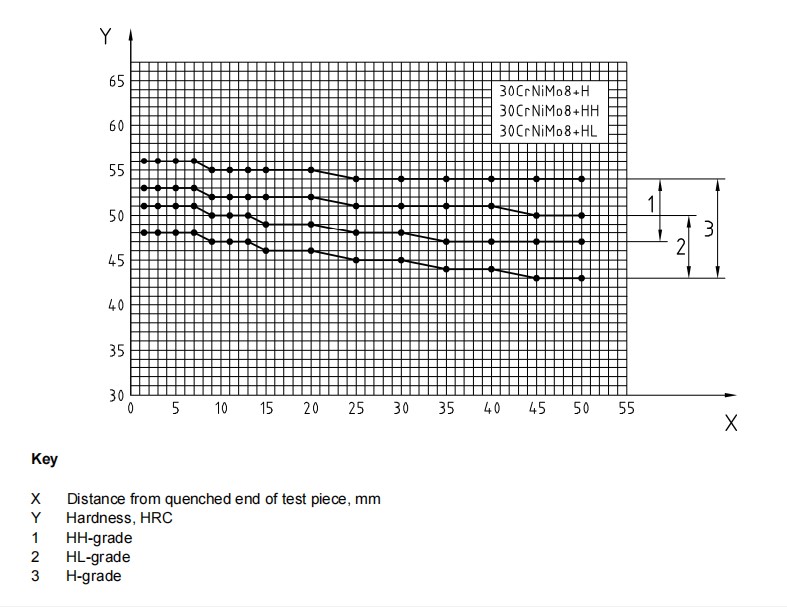
Hardenability is further categorized by three grades (+H, +HH, +HL) to suit different quenching requirements. For example, the +HH grade (high hardenability) maintains a minimum 47 HRC at 50mm from the quenched end, while the +HL grade (low hardenability) ensures consistency for smaller components.
Hunan Qilu Steel provides DIN 30CrNiMo8 (1.6580) in diverse forms and sizes, with tight tolerances to minimize post-processing:
Cold Drawn Bars: Diameter = Φ3-Φ80mm; Length = 6000-9000mm; Tolerance = +0/+0.1mm (peeled finish) or +0/+0.05mm (ground finish); Straightness = Max 1mm/1000mm.
Hot Rolled Bars: Diameter = Φ16-Φ310mm; Length = 6000-9000mm; Tolerance = +0/+1mm; Straightness = Max 3mm/1000mm.
Hot Forged Bars: Diameter = Φ100-Φ1200mm; Length = 3000-5800mm; Tolerance = +0/+5mm.
Hot Rolled Plates/Sheets: Thickness = 3-200mm; Width = 1500-2500mm; Length = 2000-5800mm.
Common stock sizes (hot rolled bars) include Φ8mm, Φ15mm, Φ20mm, Φ30mm, Φ50mm, Φ100mm, and Φ200mm—with steel wire available for diameters ≤15mm. Custom sizes are available via forging, with lead times aligned to production schedules.
Proper heat treatment and forging are critical to unlocking the alloy’s full potential. Hunan Qilu Steel follows industry-best practices:
Forging: Heat ingots to 1150-1200℃ (for full grain refinement), forge at a minimum of 850-900℃ (to avoid cracking), and cool in air or sand to prevent residual stresses.
Soft Annealing: Heat to 680-720℃, soak to ensure uniform temperature, and furnace-cool to reduce hardness for machining.
Normalizing: Heat to 860-900℃, soak, and air-cool to refine grain structure and improve machinability.
Quenching & Tempering: Heat to 830-860℃ (lower end for water quenching, upper end for oil quenching), quench in water/oil, then temper at 540-660℃ (adjust for desired hardness) and air-cool.
These processes ensure consistent mechanical properties and reduce the risk of defects like cracks or warping.
The exceptional strength-to-weight ratio and impact resistance of DIN 30CrNiMo8 (1.6580) make it ideal for aerospace and defense, where failure is not an option:
Aircraft Components: Landing gear struts, engine shafts, and torsion bars—these parts endure extreme dynamic loads and require fatigue resistance to meet aviation safety standards (e.g., FAA, EASA).
Defense Equipment: Armored vehicle gears, tank drive shafts, and missile launcher structural elements—capable of withstanding ballistic impacts and harsh field conditions.
In sectors where machinery operates under continuous heavy loads, DIN 30CrNiMo8 (1.6580) delivers reliability:
Wind Energy: Main shafts and gearbox components for onshore/offshore wind turbines—resists cyclic stresses from wind turbulence and ensures 20+ years of service life.
Oil & Gas: Drill pipes, lifting hooks, and wellhead components—withstands high pressure, corrosion, and mechanical wear in downhole and offshore environments.
Construction Machinery: Excavator bucket pins, crane boom shafts, and bulldozer transmission gears—handles shock loads and heavy vibrations during construction.
For high-performance and commercial vehicles, the alloy’s toughness and wear resistance are invaluable:
Commercial Vehicles: Truck axle shafts, transmission gears, and clutch components—endure heavy payloads and long-haul use.
Performance Cars: Racing engine crankshafts and differential gears—handles high RPMs and torque without deformation.
The alloy’s machinability and hardness make it suitable for mold and tooling applications:
Heavy-Duty Stamping Molds: Used for stamping thick metal sheets (e.g., automotive body parts)—resists wear from repeated impacts.
Injection Mold Frames: Supports large mold cavities for plastic injection molding—maintains dimensional stability under high temperatures and clamping forces.
With chromium-enhanced corrosion resistance and high strength, DIN 30CrNiMo8 (1.6580) excels in marine settings:
Ship Propulsion Shafts: Transmits engine power to propellers—resists saltwater corrosion and torsional stresses.
Submarine Pressure Housings: Withstands extreme underwater pressure (up to thousands of meters) while maintaining structural integrity.
Offshore Platform Components: Bolts, brackets, and load-bearing structures—endure salt spray, humidity, and wave-induced vibrations.
DIN 30CrNiMo8 (1.6580) has well-established equivalents across global standards to simplify international sourcing:
British Standard (BS): BS 823M30 (per BS 970).
While no direct ASTM equivalent exists in the U.S., AISI 4340 (DIN 36CrNiMo4, 1.6511) is sometimes used as a substitute, though it has lower nickel content (1.65-2.00%) and slightly different mechanical properties. For critical applications, consult Hunan Qilu Steel’s engineering team to confirm compatibility.
Three key factors influence performance:
Size: Larger cross-sections (e.g., d>100mm) have lower tensile strength (1000-1200 Mpa vs. 1250-1450 Mpa for small sizes) due to reduced heat treatment penetration.
Heat Treatment: Quenching temperature (830-860℃) and tempering temperature (540-660℃) directly impact hardness—higher tempering temperatures reduce hardness but increase ductility.
Forging Quality: Incomplete grain refinement (from insufficient forging temperature) or rapid cooling can cause residual stresses, reducing impact toughness.
Hunan Qilu Steel controls these factors via ISO 9001-certified processes to ensure consistency.
DIN 30CrNiMo8 (1.6580) has poor weldability due to two key factors:
Carbon Content: At ~0.30%, it exceeds the 0.25% threshold where weldability begins to deteriorate, increasing the risk of cold cracking.
Alloy Elements: Chromium, nickel, and molybdenum promote hardening in the heat-affected zone (HAZ) during welding.
If welding is necessary, pre-heat the base material to 200-300℃, use low-hydrogen electrodes (e.g., E8018-B2), and post-weld heat treat (PWHT) at 580-620℃ to reduce HAZ hardness. Consult a welding engineer for project-specific procedures.
Hunan Qilu Steel offers a range of finishes to match application needs:
Black Rolled/Black Forged: Economical option for non-critical surfaces; tolerance = +0/+1mm (rolled) or +0/+5mm (forged).
Peeled: Removes surface defects; tolerance = +0/+0.1mm; suitable for general machining.
Turned/Milled: Precision finish for components requiring tight dimensional control; tolerance = +0/+3mm.
Ground/Polished: Highest precision finish; tolerance = +0/+0.05mm; ideal for bearings, shafts, or other high-precision parts.
Custom finishes (e.g., zinc plating for corrosion resistance) are available upon request.
Stock levels change daily due to order volume, but Hunan Qilu Steel maintains a large inventory of hot rolled bars (Φ8mm to Φ220mm) and forged bars (Φ100mm to Φ1200mm). To check availability:
Contact the sales team via email: enquiry@qilumetal.com
Call/WhatsApp: +86-15084978853 or +86-0731-85185770
Visit the “Resource > Download” section of the website for monthly stock lists (updated on the 1st of each month).
1: Steel equivalent
Country | Europe | British |
Standard | EN10083-3 | BS970 |
Grade | 30CrNiMo8/1.6580 | 823M30 |
2: Chemical composition
Grade | C | Si | Mn | P | S | Cr | Mo | Ni |
30CrNiMo8/1.6580 | 0.26-0.34 | 0.4Max | 0.3-0.6 | 0.035Max | 0.035Max | 1.8-2.2 | 0.3-0.5 | 1.8-2.2 |
3: Mechanical properties .
Mechanical properties for 30CrNiMo8 quenching and tempering alloy steel according to EN10083-3.
Size range | Tensile strength | Yield strength | Alongation | Area of reduction | Impact value At RT/J |
d≤16 t≤8 | 1250-1450Mpa | 1050Mpa Min | 9% Min | 40% Min | / |
16<d≤40 8<t≤20 | 1250-1450Mpa | 1050Mpa Min | 9% Min | 40%Min | 30J Min |
40<d≤100 20<t≤60 | 1000-1300Mpa | 900Mpa Min | 10% Min | 45%Min | 35J Min |
100<d≤160 60<t≤100 | 1000-1200Mpa | 800Mpa Min | 11% Min | 50%Min | 45J Min |
160<d≤250 100<t≤160 | 900-1100Mpa | 700Mpa Min | 12% Min | 50%Min | 45J Min |
Sampling and preparation of test pieces for 30CrNiMo8 quenching and tempering steel.
1): According to EN10083-1, all samples shall be taken at a distance of 12.5mm below the heat treated surface
2): As stipulated in the contract between buyer and seller.
Mechanical properties for 30CrNiMo8 open die forgings steel according to EN10250-3
Size range | Tensile strength | Yield strength | Alongation | Impact value at RT/J | ||
L | Tr | L | Tr | |||
d≤160 | 900Mpa Min | 700Mpa Min | 12% Min | 8% Min | 45J Min | 22J Min |
160<d≤330 | 850Mpa Min | 630Mpa Min | 12% Min | 8% Min | 45J Min | 22J Min |
330<d≤660 | 800Mpa Min | 590Mpa Min | 12% Min | 8% Min | 40J Min | 20J Min |
Remark: L= Longitudinal Tr = Transverse
Sampling and preparation of test pieces for steel forging.
1: According to EN10250-1, all samples shall be taken at a distance of 4/T below the heat treated surface (with a minimum of 20mm and a maximum of 80mm), and t/2 from the end (where t is the equivalent thickness of the thickness of the ruling section of the forging at the time of heat treatment.
2: As stipulated in the contract between buyer and seller.
4: Surface hardness and hardenability.
Heat Treatment | Hardness |
Flame or Induction hardening | 53HRC |
Soft annealed (+A) | HB248Max |
Quenched and tempred (+QT) | HRC28-32(Common Range) |
Where the steel is ordered by using the symbols for normal (+H) or restricted (+HL, +HH) hardenability requirements, the hardenability values should apply below:
Distance in mm from quenched end | ||||||||||||||||
Distance | 1.5 | 3 | 5 | 7 | 9 | 11 | 13 | 15 | 20 | 25 | 30 | 35 | 40 | 45 | 50 | |
Hardness In HRC + H | max | 56 | 56 | 56 | 56 | 55 | 55 | 55 | 55 | 55 | 54 | 54 | 54 | 54 | 54 | 54 |
min | 48 | 48 | 48 | 48 | 47 | 47 | 47 | 46 | 46 | 45 | 45 | 44 | 44 | 43 | 43 | |
Hardness In HRC + HH | max | 56 | 56 | 56 | 56 | 55 | 55 | 55 | 55 | 55 | 54 | 54 | 54 | 54 | 54 | 54 |
min | 51 | 51 | 51 | 51 | 50 | 50 | 50 | 49 | 49 | 48 | 48 | 47 | 47 | 47 | 47 | |
Hardness In HRC + HL | max | 53 | 53 | 53 | 53 | 52 | 52 | 52 | 52 | 52 | 51 | 51 | 51 | 51 | 50 | 50 |
min | 48 | 48 | 48 | 48 | 47 | 47 | 47 | 46 | 46 | 45 | 45 | 44 | 44 | 43 | 43 | |
Scatter bands for the Rockwell - C hardness in the end quench hardenability test.
5: Supply size & Tolerance & Stock size
Product type | Size range | Length |
Cold drawn bar | Φ3-Φ80mm | 6000-9000mm |
Hot rolled bar | Φ16-Φ310mm | 6000-9000mm |
Hot forged bar | Φ100-Φ1200mm | 3000-5800mm |
Hot rolled plate/sheet | T:3-200mm; W:1500-2500mm | 2000-5800mm |
Hot Forged block | T: 80-800mm; W: 100-2500mm | 2000-5800mm |
Surface Finish | Turned | Milled | Grinding(Best) | Polished(Best) | Peeled(Best) | Black Forged | Black Rolled |
Tolerance | +0/+3mm | +0/+3mm | +0/+0.05mm | +0/+0.05mm | +0/+0.1mm | +0/+5mm | +0/+1mm |
Straighness | 1mm/1000mm max. | 3mm/1000mm max. | |||||
Qilu steel stock hot rolled bar and forged bars more than ten thousands tons every month, below our our stock size.
We have plenty of stocks for hot rolled bar, below please check stock size:
8 | 9 | 10 | 11 | 13 | 15 | 16 | 18 | 19 | 20 | 22 | 25 | 30 | 32 | 35 |
38 | 40 | 42 | 45 | 50 | 55 | 60 | 65 | 70 | 75 | 80 | 85 | 90 | 95 | 100 |
105 | 110 | 120 | 130 | 140 | 150 | 160 | 170 | 180 | 190 | 200 | 210 | 220 |
From dia 8mm to 15mm, they are steel wire, for other diameters, they are steel bar. And if the dia is above 220mm, we have to use hot forged bar, we don't have stock for hot forged bar. Since the stocks change everyday, if you want to know our stock available information, please contact our salesman.
6:Forging processing
Put the 30CrNiMo8 ingot into the furnace and heat to 1150-1200℃
Forge the ingot, forging temperature should be not less than 850-900℃
Cooling in the air or in the sand after forged
7: Heat treatment
Soft annealed:
Heat 30CrNiMo8 steel to 680-720℃ in the furnace
Soak at this temperature in the furnace
Cooling in the furnace
Normalized:
Heat 30CrNiMo8 steel to 860-900℃ in the furnace
Soak at this temperature in the furnace
Cooling in the air
Quenching and tempering:
Heat 30CrNiMo8 steel to 830-860℃ in the furnace
Soak at this temperature in the furnace
Quench in water or oil
Temper steel at 540-660℃ in the furnace
Take out of 30CrNiMo8 steel from furnace and cool in the air.
Remark: The conditions given above are for guidance, at the temperatures at the lower end of the range are generally applicable to hardening in water and those at the upper end for hardening in oil.
8: Weldability
30CrNiMo8 steel has relatively poor weldability. For steel materials, weldability is strongly influenced by the carbon content. When the carbon content exceeds 0.25%, weldability begins to deteriorate. The carbon content of 30CrNiMo8 is approximately 0.30%, which means its weldability is not ideal.
Additionally, the presence of alloying elements such as chromium, nickel, and molybdenum further increases the risk of hardening and cracking during welding.
9:Application
30CrNiMo8 is a high-strength, high-toughness alloy structural steel, which is widely used in key components with high requirements for mechanical properties and fatigue strength. Its main application areas include:
1): Aircraft landing gears, drive shafts, engine components, torsion shafts, gears and load-bearing structural elements for armored vehicles and tanks
2): Main shafts and gearbox components of wind turbines, drill pipes and lifting components of oil drilling equipment, transmission gears and bearing housings of large-scale construction machinery.
3): Heavy-duty stamping molds, mold holders for injection molds, high strength structural parts for large hydraulic presses and presses
4): Marine propulsion shafts, submarine pressure-resistant housings, high-load bolts and fasteners
DIN 30CrNiMo8 (1.6580) is a high-grade quenching and tempering (QT) alloy steel compliant with European standards EN 10083-3 and EN 10250-3, designed for industries demanding exceptional strength, toughness, and fatigue resistance. Unlike standard chromium-molybdenum (Cr-Mo) steels (e.g., 42CrMo4), its optimized composition—including a balanced blend of chromium, nickel, and molybdenum—delivers superior impact resistance and structural stability, even in extreme operating conditions.
A key advantage of this alloy is its global standard equivalence: it aligns with BS 823M30 under the British BS 970 standard, making it a versatile choice for international projects requiring consistent material performance. Hunan Qilu Steel Co., Ltd., a leading Chinese manufacturer, supplies this alloy in a wide range of forms (cold drawn bars, hot rolled bars, forged bars, plates, and blocks) with extensive stock—including monthly inventories of over 10,000 tons of hot rolled and forged bars—to meet urgent production needs.
What sets DIN 30CrNiMo8 (1.6580) apart is its post-quenching-and-tempering mechanical properties: tensile strength reaching up to 1450 Mpa (for small sizes), yield strength as high as 1050 Mpa, and minimum elongation of 9%, ensuring it can withstand heavy loads, dynamic stresses, and harsh environments. These attributes make it a preferred material for critical components in aerospace, defense, energy, and heavy machinery sectors.
The chemical makeup of DIN 30CrNiMo8 (1.6580) is precisely calibrated to enhance strength, toughness, and heat resistance. Each element plays a critical role in optimizing the alloy’s behavior:
Element | Content Range | Key Function |
Carbon (C) | 0.26-0.34% | Enhances hardness and tensile strength; controls martensite formation during quenching. |
Silicon (Si) | Max 0.4% | Improves oxidation resistance and strengthens the ferrite phase. |
Manganese (Mn) | 0.3-0.6% | Boosts hardenability and reduces brittleness. |
Phosphorus (P) | Max 0.035% | Minimized to avoid reduced toughness and cold cracking. |
Sulfur (S) | Max 0.035% | Controlled to prevent hot brittleness during forging. |
Chromium (Cr) | 1.8-2.2% | Enhances corrosion resistance, hardenability, and wear resistance. |
Molybdenum (Mo) | 0.3-0.5% | Increases high-temperature strength and reduces temper brittleness. |
Nickel (Ni) | 1.8-2.2% | Significantly improves impact toughness and ductility, critical for low-temperature or dynamic-load applications. |
This composition ensures the alloy maintains structural integrity even after rigorous heat treatment and long-term use.
Mechanical performance of DIN 30CrNiMo8 (1.6580) varies by cross-sectional size (diameter for bars, thickness for plates), as larger sizes require adjustments to heat treatment to ensure uniform properties. Below are the key mechanical properties per EN 10083-3 (for standard QT processing):
Small sizes (d≤16mm / t≤8mm): Tensile strength = 1250-1450 Mpa; Yield strength = Min 1050 Mpa; Elongation = Min 9%; Area reduction = Min 40%.
Medium sizes (16<d≤40mm / 8<t≤20mm): Tensile strength = 1250-1450 Mpa; Yield strength = Min 1050 Mpa; Elongation = Min 9%; Area reduction = Min 40%; Impact value (RT) = Min 30 J.
Large sizes (40<d≤100mm / 20<t≤60mm): Tensile strength = 1000-1300 Mpa; Yield strength = Min 900 Mpa; Elongation = Min 10%; Area reduction = Min 45%; Impact value (RT) = Min 35 J.
Extra-large sizes (100<d≤160mm / 60<t≤100mm): Tensile strength = 1000-1200 Mpa; Yield strength = Min 800 Mpa; Elongation = Min 11%; Area reduction = Min 50%; Impact value (RT) = Min 45 J.
For open-die forgings (per EN 10250-3), even sizes up to 660mm maintain impressive properties: tensile strength = Min 800 Mpa, yield strength = Min 590 Mpa, and impact value (RT) = Min 40 J—making it suitable for heavy-duty forged components like wind turbine shafts.
DIN 30CrNiMo8 (1.6580) offers flexible hardness options to match application needs, with hardenability tailored to ensure uniform properties across cross-sections:
Flame/Induction Hardening: Achieves a surface hardness of 53 HRC, ideal for components requiring wear-resistant surfaces (e.g., gears, shafts).
Soft Annealing (+A): Maximum hardness of 248 HB, facilitating machining and forming before final heat treatment.
Quenching & Tempering (+QT): Common hardness range of 28-32 HRC, balancing strength and ductility for most structural applications.
Hardenability is further categorized by three grades (+H, +HH, +HL) to suit different quenching requirements. For example, the +HH grade (high hardenability) maintains a minimum 47 HRC at 50mm from the quenched end, while the +HL grade (low hardenability) ensures consistency for smaller components.
Hunan Qilu Steel provides DIN 30CrNiMo8 (1.6580) in diverse forms and sizes, with tight tolerances to minimize post-processing:
Cold Drawn Bars: Diameter = Φ3-Φ80mm; Length = 6000-9000mm; Tolerance = +0/+0.1mm (peeled finish) or +0/+0.05mm (ground finish); Straightness = Max 1mm/1000mm.
Hot Rolled Bars: Diameter = Φ16-Φ310mm; Length = 6000-9000mm; Tolerance = +0/+1mm; Straightness = Max 3mm/1000mm.
Hot Forged Bars: Diameter = Φ100-Φ1200mm; Length = 3000-5800mm; Tolerance = +0/+5mm.
Hot Rolled Plates/Sheets: Thickness = 3-200mm; Width = 1500-2500mm; Length = 2000-5800mm.
Common stock sizes (hot rolled bars) include Φ8mm, Φ15mm, Φ20mm, Φ30mm, Φ50mm, Φ100mm, and Φ200mm—with steel wire available for diameters ≤15mm. Custom sizes are available via forging, with lead times aligned to production schedules.
Proper heat treatment and forging are critical to unlocking the alloy’s full potential. Hunan Qilu Steel follows industry-best practices:
Forging: Heat ingots to 1150-1200℃ (for full grain refinement), forge at a minimum of 850-900℃ (to avoid cracking), and cool in air or sand to prevent residual stresses.
Soft Annealing: Heat to 680-720℃, soak to ensure uniform temperature, and furnace-cool to reduce hardness for machining.
Normalizing: Heat to 860-900℃, soak, and air-cool to refine grain structure and improve machinability.
Quenching & Tempering: Heat to 830-860℃ (lower end for water quenching, upper end for oil quenching), quench in water/oil, then temper at 540-660℃ (adjust for desired hardness) and air-cool.
These processes ensure consistent mechanical properties and reduce the risk of defects like cracks or warping.
The exceptional strength-to-weight ratio and impact resistance of DIN 30CrNiMo8 (1.6580) make it ideal for aerospace and defense, where failure is not an option:
Aircraft Components: Landing gear struts, engine shafts, and torsion bars—these parts endure extreme dynamic loads and require fatigue resistance to meet aviation safety standards (e.g., FAA, EASA).
Defense Equipment: Armored vehicle gears, tank drive shafts, and missile launcher structural elements—capable of withstanding ballistic impacts and harsh field conditions.
In sectors where machinery operates under continuous heavy loads, DIN 30CrNiMo8 (1.6580) delivers reliability:
Wind Energy: Main shafts and gearbox components for onshore/offshore wind turbines—resists cyclic stresses from wind turbulence and ensures 20+ years of service life.
Oil & Gas: Drill pipes, lifting hooks, and wellhead components—withstands high pressure, corrosion, and mechanical wear in downhole and offshore environments.
Construction Machinery: Excavator bucket pins, crane boom shafts, and bulldozer transmission gears—handles shock loads and heavy vibrations during construction.
For high-performance and commercial vehicles, the alloy’s toughness and wear resistance are invaluable:
Commercial Vehicles: Truck axle shafts, transmission gears, and clutch components—endure heavy payloads and long-haul use.
Performance Cars: Racing engine crankshafts and differential gears—handles high RPMs and torque without deformation.
The alloy’s machinability and hardness make it suitable for mold and tooling applications:
Heavy-Duty Stamping Molds: Used for stamping thick metal sheets (e.g., automotive body parts)—resists wear from repeated impacts.
Injection Mold Frames: Supports large mold cavities for plastic injection molding—maintains dimensional stability under high temperatures and clamping forces.
With chromium-enhanced corrosion resistance and high strength, DIN 30CrNiMo8 (1.6580) excels in marine settings:
Ship Propulsion Shafts: Transmits engine power to propellers—resists saltwater corrosion and torsional stresses.
Submarine Pressure Housings: Withstands extreme underwater pressure (up to thousands of meters) while maintaining structural integrity.
Offshore Platform Components: Bolts, brackets, and load-bearing structures—endure salt spray, humidity, and wave-induced vibrations.
DIN 30CrNiMo8 (1.6580) has well-established equivalents across global standards to simplify international sourcing:
British Standard (BS): BS 823M30 (per BS 970).
While no direct ASTM equivalent exists in the U.S., AISI 4340 (DIN 36CrNiMo4, 1.6511) is sometimes used as a substitute, though it has lower nickel content (1.65-2.00%) and slightly different mechanical properties. For critical applications, consult Hunan Qilu Steel’s engineering team to confirm compatibility.
Three key factors influence performance:
Size: Larger cross-sections (e.g., d>100mm) have lower tensile strength (1000-1200 Mpa vs. 1250-1450 Mpa for small sizes) due to reduced heat treatment penetration.
Heat Treatment: Quenching temperature (830-860℃) and tempering temperature (540-660℃) directly impact hardness—higher tempering temperatures reduce hardness but increase ductility.
Forging Quality: Incomplete grain refinement (from insufficient forging temperature) or rapid cooling can cause residual stresses, reducing impact toughness.
Hunan Qilu Steel controls these factors via ISO 9001-certified processes to ensure consistency.
DIN 30CrNiMo8 (1.6580) has poor weldability due to two key factors:
Carbon Content: At ~0.30%, it exceeds the 0.25% threshold where weldability begins to deteriorate, increasing the risk of cold cracking.
Alloy Elements: Chromium, nickel, and molybdenum promote hardening in the heat-affected zone (HAZ) during welding.
If welding is necessary, pre-heat the base material to 200-300℃, use low-hydrogen electrodes (e.g., E8018-B2), and post-weld heat treat (PWHT) at 580-620℃ to reduce HAZ hardness. Consult a welding engineer for project-specific procedures.
Hunan Qilu Steel offers a range of finishes to match application needs:
Black Rolled/Black Forged: Economical option for non-critical surfaces; tolerance = +0/+1mm (rolled) or +0/+5mm (forged).
Peeled: Removes surface defects; tolerance = +0/+0.1mm; suitable for general machining.
Turned/Milled: Precision finish for components requiring tight dimensional control; tolerance = +0/+3mm.
Ground/Polished: Highest precision finish; tolerance = +0/+0.05mm; ideal for bearings, shafts, or other high-precision parts.
Custom finishes (e.g., zinc plating for corrosion resistance) are available upon request.
Stock levels change daily due to order volume, but Hunan Qilu Steel maintains a large inventory of hot rolled bars (Φ8mm to Φ220mm) and forged bars (Φ100mm to Φ1200mm). To check availability:
Contact the sales team via email: enquiry@qilumetal.com
Call/WhatsApp: +86-15084978853 or +86-0731-85185770
Visit the “Resource > Download” section of the website for monthly stock lists (updated on the 1st of each month).
1: Steel equivalent
Country | Europe | British |
Standard | EN10083-3 | BS970 |
Grade | 30CrNiMo8/1.6580 | 823M30 |
2: Chemical composition
Grade | C | Si | Mn | P | S | Cr | Mo | Ni |
30CrNiMo8/1.6580 | 0.26-0.34 | 0.4Max | 0.3-0.6 | 0.035Max | 0.035Max | 1.8-2.2 | 0.3-0.5 | 1.8-2.2 |
3: Mechanical properties .
Mechanical properties for 30CrNiMo8 quenching and tempering alloy steel according to EN10083-3.
Size range | Tensile strength | Yield strength | Alongation | Area of reduction | Impact value At RT/J |
d≤16 t≤8 | 1250-1450Mpa | 1050Mpa Min | 9% Min | 40% Min | / |
16<d≤40 8<t≤20 | 1250-1450Mpa | 1050Mpa Min | 9% Min | 40%Min | 30J Min |
40<d≤100 20<t≤60 | 1000-1300Mpa | 900Mpa Min | 10% Min | 45%Min | 35J Min |
100<d≤160 60<t≤100 | 1000-1200Mpa | 800Mpa Min | 11% Min | 50%Min | 45J Min |
160<d≤250 100<t≤160 | 900-1100Mpa | 700Mpa Min | 12% Min | 50%Min | 45J Min |
Sampling and preparation of test pieces for 30CrNiMo8 quenching and tempering steel.
1): According to EN10083-1, all samples shall be taken at a distance of 12.5mm below the heat treated surface
2): As stipulated in the contract between buyer and seller.
Mechanical properties for 30CrNiMo8 open die forgings steel according to EN10250-3
Size range | Tensile strength | Yield strength | Alongation | Impact value at RT/J | ||
L | Tr | L | Tr | |||
d≤160 | 900Mpa Min | 700Mpa Min | 12% Min | 8% Min | 45J Min | 22J Min |
160<d≤330 | 850Mpa Min | 630Mpa Min | 12% Min | 8% Min | 45J Min | 22J Min |
330<d≤660 | 800Mpa Min | 590Mpa Min | 12% Min | 8% Min | 40J Min | 20J Min |
Remark: L= Longitudinal Tr = Transverse
Sampling and preparation of test pieces for steel forging.
1: According to EN10250-1, all samples shall be taken at a distance of 4/T below the heat treated surface (with a minimum of 20mm and a maximum of 80mm), and t/2 from the end (where t is the equivalent thickness of the thickness of the ruling section of the forging at the time of heat treatment.
2: As stipulated in the contract between buyer and seller.
4: Surface hardness and hardenability.
Heat Treatment | Hardness |
Flame or Induction hardening | 53HRC |
Soft annealed (+A) | HB248Max |
Quenched and tempred (+QT) | HRC28-32(Common Range) |
Where the steel is ordered by using the symbols for normal (+H) or restricted (+HL, +HH) hardenability requirements, the hardenability values should apply below:
Distance in mm from quenched end | ||||||||||||||||
Distance | 1.5 | 3 | 5 | 7 | 9 | 11 | 13 | 15 | 20 | 25 | 30 | 35 | 40 | 45 | 50 | |
Hardness In HRC + H | max | 56 | 56 | 56 | 56 | 55 | 55 | 55 | 55 | 55 | 54 | 54 | 54 | 54 | 54 | 54 |
min | 48 | 48 | 48 | 48 | 47 | 47 | 47 | 46 | 46 | 45 | 45 | 44 | 44 | 43 | 43 | |
Hardness In HRC + HH | max | 56 | 56 | 56 | 56 | 55 | 55 | 55 | 55 | 55 | 54 | 54 | 54 | 54 | 54 | 54 |
min | 51 | 51 | 51 | 51 | 50 | 50 | 50 | 49 | 49 | 48 | 48 | 47 | 47 | 47 | 47 | |
Hardness In HRC + HL | max | 53 | 53 | 53 | 53 | 52 | 52 | 52 | 52 | 52 | 51 | 51 | 51 | 51 | 50 | 50 |
min | 48 | 48 | 48 | 48 | 47 | 47 | 47 | 46 | 46 | 45 | 45 | 44 | 44 | 43 | 43 | |
Scatter bands for the Rockwell - C hardness in the end quench hardenability test.
5: Supply size & Tolerance & Stock size
Product type | Size range | Length |
Cold drawn bar | Φ3-Φ80mm | 6000-9000mm |
Hot rolled bar | Φ16-Φ310mm | 6000-9000mm |
Hot forged bar | Φ100-Φ1200mm | 3000-5800mm |
Hot rolled plate/sheet | T:3-200mm; W:1500-2500mm | 2000-5800mm |
Hot Forged block | T: 80-800mm; W: 100-2500mm | 2000-5800mm |
Surface Finish | Turned | Milled | Grinding(Best) | Polished(Best) | Peeled(Best) | Black Forged | Black Rolled |
Tolerance | +0/+3mm | +0/+3mm | +0/+0.05mm | +0/+0.05mm | +0/+0.1mm | +0/+5mm | +0/+1mm |
Straighness | 1mm/1000mm max. | 3mm/1000mm max. | |||||
Qilu steel stock hot rolled bar and forged bars more than ten thousands tons every month, below our our stock size.
We have plenty of stocks for hot rolled bar, below please check stock size:
8 | 9 | 10 | 11 | 13 | 15 | 16 | 18 | 19 | 20 | 22 | 25 | 30 | 32 | 35 |
38 | 40 | 42 | 45 | 50 | 55 | 60 | 65 | 70 | 75 | 80 | 85 | 90 | 95 | 100 |
105 | 110 | 120 | 130 | 140 | 150 | 160 | 170 | 180 | 190 | 200 | 210 | 220 |
From dia 8mm to 15mm, they are steel wire, for other diameters, they are steel bar. And if the dia is above 220mm, we have to use hot forged bar, we don't have stock for hot forged bar. Since the stocks change everyday, if you want to know our stock available information, please contact our salesman.
6:Forging processing
Put the 30CrNiMo8 ingot into the furnace and heat to 1150-1200℃
Forge the ingot, forging temperature should be not less than 850-900℃
Cooling in the air or in the sand after forged
7: Heat treatment
Soft annealed:
Heat 30CrNiMo8 steel to 680-720℃ in the furnace
Soak at this temperature in the furnace
Cooling in the furnace
Normalized:
Heat 30CrNiMo8 steel to 860-900℃ in the furnace
Soak at this temperature in the furnace
Cooling in the air
Quenching and tempering:
Heat 30CrNiMo8 steel to 830-860℃ in the furnace
Soak at this temperature in the furnace
Quench in water or oil
Temper steel at 540-660℃ in the furnace
Take out of 30CrNiMo8 steel from furnace and cool in the air.
Remark: The conditions given above are for guidance, at the temperatures at the lower end of the range are generally applicable to hardening in water and those at the upper end for hardening in oil.
8: Weldability
30CrNiMo8 steel has relatively poor weldability. For steel materials, weldability is strongly influenced by the carbon content. When the carbon content exceeds 0.25%, weldability begins to deteriorate. The carbon content of 30CrNiMo8 is approximately 0.30%, which means its weldability is not ideal.
Additionally, the presence of alloying elements such as chromium, nickel, and molybdenum further increases the risk of hardening and cracking during welding.
9:Application
30CrNiMo8 is a high-strength, high-toughness alloy structural steel, which is widely used in key components with high requirements for mechanical properties and fatigue strength. Its main application areas include:
1): Aircraft landing gears, drive shafts, engine components, torsion shafts, gears and load-bearing structural elements for armored vehicles and tanks
2): Main shafts and gearbox components of wind turbines, drill pipes and lifting components of oil drilling equipment, transmission gears and bearing housings of large-scale construction machinery.
3): Heavy-duty stamping molds, mold holders for injection molds, high strength structural parts for large hydraulic presses and presses
4): Marine propulsion shafts, submarine pressure-resistant housings, high-load bolts and fasteners