
English 
T: +86-0731-85185770
E: enquiry@qilumetal.com
E: enquiry@qilumetal.com
No. 18 Xiangfu Middle Road,Yuhua District, Changsha City
 |


Grade: ASTM O2
Equivalent Steel: DIN 1.2842, ISO 90MnCrV8, GB 9Mn2V
AISI O2 tool steel features a carefully balanced chemical composition designed to deliver exceptional performance in cold work applications. Its core elements include a carbon content of 0.85-0.95%, which provides the foundation for achieving high hardness (up to 60 HRC) after heat treatment. Manganese (1.40-1.80% in the AISI grade, reaching up to 2.10% in its international equivalents like DIN 1.2842) significantly enhances hardenability and wear resistance. The addition of chromium (up to 0.50%) forms hard carbides that further boost resistance to abrasion, while a small but critical amount of vanadium (up to 0.30%) refines the grain structure, substantially improving the steel's toughness and ensuring minimal dimensional distortion during hardening.
| Quantity: | |
|---|---|
O2
Qilu
AISI O2 / DIN 1.2842 / ISO 90MnCrV8 is a premium low-alloy cold work tool steel renowned worldwide for its exceptional balance of wear resistance, toughness, and dimensional stability after heat treatment. Compliant with international standards (ASTM A681 for AISI O2, DIN 17350 for DIN 1.2842, EN ISO 4957 for ISO 90MnCrV8) and paired with the Chinese equivalent GB 9Mn2V (GB/T 1299), this steel grade is a cornerstone in precision manufacturing across automotive, electronics, machinery, and packaging industries.
Crafted with a scientifically tailored chemical composition, this cold work steel avoids the common trade-off between high wear resistance and brittleness—making it ideal for high-stress cold forming, stamping, and cutting applications. Produced by Hunan Qilu Steel via advanced steelmaking processes (EF+LF+VD/EAF+LF+VD, optional ESR for ultra-high purity), it is supplied in a full range of forms to meet diverse industrial needs, with strict quality control including ultrasonic testing for all batches.
Country | USA | ISO | Germany | China |
Standard | ASTM A681 | ISO 4957 | DIN17350 | GB/T1299 |
Grade | O2 | 90MnCrV8 | 1.2842 | 9Mn2V |
The unique blend of alloying elements is the foundation of its superior performance, with each component serving a critical role in enhancing mechanical properties. Minor variations in element ranges across standards are designed to adapt to regional manufacturing requirements, while maintaining consistent core performance:
Grade | C | Si | Mn | P | S | Cr | Mo | V |
O2 | 0.85-0.95 | 0.50Max | 1.40-1.80 | 0.030Max | 0.030Max | 0.50Max | 0.30Max | 0.30Max |
90MnCrV8 | 0.85-0.95 | 0.10-0.40 | 1.80-2.20 | 0.030Max | 0.030Max | 0.20-0.50 | / | 0.05-0.20 |
1.2842 | 0.85-0.95 | 0.10-0.40 | 1.90-2.10 | 0.030Max | 0.030Max | 0.20-0.50 | / | 0.05-0.15 |
9Mn2V | 0.85-0.95 | 0.80-1.20 | 1.70-2.00 | 0.030Max | 0.030Max | / | / | 0.10-0.25 |
Hunan Qilu Steel adheres to advanced production processes to ensure the purity and performance of AISI O2/DIN 1.2842/ISO 90MnCrV8:
EF+LF+VD / EAF+LF+VD (base process) | Optional ESR (electroslag remelting) for ultra-high purity (no inclusions, uniform grain structure)
Preheat ingot to 650-750℃
Raise to forging temperature (1050-1100℃)
Forge at ≥800-850℃ (no low-temperature forging to avoid grain coarsening)
Slow cooling in furnace/ash to reduce internal stress
This steel grade responds predictably to standard heat treatment protocols, with clear parameters to achieve targeted hardness and toughness for different applications. All heat treatment processes are optimized to minimize distortion—critical for precision tooling:
| Heat Treatment Condition | Hardness | Key Process Parameters | Application Scenario |
| Annealed (+A) | HB229 Max | Heated to 780-820℃, slow furnace cooling | Machining of tool blanks (milling, drilling, grinding) |
| Cold-Drawn | HB241 Max | Cold drawing for surface finish | Precision components with no post-drawing annealing required |
| Hardened & Tempered (+HT) | HRC60 Min | Preheat 649℃ → Salt bath heating 780-800℃ (25±1mins for test pieces) → Oil quench → Temper 170-190℃ (60mins, air-cooled) | Finished cold work tools (stamping dies, cutting blades, gauges) |
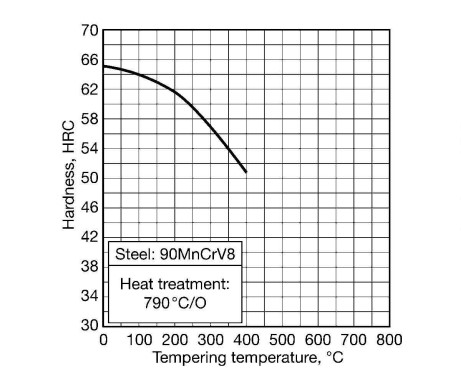
Above curve in figure is just a rough guide to the tempering behaviour of steels. When applying the curves for an estimation of the hardness which can be expected in quenched and tempered tools, it should be taken into account that the optimum heat-treatment conditions for the tools are not necessarily identical with those specified for the test pieces.
The heating time of test pieces in a salt batch shall be as give in below table:
Total heating time of test pieces in a salt bath
Nature of steel | Hardening Time min | Tempering Time min |
Cold or hot work steels | 25 +/- 1 | 60 |
High-speed steels | 3 | Minimum 2 periods of 60 each |
Critical Notes: Thicker tools (>50mm) require extended heating time (+5mins for every 25mm thickness); tempering above 200℃ will reduce hardness below HRC60. All batches undergo ultrasonic testing per EN10228-3 Class III or Sep 1921-84 D/D to detect internal defects (≥1mm) and ensure tool reliability.
Vanadium-induced grain refinement ensures minimal dimensional distortion after heat treatment—one of the most valued features of this steel grade. A full range of surface finishes and tight tolerances are available to meet specific application needs:
Surface Finish | Turned | Milled | Grinding(Best) | Polished(Best) | Peeled(Best) | Black Forged | Black Rolled |
Tolerance | +0/+3mm | +0/+3mm | +0/+0.05mm | +0/+0.05mm | +0/+0.1mm | +0/+5mm | +0/+1mm |
Straighness | 1mm/1000mm max. | 3mm/1000mm max. | |||||
Hunan Qilu Steel offers standard stock and custom-forged options with fast lead times, covering all common industrial sizes. Stock levels are updated daily, and custom dimensions are available for large-scale orders (≥500kg for forged bars):
Product type | Size range | Length |
Hot rolled bar | Φ10-Φ190mm | 2000-5800mm |
Hot forged bar | Φ200-Φ600mm | 2000-5800mm |
Hot rolled plate/sheet | T:6-80mm; W:310-810mm | 2000-5800mm |
Hot forged plate | T:70-250mm; W:310-810mm | 2000-5800mm |
Hot Forged block | T: 260-500mm; W: 300-1000mm | 2000-5800mm |
Qilu steel stock hot rolled bar and hot rolled plate, below our our stock size:
Hot-Rolled Bar Diameters: 12, 15, 18, 20, 22, 25, 28, 30, 32, 35, 40, 45, 50, 55, 60, 65, 70, 75, 80, 85, 90, 95, 100, 110, 120, 130, 140, 150, 160, 170, 180, 190mm
Hot-Rolled Plate Thicknesses: 6, 8, 10, 12, 14, 16, 18, 20, 25, 30, 35, 40, 45, 50, 55, 60, 65, 70, 75, 80mm
Leveraging its balanced wear resistance, toughness, and dimensional stability, AISI O2/DIN 1.2842/ISO 90MnCrV8 is widely used in cold work tooling, cutting/measuring tools, and wear-resistant mechanical components—delivering long tool life and reduced production downtime:
Stamping Dies: Ideal for stamping thin metal sheets (<3mm) of low-carbon steel, copper/aluminum alloys (smartphone backplates, hardware fasteners, automotive interior clips). HRC60 hardness retains sharp edges for thousands of cycles.
Forming Dies: Bending, deep drawing, and embossing (aluminum cans, stainless steel sinks, metal nameplates). Dimensional stability prevents die warping and ensures consistent part geometry.
Shearing Tools: Precision shearing of paper, plastic films, and thin metal sheets (printing press blades, packaging machinery cutters, electronics trim shears). Reduces blade sharpening frequency and maintenance costs.
Cutting Tools: Taps (metal threading), small-diameter drills (steel drilling), woodworking chisels. Toughness prevents fracturing during high-precision cutting; wear resistance extends edge life vs. lower-grade steels.
Measuring Tools: Plug gauges, snap gauges, and wear-resistant caliper components. Dimensional stability and chromium-induced corrosion resistance ensure long-term accuracy in workshop environments.
Guide Bushings: Machining centers, injection molding machines (guides for drill bits/ejector pins). High hardness prevents premature wear and ensures smooth operation.
Bearing Cages: Small/medium-sized bearings for industrial motors. Toughness absorbs minor impacts; wear resistance extends bearing service life.
Textile Machinery Parts: Weaving machine guide needles. Durability reduces needle replacement frequency and minimizes production downtime from friction-induced wear.
When selecting cold work tool steel, understanding the nuanced differences between grades is critical for optimizing performance, extending tool life, and controlling production costs. This comparison focuses on how AISI O2 (also known as DIN 1.2842 and ISO 90MnCrV8) stacks up against other popular grades, including AISI D2, AISI W1, 9CrSi, and AISI O1, based on core mechanical properties, machinability, heat treatment characteristics, and ideal application scenarios.
| Comparison Factor | AISI O2 | AISI D2 | AISI W1 | 9CrSi | AISI O1 |
| Steel Classification | Low-Alloy Oil-Hardening | High-Cr Alloy Air-Hardening | Carbon Water-Hardening | Low-Alloy Oil-Hardening | Low-Alloy Oil-Hardening |
| Core Hardness (HRC) | 58-62 | 60-65 | 56-60 | 58-62 | 60-63 |
| Wear Resistance | High | Superior | Moderate | High | High |
| Toughness & Impact Resistance | Excellent | Low | Good | Moderate | Good |
| Hardenability (Through-Size) | Good (Uniform in 50mm+ sections) | Limited (Surface-hardening only) | Poor (Only thin sections) | Moderate | Moderate |
| Dimensional Stability | Excellent (Low Distortion) | High (Pronewarpage in complex shapes) | High (Risk of cracking) | Moderate | Moderate |
| Machinability (Annealed) | Excellent (High Material Removal Rate) | Poor (Requires specialized tools) | Excellent | Good | Good |
| Heat Treatment Method | Oil Quench | Air Quench | Water Quench | Oil Quench | Oil Quench |
| Cost Level | Medium | High | Low | Medium | Medium-High |
| Ideal Application Scope | Precision stamping, forming, cutting tools, gauges | Heavy-duty blanking, high-wear extrusion | Low-stress hand tools, short-run dies | Simple blades, leather cutting | Fine cutting tools, broaches |
Based on the above analysis, the optimal grade selection depends on the specific application requirements:
Choose AISI O2/DIN 1.2842/ISO 90MnCrV8 for applications demanding a balance of precision, toughness, wear resistance, and cost-effectiveness, such as precision stamping dies, forming tools, and measuring instruments.
Select AISI D2 only for heavy-duty, high-wear applications with minimal impact stress, such as thick sheet metal blanking.
Opt for AISI W1 exclusively for low-cost, low-stress, short-run tools or hand tools where longevity is not a primary concern.
Choose 9CrSi for simple cutting tools in regional Asian markets where international standard compliance is not required.
Select AISI O1 for fine, static cutting tools or broaches where maximum wear resistance is prioritized over toughness.
A1: DIN 1.2842 has fully interchangeable equivalents across major standards: AISI O2 (ASTM A681, USA), ISO 90MnCrV8 (EN ISO 4957, Europe), and 9Mn2V (GB/T 1299, China). All have similar chemical compositions and mechanical properties, with no modifications needed for heat treatment/machining when replacing one grade with another.
A2: 9Mn2V is the Chinese equivalent with the same core performance (HRC60 hardness, wear resistance, toughness). The only difference is a higher silicon content (0.8-1.2%) for enhanced deoxidation during steelmaking—this has no impact on cold work application performance.
A3: For thick tools, extend the salt bath heating time by 5 minutes for every 25mm of thickness (base time 25±1mins for test pieces) to ensure uniform temperature penetration. Preheating at 649℃ for 20-30mins (vs. 15-20mins for thin tools) is also recommended to reduce thermal stress.
A4: Compared to high-chromium steels like AISI D2, O2 offers superior toughness and much better dimensional stability during heat treatment. While D2 may offer higher absolute wear resistance in some cases, O2 is less brittle and changes shape less during hardening, making it ideal for complex dies and tools where cracking and distortion are concerns.
A5: Welding of tool steels is generally not recommended for finished tools due to the risk of cracking in the heat-affected zone. If repair welding is absolutely necessary, it requires a specific procedure: preheating to 300-500°C, using a matching or low-hydrogen filler material, and stress-relieving immediately after welding. However, for critical tools, mechanical joining methods are preferred.
A6: In its annealed condition (HB ~229), 1.2842 has good machinability. Use sharp, high-speed steel or carbide tools with appropriate coolants. It machines similarly to medium-carbon steels but requires rigid setups to achieve tight tolerances. The controlled sulfur and phosphorus content helps prevent built-up edge and ensures a good surface finish.
Contact Us today to discuss your project requirements.