
T: +86-0731-85185770
E: enquiry@qilumetal.com
E: enquiry@qilumetal.com
No. 18 Xiangfu Middle Road,Yuhua District, Changsha City
 |


Grade: ASTM 5140
Equivalent Steel: DIN 41Cr4/1.7035, JIS SCr440, GB 40Cr
AISI 5140 is a medium-carbon chromium alloy steel built on a carefully balanced chemistry of carbon (0.38–0.43%), chromium (0.70–0.90%), and manganese (0.70–0.90%), with a small silicon addition (0.15–0.35%). This composition delivers good hardenability and well-rounded mechanical properties, allowing the steel to achieve an optimal balance of strength, toughness, and wear resistance after quenching and tempering—making it well suited for load-bearing parts such as gears, shafts, and high-strength fasteners.
| Quantity: | |
|---|---|
5140
Qilu
AISI 5140 is a medium-carbon chromium alloy steel developed for engineering components that require a practical combination of strength, toughness, wear resistance, machinability, and heat-treatment response. It is commonly supplied as hot rolled bar, forged bar, cold drawn bar, and other customized forms depending on the application.
The grade is frequently associated with DIN 41Cr4, EN 1.7035, JIS SCr440 and GB 40Cr, although these designations should not automatically be treated as technically identical because chemical composition limits and product standards can differ. The applicable specification should always be confirmed before material substitution.
AISI 5140 / 41Cr4 is particularly suitable for shafts, gears, pins, axles, bolts, spindles, machine components, automotive parts and general engineering components that operate under moderate to high mechanical loads.
Country | USA | Europe | China | British | Japan |
Standard | ASTM A29 | EN10083-3 | GB/T3077 | BS970 | JIS G4104 |
Grade | 5140 | 41Cr4/1.7035 | 40Cr | 530M40 | SCr440 |
Grade | C | Si | Mn | P | S | Cr |
5140 | 0.38-0.43 | 0.15-0.35 | 0.70-0.90 | 0.035Max | 0.040Max | 0.70-0.90 |
41Cr4/1.7035 | 0.38-0.45 | 0.40Max | 0.60-0.90 | 0.035Max | 0.035Max | 0.90-1.20 |
40Cr | 0.37-0.44 | 0.17-0.37 | 0.50-0.80 | 0.030Max | 0.030Max | 0.80-1.10 |
530M40 | 0.36-0.44 | 0.10-0.40 | 0.60-0.90 | 0.035Max | 0.040Max | 0.90-1.20 |
SCr440 | 0.38-0.43 | 0.15-0.35 | 0.60-0.85 | 0.030Max | 0.030Max | 0.90-1.20 |
Mechanical properties for 41Cr4 quenching and tempering alloy steel according to EN10083-3.
Size range | Tensile strength | Yield strength | Alongation | Area of reduction | Impact value At RT/J |
d≤16 t≤8 | 1000-1200Mpa | 800Mpa Min | 11% Min | 30% Min | / |
16<d≤40 8<t≤20 | 900-1100Mpa | 660Mpa Min | 12% Min | 35%Min | 35J Min |
40<d≤100 20<t≤60 | 800-950Mpa | 560Mpa Min | 14% Min | 40%Min | 35J Min |
Sampling and preparation of test pieces for 41Cr4 quenching and tempering steel.
1): According to EN10083-1, all samples shall be taken at a distance of 12.5mm below the heat treated surface
2): As stipulated in the contract between buyer and seller.
Mechanical properties for 41Cr4 open die forgings steel according to EN10250-3
Size range | Tensile strength | Yield strength | Alongation | Impact value At RT/J | ||
14% Min | 35J Min | |||||
d≤70 | 800Mpa Min | 560Mpa Min | ||||
Sampling and preparation of test pieces for steel forging.
1: According to EN10250-1, all samples shall be taken at a distance of 4/T below the heat treated surface (with a minimum of 20mm and a maximum of 80mm), and t/2 from the end (where t is the equivalent thickness of the thickness of the ruling section of the forging at the time of heat treatment.
2: As stipulated in the contract between buyer and seller.
Heat Treatment | Hardness |
Flame or Induction hardening | 53HRC |
Treated to improve shearability (+S) | HB255Max |
Soft annealed (+A) | HB241Max |
Quenched and tempred (+QT) | HRC28-32(Common Range) |
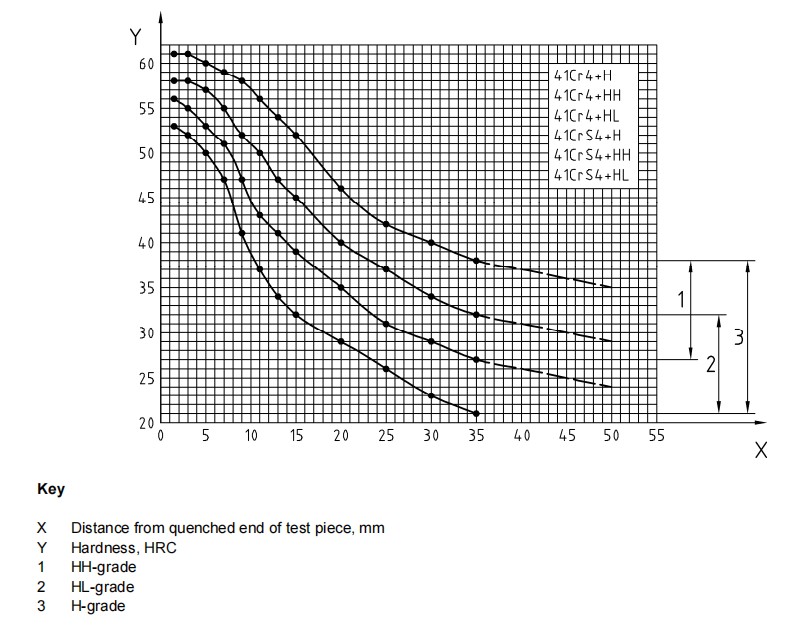
Where the steel is ordered by using the symbols for normal (+H) or restricted (+HL, +HH) hardenability requirements, the hardenability values should apply below:
Distance in mm from quenched end | ||||||||||||||||
Distance | 1.5 | 3 | 5 | 7 | 9 | 11 | 13 | 15 | 20 | 25 | 30 | 35 | 40 | 45 | 50 | |
Hardness In HRC + H | max | 61 | 61 | 60 | 59 | 58 | 56 | 54 | 52 | 46 | 42 | 40 | 38 | 37 | 36 | 35 |
min | 53 | 52 | 50 | 47 | 41 | 37 | 34 | 32 | 29 | 26 | 23 | 21 | / | / | / | |
Hardness In HRC + HH | max | 61 | 61 | 60 | 59 | 58 | 56 | 54 | 52 | 46 | 42 | 40 | 38 | 37 | 36 | 35 |
min | 56 | 55 | 53 | 51 | 47 | 43 | 41 | 39 | 35 | 31 | 29 | 27 | 26 | 25 | 24 | |
Hardness In HRC + HL | max | 58 | 58 | 57 | 55 | 52 | 50 | 47 | 45 | 40 | 37 | 34 | 32 | 31 | 30 | 29 |
min | 53 | 52 | 50 | 47 | 41 | 37 | 34 | 32 | 29 | 26 | 23 | 21 | / | / | / | |
Scatter bands for the Rockwell - C hardness in the end quench hardenability test.
Product type | Size range | Length |
Cold drawn bar | Φ3-Φ80mm | 6000-9000mm |
Hot rolled bar | Φ18-Φ300mm | 6000-9000mm |
Hot forged bar | Φ100-Φ1200mm | 3000-5800mm |
Hot rolled plate/sheet | T:3-200mm; W:1500-2500mm | 2000-5800mm |
Hot Forged block | T: 80-800mm; W: 100-2500mm | 2000-5800mm |
Surface Finish | Turned | Milled | Grinding(Best) | Polished(Best) | Peeled(Best) | Black Forged | Black Rolled |
Tolerance | +0/+3mm | +0/+3mm | +0/+0.05mm | +0/+0.05mm | +0/+0.1mm | +0/+5mm | +0/+1mm |
Straighness | 1mm/1000mm max. | 3mm/1000mm max. | |||||
Hunan Qilu Steel maintains monthly stocks of hot-rolled and cold-drawn bars (over 10,000 tons) in popular diameters (e.g., 18mm, 24mm, 50mm, 72mm, 100mm, 200mm), ensuring fast delivery for urgent orders.
Below our our stock size:
| 18 | 20 | 22 | 24 | 25 | 28 | 30 | 32 | 35 | 36 | 38 | 40 | 42 | 48 |
| 48 | 50 | 52 | 55 | 60 | 65 | 70 | 72 | 75 | 80 | 85 | 90 | 95 | 100 |
| 105 | 110 | 115 | 120 | 125 | 130 | 140 | 150 | 160 | 170 | 180 | 190 | 200 | 210 |
| 220 | 230 | 240 | 250 | 260 | 270 | 280 | 290 | 300 |
Soft annealing: Heat to 670-710℃, soak at temperature, then furnace-cool. This reduces internal stress and lowers hardness for machining.
Normalization: Heat to 850-880℃, soak, then air-cool. Refines the microstructure, improving uniformity for subsequent QT treatment.
Quenching and tempering: Heat to 820-860℃ (lower end for water quenching, upper end for oil quenching), soak, quench in water or oil, then temper at 540-680℃ and air-cool. This process develops the alloy’s signature strength-toughness balance.
Forging: Heat ingots to 1150-1200℃, forge at a minimum temperature of 800-850℃, then sand-cool to prevent cracking. Forged components benefit from grain refinement, enhancing overall durability.
While DIN 41Cr4 1.7035 offers exceptional performance, its weldability is classified as moderate to poor due to its carbon content (0.38-0.45%)—exceeding the 0.25% threshold where weldability begins to deteriorate. To minimize cracking during welding:
Preheat the base material to 200-300℃ before welding.
Use low-hydrogen electrodes (e.g., E7018) to reduce hydrogen-induced cracking.
Maintain interpass temperatures above 200℃ during multi-pass welding.
Post-weld heat treatment (PWHT) at 600-650℃ to relieve residual stress.
These steps ensure welded joints retain sufficient strength for non-critical applications; for high-stress components, mechanical fastening (e.g., bolts) is preferred over welding.
Transmission systems: Gears, drive shafts, and camshafts—benefiting from the alloy’s 1000-1200 MPa tensile strength and wear resistance (53 HRC via induction hardening).
Chassis and suspension: Steering knuckles, steering shafts, and suspension arms—leveraging the alloy’s toughness (35 J impact resistance) to withstand road shocks.
Engine and powertrain: Cylinder piston rods, hydraulic valve cores, and connecting rods—where the QT-induced 28-32 HRC hardness balances strength and machinability for precision fitting.
Power transmission: Gearboxes, differential parts, and torque converters—relying on the alloy’s uniform hardenability to maintain strength across thick sections.
Fasteners and structural parts: High-strength bolts, flanges, and brackets—benefiting from the alloy’s ≥560 MPa yield strength to resist loosening under heavy loads.
Hydraulic and pneumatic systems: Hydraulic cylinder rods and valve spools—where the alloy’s machinability (≤241 HB after soft annealing) enables tight tolerances and smooth surfaces.
Mold bases and fixtures: Jigs, fixtures, and tooling substrates—where the alloy’s soft annealing hardness (≤241 HB) allows easy machining of complex shapes, and subsequent QT treatment (28-32 HRC) provides long-term dimensional stability.
Auxiliary mold components: Ejector pins and guide pillars—benefiting from the alloy’s wear resistance to withstand repeated cycles in injection molding or stamping processes.
Agricultural machinery: Harvester knives, thresher shafts, and transmission chains—leveraging the alloy’s 53 HRC surface hardness (flame-hardened) to resist wear from crop residue and soil.
Industrial wear components: Bearing rings, rolling elements, and conveyor rollers—where the alloy’s combination of hardness (28-32 HRC) and toughness (35 J impact) prevents premature failure.
Mining and construction: Crusher parts and screen shafts—benefiting from the alloy’s forging capability (up to Φ1200mm) to create large, durable components for heavy-duty operations.
A1: AISI 5140 and DIN/EN 41Cr4 are commonly compared as equivalent or closely related grades, but they are not automatically identical in every specification. Chemical composition limits and mechanical requirements can differ, so the applicable standard should be stated on the purchase order.
A2: Not necessarily. 4140 generally provides higher hardenability and stronger performance for demanding applications, while 5140 can offer a cost-effective solution for general engineering components where the additional molybdenum in 4140 is unnecessary.
A3: For components requiring deeper hardening, improved wear resistance and better performance under higher mechanical loads, 5140 is generally the stronger choice. 1045 remains attractive when lower cost and simpler machining are priorities.
A4: 5140 is not normally selected primarily for welding because its medium-carbon content and alloying elements can increase cracking risk compared with low-carbon structural steels. If welding is unavoidable, a qualified welding procedure, preheating and appropriate post-weld treatment should be evaluated.
A5: 5140 and 40Cr have similar medium-carbon chromium-alloy characteristics, but their standards and chemical limits are different. They should be purchased according to the required specification rather than treated as automatically interchangeable.
A6: Both are quenched-and-tempered chromium alloy steels, but 42CrMo4 contains molybdenum, which generally provides higher hardenability and improved performance in demanding sections. 41Cr4 is often selected for less demanding applications where the additional alloying of 42CrMo4 is unnecessary.
Contact us for real-time stock availability, custom quotes, or technical consultation—we deliver global-grade alloy steel to your doorstep, with flexible shipping options for all industries.